

Product Launch Press Release: Template and When It's Worth It
A product launch press release template for dev tools and SaaS: when a release is worth it, how to pitch it, and the SEO link rules to follow when distributing.
Product Launch Press Release: Template and When It's Worth It
Quick answer: A product launch press release is worth it when you have news for an outside audience: funding, a partnership, general availability with real users, or a major open-source release. For most early dev tools, a launch post and direct pitches work better. When you do write one, keep it to one page, lead with the change, include checkable technical facts, publish it on your own site, and don't use it for keyword-anchor links.
A product launch press release is worth writing when it gives a journalist, analyst or partner a reason to cover you that doesn't depend on your blog post. For most early developer tools, that's rare, and a well-written launch post plus direct outreach will do more.
This guide covers when a press release earns its place, when it doesn't, a fill-in template built for technical products, and how to distribute it without hurting your site's search standing. It's written for founders who have never worked with a PR agency and don't plan to.
When a press release is (and isn't) worth it for a dev tool
A press release is a format for news. If there's no news for an outside audience, the format doesn't create it.
| Worth it | Usually not worth it |
|---|---|
| Company launch with funding, a notable founding team or a known customer | A new product from an unknown team with no other news hook |
| Partnership or integration with a company whose audience you want | A feature update or a UI redesign |
| General availability of a product that already has public users and numbers you can share | An MVP or beta with a waitlist |
| Open-sourcing a significant project, a licence change, or an acquisition | A launch whose main channels are Hacker News, Product Hunt or Reddit |
| News aimed at a regulated or enterprise market where buyers expect formal announcements | News you'd only send to a wire service and never pitch to anyone |
License changes are a good example of the "worth it" column, because they affect customers, contributors and competitors who don't follow your blog. When HashiCorp moved from MPL 2.0 to the Business Source License, its announcement on August 10, 2023 applied the change to "all future releases of HashiCorp products" while keeping its APIs, SDKs and "almost all other libraries" on MPL 2.0. That's the kind of precise, checkable statement a reporter needs, and the kind a release should lead with.
A quick test before you write anything
Our advice: answer these three questions in one sentence each. If any answer is weak, write a blog post instead.
- Who outside your users would care? Name a publication, newsletter or analyst, not "the tech press".
- What changed today that wasn't true yesterday? A product being available, a price, a licence, a partner. "We improved our dashboard" isn't a change for an outsider.
- What can a reporter verify? A public repo, a docs page, a pricing page, a customer willing to talk. If nothing is checkable, the release is an opinion.
Developer communities rarely respond to press release language. A Show HN post written like a release ("is pleased to announce") reads as marketing, and the Show HN guidelines want something people can try, not an announcement. For those channels, write a launch post in your own voice and keep the press release for journalists and partners.
If you're not sure, write the launch post first. Our product launch strategy guide covers that side. If the post has a news hook an editor would care about, adapt it into a release.
The anatomy of a launch press release
Press releases follow a predictable structure because editors skim hundreds of them. Predictability is a feature: it lets them find the facts fast.
| Section | What it does | Length |
|---|---|---|
| Headline | States the news: who launched what, for whom | One line, under about 100 characters |
| Subheadline | Adds the most important detail the headline couldn't fit | One sentence |
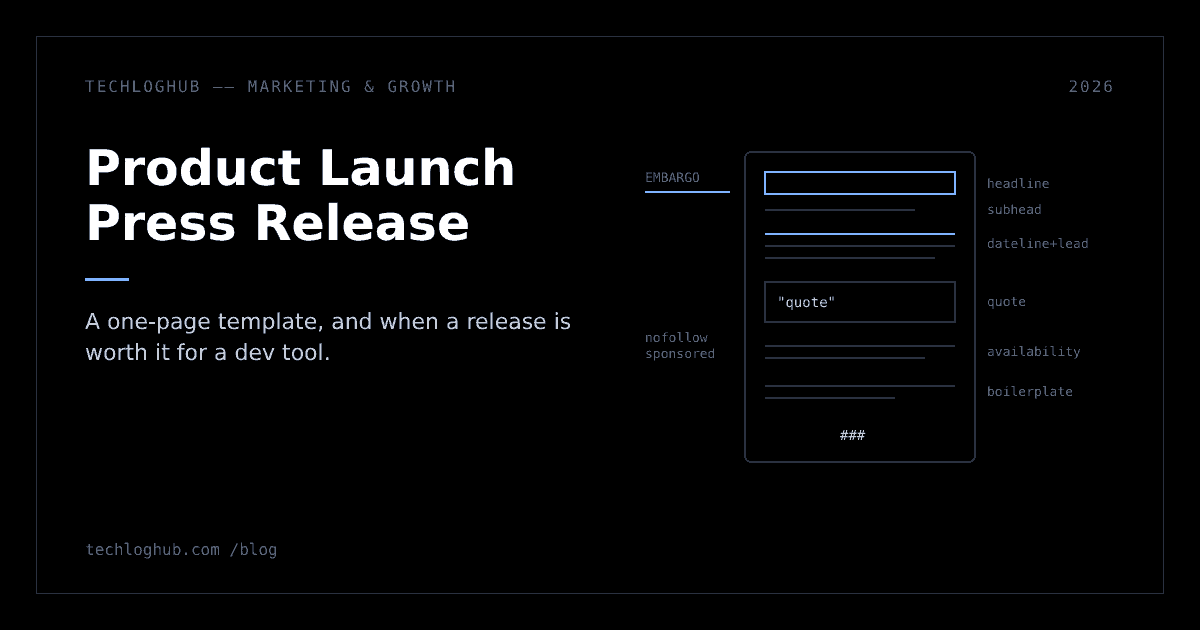
| Dateline and lead | City, date, then who, what, when, where and why | Two to three sentences |
| Problem and solution | Why this matters and how the product works, in concrete terms | Two short paragraphs |
| Quote | A founder or customer saying something a reporter could actually use | Two to three sentences |
| Details | Features, technical specifics, integrations, supported platforms | Short paragraph or bullet list |
| Availability and pricing | When, where and how much | Two to three sentences |
| Boilerplate | Standard "About the company" paragraph | Three to four sentences |
| Media contact | Name, email, and where to find assets | Three lines |
Aim for one page, roughly 400 to 600 words. If an editor has to scroll to find the price or the availability date, they'll move on.
A product launch press release template
Copy this structure and replace each bracketed placeholder. Delete any line you can't fill honestly rather than padding it.
FOR IMMEDIATE RELEASE(orEMBARGOED UNTIL [date, time, time zone])- Headline: [Company] launches [Product], [what it does] for [audience]
- Subheadline: [The single most newsworthy detail: open source, funding, a named customer, a specific capability]
- Dateline and lead: [CITY], [Month Day, Year] — [Company] today launched [Product], a [category] that lets [audience] [outcome]. [Product] is available now at [URL] with [free tier / trial / pricing summary].
- Problem: [Two or three sentences on the problem, with a concrete example a developer would recognise.]
- Solution: [How the product solves it. Name the mechanism: what it runs on, what it integrates with, what it replaces.]
- Quote: "[A specific opinion or insight, not 'we're excited']," said [Name], [title] at [Company]. "[One more sentence of substance.]"
- Details: [3–5 bullets: key features, supported languages or platforms, deployment options, licence if open source]
- Availability and pricing: [Product] is available today at [URL]. [Pricing]. [Docs URL]. [Repo URL if open source].
- About [Company]: [Who you are, what you build, where you're based, founding year, one notable fact.]
- Media contact: [Name], [email], [press kit URL]
###(the conventional end-of-release marker)
Two rules make a dev-tool release better than most. First, include technical facts reporters can check: the languages supported, whether it's self-hostable, the licence, a link to docs. Second, write the quote like something a person would say. If you'd cut it from a blog post, cut it from the release.
A worked example: filling in the template
Here's the template filled in for a hypothetical open-source tool. The company, product, people and URLs are invented for illustration; only the structure is the point.
FOR IMMEDIATE RELEASE- Tracelet launches open-source request tracing for serverless functions
- Subheadline: Self-hostable, MIT-licensed, with SDKs for Node.js, Python and Go
- BENGALURU, India, [Month Day, Year] — Tracelet today released Tracelet 1.0, an open-source tracing tool that shows developers where time goes inside a single serverless request. It runs as a lightweight library and a self-hosted collector, and is available now on GitHub under the MIT licence, with a hosted version free for up to [N] traces a month.
- Serverless functions make slow requests hard to debug: a cold start, a slow database query and a retry loop can all look like the same timeout in a log. Tracelet records each step of a request as a span and draws them on one timeline, so a developer can see that the 2.4-second request was 1.9 seconds of waiting on a single query.
- "Most teams we talked to had logs but no way to see one request end to end without adopting a full observability platform," said [Name], co-founder of Tracelet. "We built the smallest thing that answers 'why was this request slow?' and made it free to self-host."
- Key details: SDKs for Node.js, Python and Go; exports OpenTelemetry-compatible traces; Docker image for the collector; MIT licence.
- Availability and pricing: Tracelet 1.0 is available today at [URL]. The self-hosted version is free. Hosted plans start at [price]. Docs: [URL]. Source: [repo URL].
- About Tracelet: Tracelet builds debugging tools for serverless developers. The company was founded in [year] and is based in Bengaluru.
- Media contact: [Name], press@[domain], press kit at [URL]
###
What makes this version work, line by line:
| Element | Why it works | Common weak version |
|---|---|---|
| Headline | Says who, what and for whom in plain words | "Tracelet Revolutionizes Observability" |
| Subheadline | Licence, hosting and languages are the facts a developer reporter checks first | A second slogan |
| Lead | Product, mechanism, licence and price in two sentences | Two sentences about the company's mission |
| Problem paragraph | A specific failure developers recognise, with an example request | Market-size statistics with no source |
| Quote | An opinion about a gap in the market, in normal speech | "We're thrilled to bring this to the community" |
| Availability | Links a reporter can open while writing | "Coming soon" with no date |
Notice what's missing: no adjectives like "leading" or "next-generation", no claims the reader can't check, and no numbers without a source. If you have real numbers, such as public GitHub stars or paying customers you're allowed to name, put them in the subheadline or lead. If you don't, leave them out.
Writing it for technical readers
- Lead with the change, not the company. "Developers can now run X without Y" beats "Company is proud to announce".
- Replace adjectives with numbers you can back up. If you can't link the number to a public source or your own published data, don't use it.
- Show the product. Attach two screenshots and one code sample. A code to image tool makes a clean snippet image for the press kit.
- Keep one call to action. Usually the docs or the free tier, not five links.
- Edit for scanning. Short paragraphs and subheads. Compare drafts with a text diff checker when several people are editing.
Headline patterns that work
Most of a release's chance of being read is decided in the headline and the pitch subject line. These patterns are our recommendations from reading a lot of dev-tool announcements; adapt them, don't copy them word for word.
| Pattern | Example shape | Use when |
|---|---|---|
| Company + verb + product + outcome | [Company] launches [Product] to [do X] for [audience] | Most product launches |
| Change-first | Developers can now [do X] without [Y] | The capability is the story |
| Licence or model change | [Product] is now open source under [licence] | Open-sourcing, relicensing |
| Partnership | [Company] and [Partner] bring [Product] to [platform] | The partner's name is the hook |
| Milestone | [Product] reaches general availability after [public beta detail] | GA with real public usage to point to |
Failure modes editors spot immediately
- The buried lead. The price and availability are in paragraph six. Move them into the first two sentences.
- Superlatives with no proof. "The fastest", "the first", "the only". Unless you can link a benchmark or a source, a reporter will either ignore it or ask, and you'll have to retract it.
- Jargon soup. "AI-native, cloud-agnostic, developer-first platform." Say what it does in one sentence a non-specialist editor understands, then add the technical detail.
- Fake quotes. A quote that's obviously written by marketing gets cut. A quote nobody actually said, or a customer quote you didn't get approval for, is worse: don't do it.
- Attachments only. A PDF with no text in the email body. Paste the release as plain text below the pitch and link the hosted version.
The pitch email and press kit
The pitch is the part that actually gets read. The release underneath it is reference material for the reporter who's already interested.
A pitch template
- Subject: [Embargoed until date/time TZ:] [Product] — [the change in under ten words]
- Line 1: Why you're writing to this person specifically: a recent article or newsletter issue of theirs that relates.
- Lines 2–3: The news in plain words and why their readers would care.
- Line 4: What you can offer: early access, a demo account, an interview with the founder, a customer who'll talk.
- Line 5: Your name, role and phone number, then the release pasted below as plain text.
Keep it under 150 words above the release. If you can't explain the news in that space, the release won't explain it either.
Choosing who to pitch
- Read before you pitch. Pick 10 to 20 reporters, newsletter editors or podcasters who covered a similar tool in the past few months. A short, accurate list beats a bought database of thousands.
- Newsletters count. For developer tools, a curated newsletter or a niche podcast often reaches more of the right readers than a general tech site.
- One person per outlet. Pitching three people at the same publication makes it look like you didn't check who covers what.
Follow-up etiquette
Our advice: one follow-up, a few working days later, with something new (a demo video, a customer, a date). After that, stop. Never ask whether they "got your email"; they did.
What goes in the press kit
| Asset | Format | Notes |
|---|---|---|
| Logo | SVG plus PNG on light and dark | Run SVGs through an SVG optimizer so they open cleanly |
| Product screenshots | PNG, 1600px+ wide | Real UI with realistic data, no lorem ipsum |
| Code sample image | PNG | One short, working snippet |
| Founder headshots and short bios | JPG plus two-sentence bio | Name spellings and titles exactly as you want them printed |
| Fact sheet | HTML page | Founding year, location, team size, licence, pricing, links |
| The release itself | HTML on your newsroom page | The canonical, linkable version |
Host the kit on a stable URL on your domain rather than a file-sharing link that expires. The image resizer helps produce consistent screenshot sizes.
Distribution: pitches first, wires second
A press release sitting on a wire service is rarely read by the people you want. The release works best as an attachment to a short, personal pitch.
| Method | Best for | Notes |
|---|---|---|
| Direct pitch to a journalist or newsletter editor | Most dev-tool launches | Three to five sentences, the release below, an offer of early access or an interview |
| Embargoed preview | News with a fixed date | Send a few days ahead; state the embargo time and time zone clearly in the subject and the release |
| Your own newsroom page | Every release | Publish on your domain so it's the canonical source and stays findable |
| Paid wire service | Enterprise, finance or regulated markets; company milestones | Check what audience and outlets you're actually paying for before buying |
Embargoes, exclusives and timing
| Option | How it works | Trade-off |
|---|---|---|
| Embargo | Several reporters get the news early on condition they don't publish before a set time | More outlets can prepare; you rely on everyone honouring it |
| Exclusive | One outlet gets the story first, often with an interview | Deeper coverage from one place; others may skip it once it's out |
| Same-day release | Everyone gets it when it goes public | Simplest; least time for anyone to write a considered piece |
Our advice for small teams: offer an exclusive only if you have a specific outlet that matters most to your buyers, and tell other reporters honestly that it ran there first. Write embargo times with a time zone and, ideally, a UTC equivalent, so nobody in another country publishes early by mistake. Line the public moment up with your other launch channels; if you're also on Product Hunt, our Product Hunt launch guide covers how its day is scheduled.
Publish the release on your own site in HTML, not only as a PDF. If you draft in Markdown, a Markdown to HTML converter produces clean markup, and an OG image generator gives the page a proper preview when journalists share the link.
Press releases and SEO: what to avoid
Press releases used to be a link-building tactic. Google treats that as spam. Its spam policies list "links with optimized anchor text in articles, guest posts, or press releases distributed on other sites" as an example of link spam.
The same policy says such links are fine "as long as they are qualified with a rel="nofollow" or rel="sponsored" attribute value."
Google's guide to qualifying outbound links defines sponsored as the value for "advertisements or paid placements", which is what a paid wire placement is. In practice:
- Link your brand name or a bare URL, not keyword-stuffed anchor text.
- Expect wire-distributed links to carry
nofolloworsponsored, and don't pay for distribution to get links. - Treat the press release as a way to earn coverage. Links from articles that journalists write themselves are the ones that matter.
After the release goes out
- Reply to every journalist the same day. Have the founder, screenshots, logo files and a demo account ready.
- Post the news where your users are. A changelog entry and a post on the TechLogHub releases feed reach developers who never read press coverage.
- Keep your listing current. If you haven't yet, submit your product so the launch has a permanent page on a discovery platform.
- Link coverage from your newsroom. A short "in the press" list helps future journalists and buyers.
- Note what got picked up. Next time, pitch the outlets and angles that worked.
Measuring whether it worked
Coverage counts are easy to inflate with syndicated wire pickups that nobody reads. These are the measures we'd suggest tracking instead:
| Metric | Definition | How to capture it |
|---|---|---|
| Earned articles | Pieces a journalist or editor wrote themselves, not reposted wire copy | Keep a simple list with URL, outlet and date |
| Referral visits | Sessions arriving from those articles | Your analytics referrer report, filtered by the outlet domains |
| Signups from coverage | Accounts created within a week by visitors who came from coverage | A distinct UTM-tagged link in the release and pitch |
| Inbound requests | Interview, partnership or sales enquiries that mention the coverage | Ask "how did you hear about us?" on forms and calls |
| Reply rate | Replies divided by pitches sent | Your sent folder; useful for improving next time's pitch |
If the release produced no earned articles, the problem is usually the news or the list, not the wording. Fix those before you rewrite the template. The launch page the coverage points to matters too; our product launch website guide covers what it needs, and the product launch checklist puts the release in order with everything else.
FAQ
Do I need a press release to launch a developer tool?
Usually not. For most early dev tools, a launch post on your blog, a working demo and direct outreach to a few journalists or newsletter editors work better. Press releases are worth it for funding, partnerships, acquisitions, major open-source releases or enterprise-facing news.
How long should a product launch press release be?
About one page, roughly 400 to 600 words: headline, subheadline, dateline and lead, problem and solution, one quote, details, availability and pricing, boilerplate and media contact.
What is an embargo in a press release?
An embargo asks journalists not to publish before a set date and time. Put the embargo time and time zone at the top of the release and in the pitch subject line, and only send embargoed news to people you trust to respect it.
Do press release links help SEO?
Not in the way they used to. Google's spam policies list optimized anchor text in press releases distributed on other sites as link spam unless the links use rel=nofollow or rel=sponsored. Coverage written by journalists is what earns valuable links.
Should I use a paid wire service?
Only if your audience reads the outlets the wire reaches, as in enterprise, finance or regulated markets. For most dev tools, personal pitches with the release attached get more coverage for less money.
What's the difference between a company launch press release and a product launch press release?
A company launch release introduces the business itself: founders, funding, mission and first product. A product launch release focuses on one product's availability, features and pricing, and is usually shorter.
A press release is a delivery format for news; get the news right first, then write the release.