
Koed
Koed is an Apache-2.0 memory layer that records your Codex, Claude Code and Pi sessions in the background, indexes them locally with Postgres, pgvector and local embeddings, and lets the agent recall past decisions with citations over MCP. Free self-hosted; cloud, team and enterprise editions coming.
About Koed
What Koed is
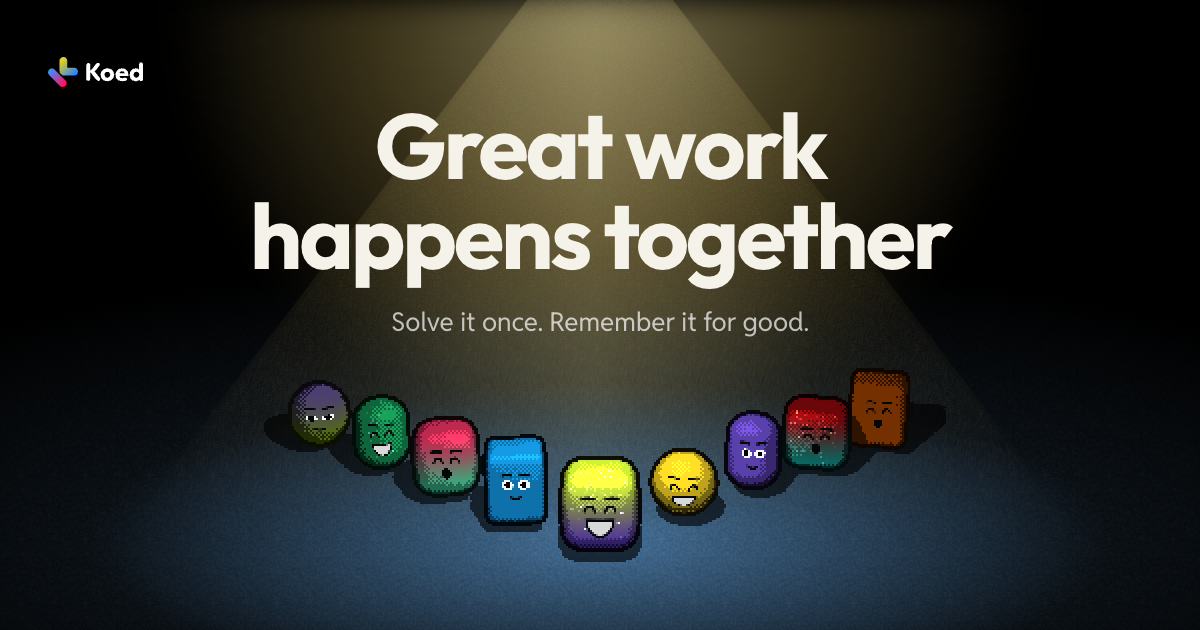
Koed is an open-source memory layer for AI coding agents. It records your Codex, Claude Code and Pi conversations in the background, stores and indexes them on your own machine (or on a server you run), and gives the agent an MCP tool it can call to recall earlier decisions, dead ends and project context with citations back to the source conversation. The project's pitch is that every new agent session otherwise starts from zero: you re-explain the project, repeat your preferences and watch the agent try the fix that failed last week. Koed does not put another language model between you and your agent for answering; it stores and searches the memory, and your own AI client writes the answer.
Koed is built by Koed Labs (GitHub organization koed-labs). The repository was created in May 2026 and is licensed Apache-2.0; the project's own licensing note says earlier versions were distributed under AGPL-3.0-only and that Apache-2.0 has been added as a grant for that history too. Version 1.0.0 was released on November 12, 2026, and the project launched on Product Hunt on November 25, 2026 as "Supercharged Agents!".
How it works
- Capture. Once an AI client is connected, Koed records its conversations in the background with nothing to copy, paste or tag. Supported clients today are Codex, Claude Code (minimum version 2.1.227, set up from Koed Desktop) and Pi (0.84.2 or newer). Each client works independently; if one fails, the others carry on.
- Local storage and search. Memory lives under a
KOED_HOMEfolder. Koed runs PostgreSQL 17 with pgvector, and local embeddings through llama.cpp'sllama-server, natively on macOS, Linux or WSL with no Docker and no cloud account. Downloads of the runtime and models are checked against pinned SHA-256 checksums before they are used. - Recall through MCP. The main tool is
memory_answer, which returns evidence with citations so you can see which conversation an answer came from. Diagnostic tools (memory_search,memory_expand,memory_access_check), a Team Workspace discovery tool and a tool for proposing curated memory sit alongside it. - Projects without losing the source. A conversation can belong to several Projects, and Koed records a Git Anchor or exact Folder for it, so recall can be scoped to a repository or a directory. Version 1.3.0 suggests a Folder or Project for unfiled conversations and records a Git Anchor automatically when the evidence proves it.
- Control over what is kept. Capture Policies, Capture Pause and an optional local Privacy Filter model decide what Koed keeps and what it masks. The Privacy Filter is a separate download, verified before activation with a synthetic masking test.
- Koed Desktop. A desktop app (macOS on Apple silicon, Linux as an AppImage for x64) to browse every Project, session and conversation, connect clients and manage settings. Windows users run Koed inside WSL.
- Koed Server. A headless install for macOS arm64 and Linux x64, started with a one-line installer, for people who want memory on a private VPS. Teams can run a self-hosted Team backend; device pairing and Personal Device Sync exist but are off by default in this release.
What we checked: the source and the benchmark claim
Koed's home page leads with a benchmark: 52% less coding time, 69% fewer coding tokens and 42% lower cost with Koed. On November 26, 2026 we cloned the repository (commit 7227b2f, package version 1.3.0) and read the benchmark write-up, the MCP server and the installer, then recomputed the published figures with our own script.
$ git clone --depth 1 https://github.com/koed-labs/koed && git -C koed log -1 --format='%h %cI'
7227b2f 2026-11-25T19:23:20+00:00

$ grep -n 'case "memory_' packages/mcp-server/src/mcp-server-factory.ts   # tool titles
memory_answer          "Answer from memory"       (annotated readOnlyHint: true)
memory_workspaces      "Discover Team Workspaces"
memory_intake_propose  "Propose Curated Memory"
memory_access_check    "Memory access check"      (diagnostic)
memory_search          "Search memory"            (diagnostic)
memory_expand          "Expand memory node"       (diagnostic)
+ memory_answer_result / memory_answer_cancel for long-running answers

$ python3 koed_check.py      # inputs: docs/benchmark-results.md
without  pass 7/60 = 11.7%  wilson95 5.8%-22.2%  cost/pass $1.156
with     pass 38/60 = 63.3%  wilson95 50.7%-74.4%  cost/pass $0.123
coding-only cost/pass with Koed: $0.089
overhead share of Koed total: 27.5%
prompt tokens incl. overhead: 64.6% lower

$ curl -fsSL https://koed.ai/install | head -4
#!/usr/bin/env bash
# Koed Server installer release template, rendered with one exact version.
# Everything before the final line only defines functions, so a truncated
# download cannot start an installation.
What this tells you. The arithmetic in Koed's write-up is correct: our recomputed pass rates, 95% Wilson intervals and cost per passing run match the published table to the cent. What the headline numbers mean is narrower than the home page suggests, and the write-up says so itself. The test used 20 tasks selected by the team from Terminal-Bench 4, run three times each on one model, and Koed already had earlier successful sessions for every task, some with reference help. In other words it measures how well an agent repeats work it has already solved, not how it does on new problems. The gains are also concentrated: 12 tasks improved, none got worse, and 8 did not change (7 failed every time with or without Koed). The median coding time fell only 21%, against 52% for the total, because much of the saving comes from avoiding a few very long runs. Koed's own overhead (its answer helper and summary preparation) was 27.5% of its known cost, and the write-up notes the all-in cost is higher still because some helper usage and setup were not counted. On the code side, only memory_answer carries a read-only annotation, and the installer is written defensively: it defines functions first so a truncated download cannot start an install, and verifies files by SHA-256.
Pricing and versions (checked November 26, 2026)
| Edition | Price | What it includes |
|---|---|---|
| Self-hosted (Free) | $0 | The core memory loop: capture, recall and inspection, on your machine or your own server; Apache-2.0 |
| Pro (Cloud) | To be announced, coming soon | Everything in Free in the cloud; Koed handles embeddings and hosts memories so you can recall them on any device |
| Team | To be announced, coming soon | Shared context across a team |
| Enterprise | To be announced, coming soon | Deployment, security, control and support for organizations |
Versions on the day we checked: the download page offered Koed Desktop v1.2.0, while GitHub had already published v1.3.0 (November 25). GitHub lists 14 releases since v0.1.1 on June 5, 2026, with 2,563 asset downloads across all of them. The repository had 18 stars and 2 forks. Requirements for running from source: Node.js 24 and pnpm, Homebrew on macOS, and on Linux or WSL an x64 machine with glibc 2.35 or later (for example Ubuntu 22.04+). The one-line server installer needs Python 3. The project's commercial-boundary document says paid value will come from hosting, collaboration operations, enterprise controls and support, and that the public code must keep local and self-hosted Team deployments working rather than hiding core features in private modules.
Koed vs the alternatives
| Koed | Beacon | AI Context Flow | Skillbox | |
|---|---|---|---|---|
| What it does | Captures coding-agent conversations and serves cited recall over MCP | Captures sessions from 20+ agent harnesses and turns workflows and corrections into reusable knowledge | Permissioned memory buckets shared with chat apps and MCP agents | One library of agent skills synced to many coding tools |
| Where memory lives | Your machine or your server (cloud edition coming) | Local agent; optional Beacon Cloud | Hosted by Plurality Network | Skill files, not conversation memory |
| Clients | Codex, Claude Code, Pi | Claude Code, Cursor, Codex, OpenCode and more | ChatGPT, Claude, Gemini, Grok, Perplexity, MCP agents | Claude Code, Cursor, Codex and 11 more |
| Licence | Apache-2.0 | MIT agent | Commercial | Commercial |
| Price | Free self-hosted; paid editions TBA | Free; Pro $20/month | Free; Plus $10/month, Pro $20/month | Free; from £6.99/month |
Koed's distinctive choices are keeping everything local by default, with its own Postgres, vector index and embedding model, and answering with citations rather than handing the agent raw search hits. Beacon covers far more agent harnesses today, which matters if your team uses Cursor or OpenCode. AI Context Flow is the easier option if you also want memory inside chat apps and do not mind hosted storage. If what you actually need is the same instructions in every tool rather than recall of past sessions, Skillbox is the better fit. Note that terminal agents such as OpenCode are not among Koed's supported clients yet.
Limits and trade-offs
- Three clients only. Codex, Claude Code and Pi. Cursor, OpenCode, Copilot and others are not supported yet.
- The benchmark is about repeated work. As above, the headline gains come from tasks Koed had already seen solved. Treat them as an upper bound for "I keep re-solving the same problems", not as a general speed-up.
- It is a real local stack. Koed installs and runs PostgreSQL, pgvector and a local embedding server on your machine. Version 1.1.0 lowered their scheduling priority and capped embedding threads at half your CPUs, but expect background resource use and a sizable first-run download.
- Platform gaps. Desktop is Apple silicon only on macOS and x64 only on Linux; Windows needs WSL. Multi-device sync is off by default, so memory is per machine unless you run your own server.
- Your transcripts are sensitive. Captured conversations can contain code, secrets and customer data. The Privacy Filter is optional, and on a VPS the docs tell you to keep Postgres and Redis on private networks and to turn on envelope encryption for memory and evidence.
- Paid editions are not priced. Cloud, Team and Enterprise are "coming soon" with no prices, so anyone planning team-wide use should self-host or wait.
- Young project. Small community so far and frequent releases (1.0 to 1.3 in two weeks), so expect change.
Who it is for
Developers who use Codex, Claude Code or Pi every day on the same codebases and are tired of re-explaining context, especially those who want that memory to stay on their own machine or server rather than in a vendor's cloud; and small teams willing to run a self-hosted backend to share what their agents have learned.
Value & Audience
Value Proposition
Gives coding agents a searchable memory of earlier sessions, with citations, that stays on your own machine or server, so new sessions start with the decisions and dead ends of the last ones.
Problem Solved
Every new AI coding session starts from zero, so developers re-explain projects and preferences and agents repeat fixes that already failed.
Target Audience
Tech Stack
Social & Links
Additional Links
Loading ratings...
Loading comments...
Gallery
Feedback & Roadmap
Koed FAQ
Common questions about Koed's features, pricing, and use cases
Is Koed free to use?
Yes. Koed is open source and free to use.
What are some alternatives to Koed?
Popular Developer Tools alternatives to Koed include CodeSpy, DevOp and Global TTFB Checker.
Koed appears in
You May Also Like

CodeSpy
CodeSpy quietly scans your WordPress site for what's actually wrong, from messy code and plugin conflicts to broken forms and layout issues, explaining it in plain language.
View Product
DevOp
An Agentic IDE for Windows, Mac, and Linux that leverages intelligent, autonomous AI coding agents to accelerate software development.
View ProductGlobal TTFB Checker
Free global TTFB checker. Measure Time To First Byte from 114 countries with live world map, city-level results, and instant latency reports. No signup.
View Product
Next.js AI SaaS Cursor Rules Pack
15 battle-tested .mdc Cursor rules for Next.js AI SaaS, covering Supabase, Clerk, Stripe, and Verc/AI SDK.
View ProductOne email a week
TechLogHub tracks 966 tools and 626 open-source projects. Get the week's new launches, release roundups and open-source picks — nothing else.
Get the TechLogHub digest
One email a week: new and trending developer tools, fresh comparisons, and what shipped. Unsubscribe in one click.