


Search Console's Multimodal Split, Explained
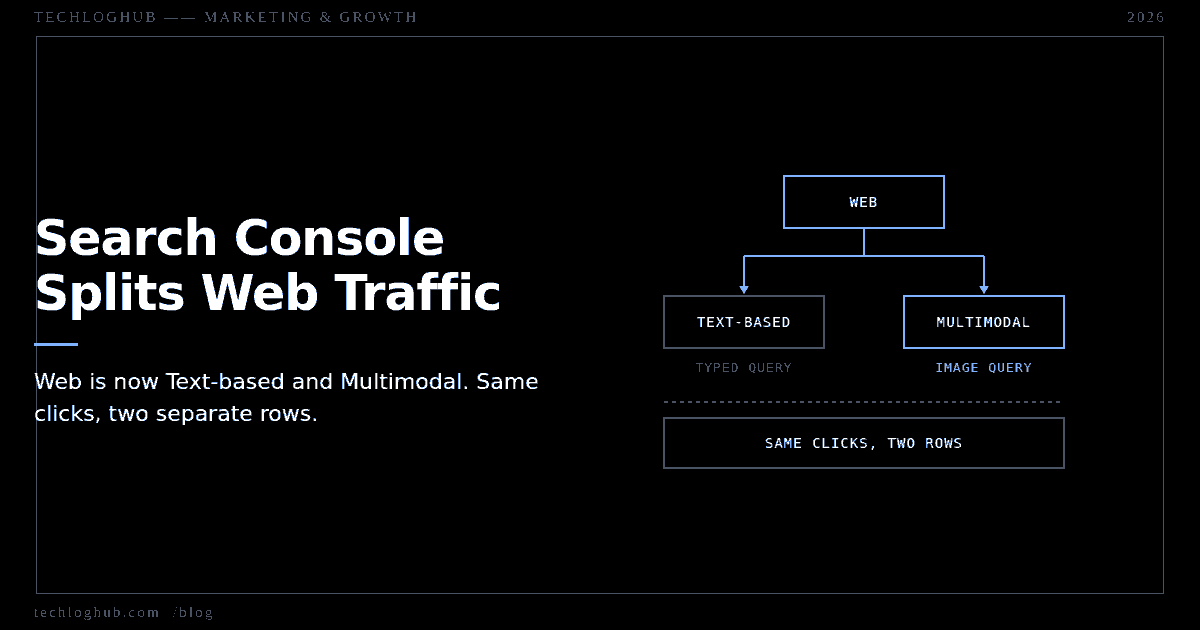
Quick answer: On 24 September 2026 Google split the Web search type in Search Console's Performance report into Text-based and Multimodal. Multimodal covers web results where an image was part of the query. No new traffic appeared — those clicks were always inside your Web total. What changed is that you can now subtract them, and find out whether images are pulling web rankings for you or doing nothing at all.
Most Search Console changes are additive: a new report, a new filter, a new appearance type. This one is subtractive, and that makes it more useful than it first looks. A number you have been reading for years just became two numbers, and the ratio between them is information you have never had.
It is also the kind of change that gets over-read within a week. So here is what Google documented, what it did not, and what is worth doing before the takes pile up.
What Google actually changed
The Search type filter in the Performance report used to offer Web, Image, Video and News. Web is now two options. Google's Performance report documentation defines them in one sentence each.
Web: text-based — "Includes traditional search traffic originating from text queries entered into the standard Google search bar."
Web: multimodal — "Includes web search results where an image was used as part of the search."
That is the entire official definition. Google announced it on the Search Central blog the same day. Search Engine Land's coverage, also dated 24 September 2026, lists the surfaces that produce these searches: Google Lens, Circle to Search on Android, images uploaded directly into Google Search, and Chrome's right-click "Search this image."
This is not the Image search type
The single most common misreading already circulating is that multimodal is a rename or expansion of the existing Image filter. It is not, and the distinction is the whole point.
| Search type | The query is | The result is |
|---|---|---|
| Web: text-based | Typed text | A web page link |
| Web: multimodal | An image, alone or with text | A web page link |
| Image | Typically text | One of your images |
Image traffic is someone finding your picture. Multimodal traffic is someone finding your page because a picture — usually not yours — was the input. Those are different funnels with different fixes, and lumping them together is how teams end up optimising thumbnails to solve a page-content problem.
What the split can tell you
Three things, none of which needed a new data source — only a way to separate the rows.
The share. Filter to Multimodal, compare clicks against Text-based over the same window, and you have a baseline percentage. For most technical sites it will be small. Knowing it is small is a result — it tells you not to spend a quarter on visual search.
Which pages. Apply the filter, then read the Pages tab and check what it gives you. Pages that over-index on multimodal are pages where something visual — a screenshot, an error dialog, a chart, a product UI — is what people are pointing their camera or their clipboard at. That is a strong signal about what those pages are actually for.
Whether the trend moves. A split you can track weekly is worth more than a one-time number. If multimodal share climbs while text-based flattens, your discovery mix is changing and your content plan should follow.
What it cannot tell you
Google's Performance report help page lists dimensions generically and does not publish a per-search-type table of which dimensions are available under which filter. So do not take anyone's word for what Queries shows under Multimodal, including this article — open the filter on your own property and look. Properties differ, and a dimension can be present but heavily thresholded.
More importantly, it cannot tell you which image triggered the search. The input image lives on the searcher's device or on somebody else's page. Google reports that a web result was served to an image-initiated query; it does not report what the picture was. Any workflow that assumes you can reverse-engineer the trigger image from Search Console is built on nothing.
And it is not the generative AI report. That is a separate surface with its own gaps, covered in the Search Console AI report and its missing query data. Treating multimodal numbers as an AI-visibility proxy will get you a wrong answer twice.
What to actually do
Nothing dramatic. The change does not introduce a new ranking surface, and there is no multimodal schema type to add. What it does is raise the return on image hygiene you probably skipped, because now you can measure whether it moved anything.
Start with what Google actually documents about images. Its Google Images guidance is blunt about the mechanics: images must be reachable in the src of an <img> element, and "Google doesn't index CSS images." A screenshot rendered as a CSS background is invisible to the entire pipeline.
Formats are wider than people assume: BMP, GIF, JPEG, PNG, WebP, SVG and AVIF are all supported, with the extension expected to match the file type. Worth noting that this list is not the same list Google accepts for favicons, which excludes SVG entirely — same company, two different rules, and assuming one applies to the other is a recurring own goal. If you need to move between formats, an image format converter is faster than a build-step change, and an SVG optimizer is worth running on anything vector before it ships.
Alt text still carries the description. Google's own example contrasts alt="puppy" with alt="Dalmatian puppy playing fetch", and warns that keyword stuffing "results in a negative user experience and may cause your site to be seen as spam." For a technical site the practical version is: describe what is in the screenshot, not what you want to rank for. "Terminal showing a pnpm install failing with EACCES" beats "package manager tutorial."
Filenames matter for the same reason — short and descriptive, not IMG00023.JPG. And if you are generating social cards programmatically, make sure the OG image you emit is a real file at a real URL rather than a redirect chain; the structured data image attribute is, in Google's words, "a required field to be eligible for a badge and rich result in Google Images."
Image sitemaps are the underused piece. Google permits URLs from other domains inside <image:loc>, which means CDN-hosted assets can still be declared against the page they belong to. Most sites with a separate asset domain never do this and quietly lose the association. The same discipline applies to video, where Google recently added a creator property to VideoObject.
FAQ
When did Google add the multimodal filter?
Google announced web multimodal Search performance reporting on the Search Central blog on 24 September 2026, and the Search type filter in the Performance report now splits Web into Text-based and Multimodal.
Does multimodal traffic mean I am getting more clicks?
No. These clicks were already counted inside the Web search type. The split changes what you can see, not what you receive, so do not read the new row as growth.
How is multimodal different from the Image search type?
Image reports impressions and clicks on your images in image results. Multimodal reports web page results that were served in response to a query containing an image. In one case your picture is the result; in the other someone else's picture is the question.
Can I see which image triggered a multimodal search?
No. The input image is supplied by the searcher and is not reported. You can see which of your pages were returned, not what was pointed at the camera.
Is there structured data for multimodal search?
Google has not published any. The applicable guidance is the existing image documentation: crawlable <img> elements, descriptive alt text and filenames, image sitemaps, and a valid image property in your structured data.
Should I change my content strategy because of this?
Measure first. Pull four weeks of Multimodal versus Text-based clicks and see what the ratio is. If multimodal is a rounding error on your property, the honest conclusion is that this filter is a monitoring line item, not a project.
Check the ratio before you build a strategy on top of it. Most technical sites will find the answer is "not yet."