



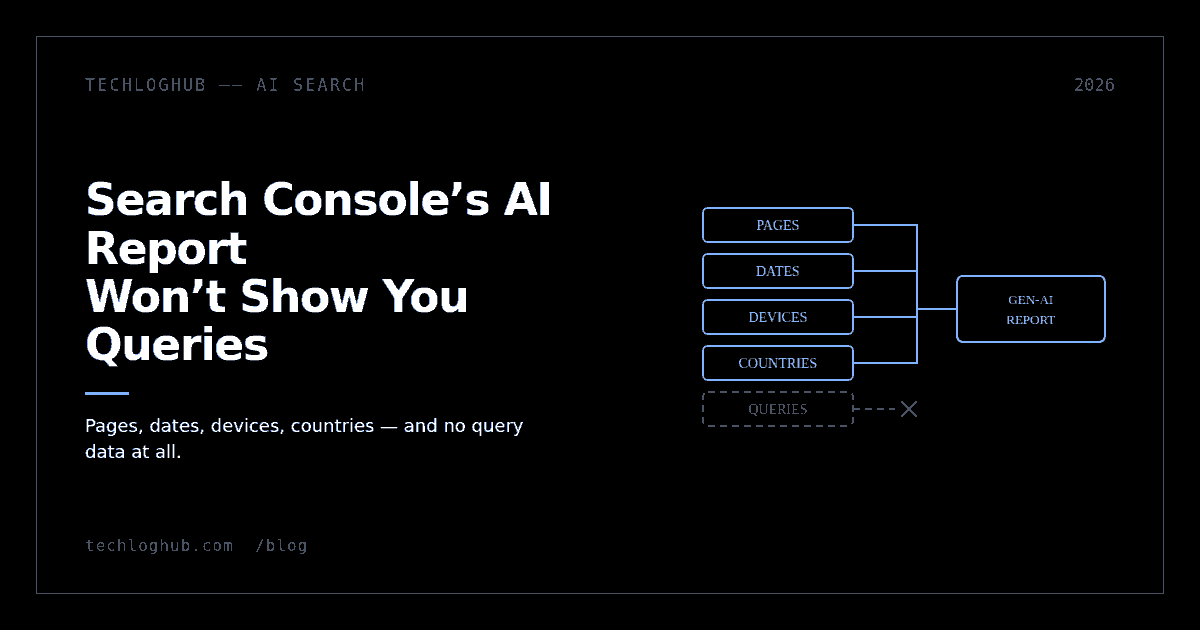
Search Console's AI Report Won't Show You Queries
Quick answer: Google finished rolling out the Search generative AI performance report worldwide on 31 August 2026. It groups data by pages, countries, devices and dates — and deliberately not by query. The queries that trigger AI Overviews and AI Mode are still in Search Console, folded into the general performance report where you cannot isolate them. Plan your measurement around page-level data, because that is the only clean signal Google gives you.
The report developers spent a year asking for arrived without the column that made it worth asking for. Google's Search generative AI performance report tells you which of your pages got linked from AI Overviews and AI Mode, on which day, in which country, on which device. It does not tell you what anyone typed.
That is not an oversight. It is the shape of the product, and it changes what a realistic AI-visibility measurement setup looks like.
What actually shipped
The report covers two surfaces: AI Overviews and AI Mode. Per Google's own documentation, it offers four dimensions — Pages, Countries, Dates and Devices. Pages groups by the final URL linked from a generative AI feature, after redirects. Dates run in Pacific time and can be viewed by day, week or month. Dotted lines mark preliminary data still subject to change.
Two exclusions matter. Search Labs experiments are not reported, because Google considers them still in development. Generative AI data from Discover lives in a separate report, so a spike in one will not show in the other.
One impression rule matters before you read any chart: if two results from the same site appear inside one generative AI response, that counts as a single impression. You are measured on “did this site get cited in this answer”, not on how many of your links made it in. Publishing three near-identical pages on a topic does not triple your impressions. It splits your citation odds across three candidates.
The missing dimension is the one you wanted
There is no Queries dimension. There is no search-appearance filter that separates an AI Mode citation from a classic blue link. You get a page, a date, a country, a device, and a number.
The practical consequence is that you cannot answer the question every content team actually has, which is “which questions are we getting cited for, and which are we losing?” You can only answer “which URLs are getting cited, and is that number moving?” Those are different questions, and the second one is much harder to act on, because a single page usually serves a dozen intents.
This is the same structural problem that hit structured data after Google dropped FAQ rich results: the measurement surface got narrower while the work required to earn placement got broader.
The queries exist. They are just not separable.
Here is the part that trips people up. Google's position, stated by John Mueller in August 2026 and reported by Search Engine Roundtable, is that Search Console already includes AI Overviews and AI Mode information in the general performance report. The queries are in there. They are mixed in with everything else, with no flag marking their origin.
Google's impressions documentation also spells out how AI Mode conversations are counted: a follow-up question inside AI Mode is treated as a new query, and the impression, position and click data from that response are attributed to the new query. So a five-turn conversation produces five query rows, each looking like an ordinary search.
That gives you one crude but real heuristic. AI Mode follow-ups do not read like search queries; they read like speech — fragments such as “yes, pricing” or “what about the free tier”. A growing tail of conversational fragments in your query export is your AI Mode traffic, unlabelled. It is a heuristic, not a report. Do not build a dashboard on it.
What you can and cannot answer
Before you design a reporting setup, be honest about which questions the data supports:
| Question | Answerable? | With what |
|---|---|---|
| Is this page cited in AI surfaces at all? | Yes | Pages dimension, generative AI report |
| Is our AI citation trend up or down? | Yes | Dates dimension, week or month view |
| Which countries cite us most? | Yes | Countries dimension |
| Which queries cite us? | No | Not exposed in the AI report |
| What share of our Search clicks came from AI? | No | AI clicks are not split out of Search totals |
| Which competitor replaced us in an answer? | No | No competitive data in Search Console |
The honest summary: this is a page-level trend tool. Treat it as one, and it is genuinely useful. Treat it as a keyword tool and you will invent conclusions.
The opt-out switch, and why most sites should leave it alone
The same rollout shipped a control that lets a site block its content from being used to ground responses in AI Overviews, AI Mode, and AI Overviews in Discover. Google's framing, as reported at the time of the global rollout, is that sites which opt out will not receive traffic or impressions from generative AI features, and that the control is not a ranking signal for classic web results.
Read that carefully. Opting out is not a negotiating position. It does not create a licensing conversation and it does not withhold your content from the index. It removes you from a surface while leaving every competitor in it. For a developer tool trying to get discovered, that is unilateral disarmament. There are publishers with a real case for pulling out — sites whose whole business is the click. A product directory or a docs site is not one of them.
A measurement setup that survives this
Given what the report does and does not expose, here is a setup that does not depend on data Google withholds.
1. Baseline at the page level, not the keyword level
Export the generative AI report by page weekly and store it. You are building your own history, because Search Console's retention will not do it for you and because the only trend that matters is your own. Tag each URL with its intent type — comparison, how-to, reference, listing — so you can see which content shapes get cited rather than which strings do.
2. Capture non-Google AI referrals in your logs
Google is one AI surface among several. Referrals from assistant products arrive with their own referrer headers and are trivially separable in server logs or your analytics, unlike AI Mode clicks. That data is lower volume and higher fidelity, and the closest thing you have to a query-level view: the landing page tells you what the assistant thought you answered.
3. Fix the structural things the report cannot see
If a page is not being cited, the report will not tell you why. The usual causes are structural: the answer is buried below 600 words of preamble, the headings do not state claims, or the page covers six topics at once so no single passage is extractable. Run a page through the AI readability score and the passage extractor to see which chunk a model would actually lift. Use the heading structure analyzer when the hierarchy is the problem, and the content chunking tool when a long page needs splitting into self-contained sections. The rest of the free developer tool set runs in the browser, so none of this needs a build step.
4. Stop reporting AI visibility as a single number
There is no honest way to roll AI Overviews impressions, AI Mode citations, assistant referrals and classic organic clicks into one metric. They have different denominators. Report them as separate lines and let the shape of each one say something.
The uncomfortable conclusion
Google shipped a report that measures presence, not demand. Presence is a lagging indicator of work you did months ago, and you cannot reverse-engineer intent from it. The teams that do well here will stop waiting for keyword data that is not coming and go back to what was true long before AI Mode: publish pages where a specific question has a specific, extractable, correct answer, and do not publish the ones that miss that bar. The publish gate argument applies here with more force than it did to classic search, because an AI surface picks exactly one passage and ignores the rest of the page.
FAQ
When did the Search Console generative AI report roll out?
Google completed the worldwide rollout on 31 August 2026. It covers AI Overviews and AI Mode, and excludes Search Labs experiments.
Why does the AI report not show queries?
Google did not include a Queries dimension. The report exposes only Pages, Countries, Dates and Devices. Query data for AI Overviews and AI Mode is included in the general Search Console performance report, mixed in with all other search queries and not separately labelled.
Are AI Mode clicks counted in my normal Search Console totals?
Yes. Google's position is that AI Overviews and AI Mode information is part of the general performance report, which means those clicks and impressions are already inside your Search totals rather than being additional to them.
How is a multi-turn AI Mode conversation counted?
Each follow-up question is treated as a new query. Impressions, position and clicks from the response to a follow-up are attributed to that new query, so one conversation can generate several rows.
Should I use the opt-out control to block AI features?
For most developer-facing sites, no. Opting out removes your impressions and traffic from those surfaces while competitors remain, and it does not act as a ranking signal in classic web search. It makes sense only for publishers whose entire revenue model depends on the click.
What is the best proxy for query-level AI visibility?
Server-log referrals from AI assistants, segmented by landing page. They are lower volume than Google AI surfaces but cleanly attributable, and the landing page tells you what question the assistant matched you to.
Measured against the reports we had a year ago, this is progress. Measured against what you need to run a content programme, it is a page-level trend line with the interesting column removed.