

Google Search Profiles: Who Actually Qualifies
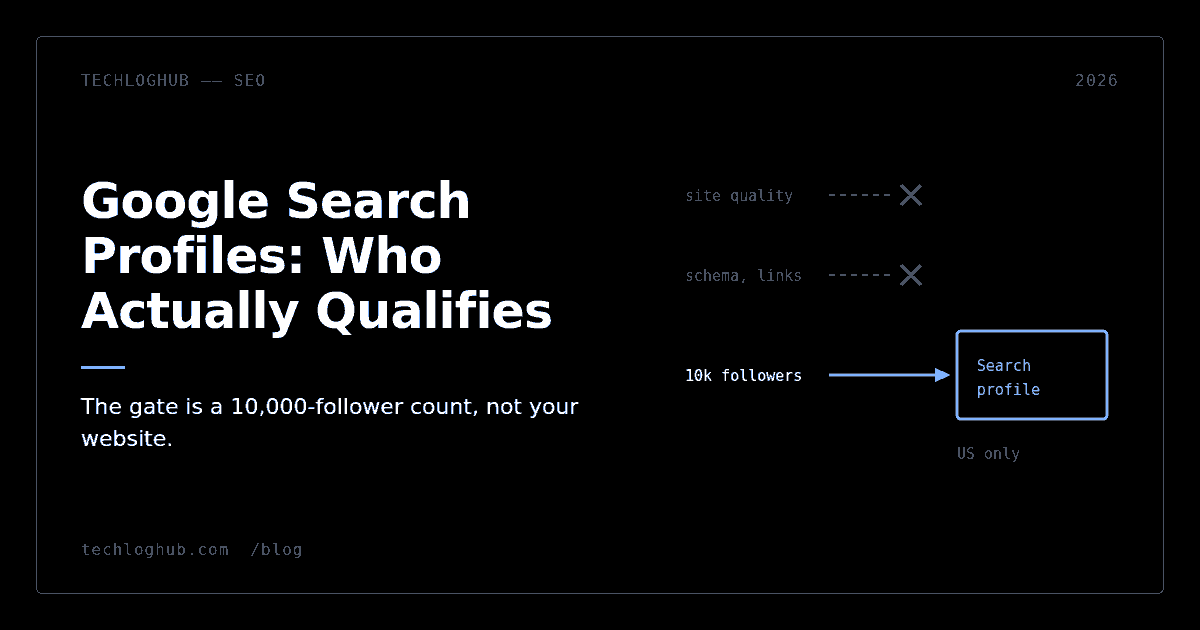
Quick answer: Google added badge documentation for Search profiles on 16 September 2026, which made a lot of people think this is a new SEO surface to optimise. It is not. Eligibility is gated on a social follower count — 10,000 subscribers or followers on YouTube, Instagram, X or TikTok — plus being 18 or older, and the feature is US-only. Your site's content quality, backlinks and structured data have nothing to do with whether you qualify.
Google published documentation for adding a Search profile badge to your website on 16 September 2026, and the SEO world did what it does: treated a badge snippet as a ranking opportunity. Before anyone burns a sprint on this, it is worth being clear about what a Search profile is, what the badge does, and who is allowed to have one.
Short version: for most developer-tool companies and technical founders, the answer is "you are not eligible, and it would not help much if you were."
What a Search profile actually is
Google announced Search profiles on 4 June 2026 as "a new way for publishers and creators to shape their presence on Search." A profile is a destination page at profile.google.com/@handle that pulls your content together from across platforms — Instagram, TikTok, YouTube, X, Facebook and your website — into one place.
It is reached three ways: through your knowledge panel on mobile, by tapping a publisher or creator name in Discover, or by the direct URL. Google's stated benefit is Discover distribution — claiming and populating a profile makes your content "more likely to appear for your audience on Google Discover."
Read that carefully. The payoff Google describes is Discover, not Search rankings. Nothing in the documentation claims a profile influences where your pages rank for a query. It is an audience-retention surface, in the same family as the follow-and-subscribe mechanics that have been creeping into Search for two years.
The eligibility bar is a follower count
This is the part that gets buried. Per Google's own support documentation, to create a Search profile you must have a minimum number of subscribers or followers on at least one content platform:
| Platform | Minimum |
|---|---|
| YouTube | 10,000 subscribers |
| 10,000 followers | |
| X | 10,000 followers |
| TikTok | 10,000 followers |
You also have to be at least 18, and your content has to meet Google's policy guidelines. Profiles are currently available only in the United States. You can hold up to 10 separate profiles from one Google account, for different brands or identities you manage.
There is no website-based route in. A technical blog with 50,000 monthly organic sessions, clean structured data and a decade of archives does not qualify on that basis. A TikTok account with 10,001 followers does. That is a defensible product decision — Google is building a creator surface, not a publisher-quality surface — but it means the feature is irrelevant to most B2B and developer-tool companies, and the documentation does not say so out loud.
What the badge documentation actually gives you
The 16 September addition is not a new capability. It is brand guidance for linking to a profile you already have. The markup is a hyperlink:
<a href="https://profile.google.com/@example" aria-label="Find us on Google Search"><img src="/path/to/google-search-badge.svg" alt="Google Search"></a>
A plain text link is offered as an alternative. There is no structured data type, no meta tag, no verification step, nothing Google parses. The rules that come with it are accessibility and trademark rules: minimum touch targets of 48 × 48 dp on Android and 44 × 44 px on iOS and web, no stretching or recolouring the asset, and consistency about whether you use the monochrome or colour variant.
In other words, this is the same category of thing as an app store badge. Treat it as a conversion element in your footer, not as an SEO artifact. If you are building the footer markup anyway, a quick SVG optimiser pass on the badge asset is worth more to your page weight than anything the badge does for your visibility.
Why this keeps happening
Search profiles are the third opt-in loyalty surface Google has shipped in roughly a year, alongside preferred sources and the Discover follow mechanics. The pattern is consistent: Google is moving distribution toward audiences who have already chosen you, and away from the open-query traffic that built most content businesses.
For a directory or a developer-tools site, the strategic read is not "get a profile." It is that the share of your traffic that arrives because someone already knows your name is going up, and the share that arrives from an unbranded query is going down. That trend shows up in your own analytics long before it shows up in a Google blog post — and, awkwardly, it is the one thing Search Console still will not break down for you, as we covered in the piece on the generative AI report having no query dimension.
What to do instead, if you are not eligible
Three things carry over from the profiles model without needing 10,000 followers anywhere.
Make your entity legible
A Search profile is a knowledge-panel artifact. What earns a knowledge panel is a consistent, machine-readable identity: a stable Organization block, sameAs links to the social accounts you actually run, consistent naming everywhere. That work pays off with or without a profile. It is also the part of structured data that survived the FAQ rich-result removal, as argued in what schema is for now.
Own the surfaces you can actually get into
Directory listings, launch platforms and category pages have no follower gate. They are slower than a Discover feed and far more durable. Our ranked breakdown of launch platforms covers which ones still send real traffic, and you can submit a product to TechLogHub without hitting any audience threshold.
Stop optimising for badges
Every few months a new opt-in widget arrives and a wave of posts treats it as a ranking factor. The test is simple: does Google's documentation say the thing affects ranking or eligibility for a result type? If it only says the feature helps people who already follow you find you again, it is a retention feature. Budget it like one.
If you do qualify
Plenty of individual developers with a large YouTube or X following do clear the bar, even when their company does not. If that is you, the process is short: go to profile.google.com/claim, sign in, authenticate at least one eligible platform account, optionally link the others, and create the profile. Linking a platform automatically pulls its content onto the profile. Bio, photo and social links are editable, but Google notes that changes to factual information require approval.
One thing worth doing deliberately: link your website. A profile that aggregates five social platforms and omits your own domain is a profile that trains your audience to consume you on someone else's property. The whole reason a site with real pages is worth maintaining is that you control it.
FAQ
Does a Search profile improve my rankings?
Google does not claim that it does. The stated benefit is that your content is more likely to appear for your audience on Google Discover. No documentation describes a profile as a ranking signal for Search results.
Can a company get a Search profile, or only individuals?
Google describes it as being for publishers and creators, and allows up to 10 profiles per Google account for eligible brands or identities you manage. The gate is still the follower threshold on a linked social or video platform, so a company qualifies via its social accounts, not its website.
Is the Search profile badge the same as the preferred sources badge?
No. They are separate assets for separate features, and Google's badge documentation includes specific guidance on pairing them when a site uses both. The Search profile badge links to your profile destination; the preferred sources control is about how often your site surfaces for people who opted into it.
Is there structured data for Search profiles?
No. The badge is an ordinary anchor tag pointing at your profile.google.com URL, with an image or text label. There is no schema type, meta tag or verification file involved.
Are Search profiles available outside the United States?
Not yet. Google's support documentation states that Search profiles are currently only available in the United States, and the launch announcement said expansion to more publishers and creators would be considered in future.
Should I add the badge if I already have a profile?
Sure — it costs a footer link and it gives visitors a way to follow you on a surface you do not otherwise control. Just do not expect it to move organic traffic. Follow the touch-target and asset rules so it does not become an accessibility problem.
A badge is not a strategy. If the eligibility rule is a follower count, the feature is telling you what Google thinks distribution is for now — that is the useful signal, not the snippet.