

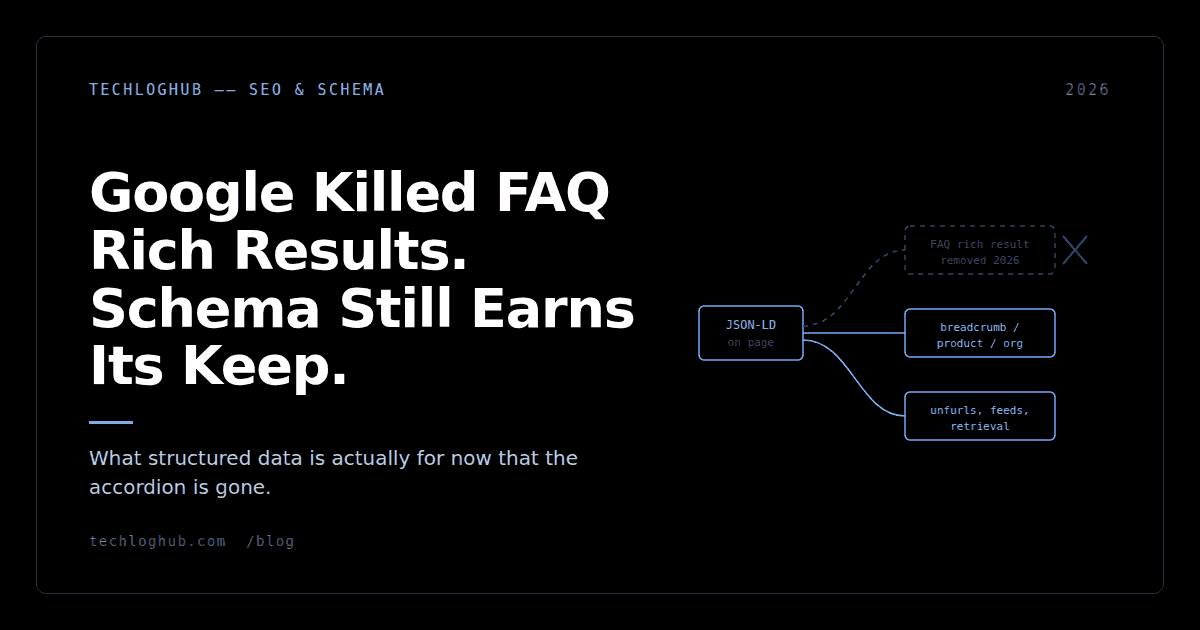
Google Killed FAQ Rich Results. Schema Still Earns Its Keep.
Quick answer: Google stopped showing FAQ rich results in Search on May 7, 2026 and removed the documentation for the feature in June 2026. That does not make structured data pointless. It kills one specific trade — markup in exchange for SERP real estate — and leaves the part that was always more durable: telling machines unambiguously what a page is, who published it, and where it sits in your site.
If your structured data strategy was "add FAQPage to everything and watch the SERP listing get taller," that strategy is now worth exactly zero. Google's own documentation for the FAQ rich result carries the deprecation plainly: the feature no longer appears in Google Search as of May 7, 2026, and the docs page itself was retired the following month.
This was not a surprise. Google narrowed FAQ rich results to a small set of government and health sites back in August 2023, and HowTo rich results went the same way at the same time. The May 2026 change simply finished the job. Anyone who built a content program on top of FAQ snippets had roughly two and a half years of warning.
The useful question is not "what replaces FAQ schema." It is "what was schema ever actually doing," because the answer changes what you keep and what you delete.
The rich-results trade was always a bad deal
The implicit bargain went like this: you write structured data, Google gives you a visual upgrade in the results page. It worked, briefly, and it produced an entire genre of content — pages with eight bolted-on questions at the bottom that no human asked, existing purely to trigger an accordion in the SERP.
The problem with a bargain like that is that only one side can change the terms. Google can retire a rich result any Tuesday. It retired this one. Every hour spent writing filler Q&A for the accordion was spent on an asset with a unilateral expiry date attached.
The same logic applies to anything you build purely because a platform currently rewards it. We made this argument about scaled content in programmatic SEO without thin pages : a page that exists to satisfy a mechanism rather than a reader is a liability the moment the mechanism moves. FAQ schema just proved it on a two-year timeline.
What structured data actually does
Strip away the SERP decoration and schema does one job: it removes ambiguity. HTML tells a parser there is a heading and a paragraph. It does not tell a parser that the string "TechLogHub" is an Organization, that the number next to it is an aggregate rating and not a price, or that this page is item three in a hierarchy whose root is your products directory.
That disambiguation is consumed by more than Google. Bing, Yandex, Pinterest, Slack and Discord unfurls, Apple's rich links, feed readers, and an expanding set of retrieval pipelines all parse JSON-LD or Open Graph because parsing structured fields is cheaper and more reliable than inferring meaning from prose. When you emit a clean
Organization
block, you are not bidding for a snippet — you are making yourself cheap to parse.
Cheap to parse is the durable position. Pretty in the SERP is the rented one.
Read Google's AI guidance carefully
Google's documentation on AI features states flatly that "there are no additional requirements to appear in AI Overviews or AI Mode, nor other special optimizations necessary," and that you need "no new machine readable files, AI text files, or markup to appear in these features," including "no special schema.org structured data."
Half the industry read that as "schema is dead." That is a misreading. Google is saying there is no additional AI-specific markup to invent. In the same document it still lists accurate structured data among the things that help, alongside content available in textual form, sane internal linking, and a page that is indexable with a snippet.
Translation: stop hunting for the magic new file. Keep the markup that describes reality. Those are compatible positions and most of the commentary has collapsed them into one bad take.
The markup that still pays
Here is the honest split as of September 2026, judged on whether the type still produces a visible search feature, still drives machine understanding, or neither.
| Type | Visible feature | Verdict |
|---|---|---|
| BreadcrumbList | Yes — breadcrumb trail | Keep. Cheapest win available. |
| Product / Offer | Yes — price, availability, rating | Keep. Highest commercial value. |
| Organization | Partially — knowledge panel inputs | Keep. Entity identity, site-wide. |
| Article / BlogPosting | Limited | Keep. Authorship and dates, near-zero cost. |
| FAQPage | No — removed May 7, 2026 | Keep only where the Q&A is real. |
| HowTo | No — retired earlier | Keep only on genuine procedures . |
Note what is missing from the "delete" column: nothing. Valid markup describing content that genuinely exists costs you a few hundred bytes and creates no risk. The thing to delete is not the schema — it is the fake content underneath it.
What to do with your existing FAQ blocks
If the questions are real, keep everything
A support page answering the six questions your users actually send should keep both the visible FAQ and the markup. You lose the SERP accordion; you keep a clean, extractable block of question-answer pairs that any retrieval system can lift verbatim. Generate the JSON-LD with the FAQ schema generator and move on — this takes two minutes and needs no further thought.
If the questions were filler, delete the questions
Those five invented questions at the bottom of every product page were padding for a feature that no longer exists. Remove the section. You will lose nothing, and the page gets shorter and denser, which is the direction every retrieval system rewards.
Spend the recovered effort on structure
The markup with a live feature attached is where the time goes now. Ship BreadcrumbList across every templated section, make sure canonical tags are correct on paginated and filtered views, and confirm your Open Graph tags render properly in Slack and Discord, where a large share of developer link-sharing actually happens. The whole set is in the free browser tools , no signup.
A one-afternoon audit
Four passes, in order, no tooling budget required.
One.
Grep your templates for
FAQPage
and list which templates emit it. Mark each as real or filler. Delete the filler content, not just the markup.
Two. Check that every templated URL family emits BreadcrumbList with positions that match the actual URL path. Mismatched breadcrumbs are more common than missing ones and quietly worse.
Three.
Verify one Organization block exists, site-wide, with a stable
@id,
and that every Article block references it as publisher. Duplicated or conflicting Organization entities are the single most common structured-data defect on content sites.
Four. Sample ten pages and confirm titles and descriptions are not truncated or duplicated. A correct title and meta description still moves more clicks than any schema type on this list.
FAQ
Should I remove FAQPage schema from my site?
No, not as a blanket action. Valid FAQPage markup on a page with genuine questions and answers is harmless and stays machine-readable. What should go is invented filler Q&A written only to trigger the old rich result — remove the content, and the markup goes with it.
When exactly did Google stop showing FAQ rich results?
Google's documentation states the feature no longer appears in Google Search starting May 7, 2026, with the deprecation announced around May 8, 2026 and the feature documentation removed in June 2026. Google had already restricted FAQ rich results to a narrow set of government and health sites in August 2023.
Does structured data help with AI Overviews or AI Mode?
Google's AI features documentation says no special schema.org structured data is required, and that no new machine-readable files or markup are needed to appear. It also still lists accurate structured data among general recommendations. The practical reading: do not invent AI-specific markup, and do not rip out markup that correctly describes your content.
Which schema types still produce a visible search feature?
BreadcrumbList and Product/Offer are the reliable ones for most sites, with Organization feeding knowledge panel data indirectly. FAQPage and HowTo no longer produce a rich result in Google Search.
Is HowTo schema also deprecated?
Yes. Google retired the HowTo rich result alongside the first FAQ restriction in 2023. The markup remains valid schema.org vocabulary and is still worth emitting on genuine step-by-step procedures, but it will not change how your listing looks.
What should I prioritize instead?
Breadcrumbs across every templated section, one canonical Organization entity site-wide, correct canonical tags on filtered and paginated views, and titles and descriptions that are not truncated. That ordering reflects what still changes outcomes, not what is fashionable to discuss.
Markup that describes something true keeps working when the feature it was written for disappears. That is the whole lesson.