


Google Will License EU Search Data. Not to You.
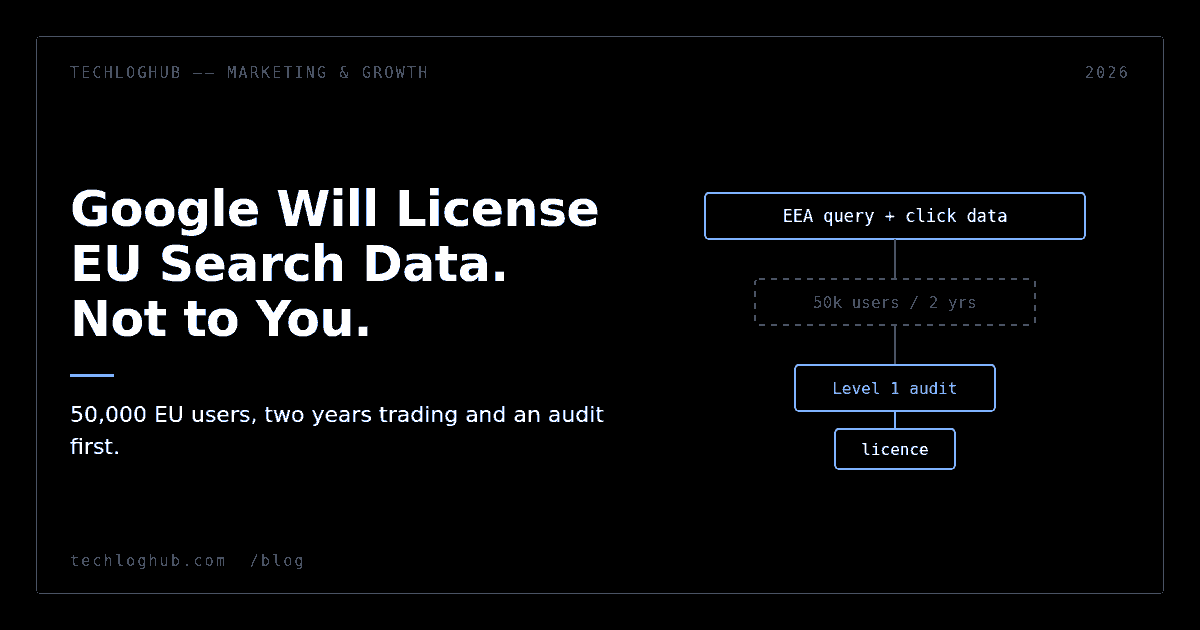
Quick answer: Google now publishes terms for licensing its EEA ranking, query, click and view data, under a European Commission decision of 16 July 2026 taken on Article 6(11) of the Digital Markets Act. It is not an SEO product. To qualify you must operate an online search engine serving EEA users, have run for two consecutive years or raised over EUR 50 million, hit 50,000 monthly average EU users, and pass an independent Level 1 reasonable assurance audit before you see the full dataset. Roughly nobody reading this qualifies, and that is the point worth understanding.
Every time a headline says "Google is sharing its search data", a wave of people assume a new keyword tool is coming. It is not. What is coming is a regulated wholesale channel for companies that already run a search engine, and the eligibility gates are set high enough that the list of qualifying entities in Europe is short and mostly predictable.
Understanding the difference matters, because the second-order effects on how AI assistants and smaller search engines rank content are real even though the data itself will never touch your dashboard.
What the dataset actually contains
Per Google's own programme page, the dataset comprises ranking, query, click and view data from Google Search in the European Economic Area. The Commission's specification proceedings describe it more precisely: anonymised queries, query metadata such as language and device type, viewed URLs, user interactions with results, and ranking information.
The exclusions are as informative as the inclusions. Out of scope: user account information, search histories, precise timestamps, paid result URLs, and queries containing rare terms or sensitive information. Strip those and you have something useful for training and evaluating a ranking system, and close to useless for tracking one website's positions.
Three tiers are on offer: a free 1,000-row sample, a paid synthetic dataset of 10 million queries, and a paid 5% sample of the full dataset. Note that second tier carefully. Synthetic means generated to match the statistical shape of the real thing, not the real thing. Anyone planning analysis on it needs to know which of their conclusions survive that substitution.
The eligibility gates, in order
This is where the "not to you" part becomes concrete. Every one of these is a hard filter.
| Gate | Requirement |
|---|---|
| Business type | Operates an online search engine serving EEA users. AI chatbots offering search functionality can qualify. |
| Track record | Operating in the EU for at least the last two consecutive years, or founded recently with more than EUR 50 million in capital investments. |
| Scale | At least 50,000 monthly average users in the EU over the past year. |
| Sanctions and control | No ties to entities under EU sanctions; not controlled by non-EEA states posing cybersecurity or data protection risks. |
| Audit | A Level 1 reasonable assurance report from an independent third party before full dataset access; a Level 2 report for continued access. |
The audit requirement is the one that quietly decides everything. A reasonable assurance engagement is not a questionnaire. It is a formal attestation by an accredited third party that your technical and organisational controls do what you claim, and it is the kind of engagement that takes months and costs real money before a single row of data is transferred.
Combine that with the 50,000-monthly-user floor and the two-year operating history, and the programme is clearly designed for organisations that already have compliance functions. That is a policy choice, not an accident: the dataset still contains personal information, and recipients must maintain segregation preventing re-identification.
The timeline you should actually track
The Commission's implementation milestones and Google's programme page describe the same rollout from two angles:
August 2026 — eligibility applications open and the beneficiary webpage is published. 17 September 2026 — Google begins providing the licensing agreement, matching the Commission's September milestone for licence templates and test data samples. 16 November 2026 — data samples become available, against a Commission milestone of a finalised anonymised dataset that month. January 2027 — final pricing offer.
Google commits to responding to expressions of interest within 7 calendar days. Individual beneficiary licences run for a maximum of five years. Fees are set on FRAND terms, which the Commission's measures limit to the incremental cost of making the data available plus a specified rate of return — in other words, Google is not permitted to price the programme out of existence, but it is also not required to subsidise it.
Why this exists at all
Article 6(11) of the DMA requires gatekeepers to provide rival search engines with access to ranking, query, click and view data on fair, reasonable and non-discriminatory terms. The theory is straightforward: a search engine's quality depends heavily on click and query data it can only get by already having users, which makes the market self-reinforcing. Sharing the data is meant to break that loop.
Whether it works is an open question. A 5% anonymised sample with rare queries stripped out is not the asset Google runs on, and the long tail is exactly where a challenger most needs signal. The answer will not be visible for a couple of years.
What is not in dispute is that AI chatbots with search functionality are explicitly named as potential recipients. That is the detail with the longest shadow. If assistants can license EEA click and ranking data, the systems deciding which pages get cited in AI answers start converging on signals derived from Google's own behavioural data — which is a different world from the one where each assistant crawls and ranks independently.
What this means if you publish rather than build a search engine
Nothing changes in your workflow this quarter. Stop treating it as an opportunity and treat it as context.
Your own first-party data is still the only query-level data you will ever have about your own site, and it is still thin in exactly the place everyone wants it. Search Console's generative AI reporting, for instance, still has no Queries dimension — you get impressions and clicks without knowing what was asked. No licensing programme fixes that for publishers.
The things that do move the needle are unglamorous and unchanged. Structured data that maps to a feature Google still renders, rather than one it retired — we went through what schema still earns after FAQ rich results were removed. Pages that answer a specific question completely enough to be quoted, instead of thin templated variants — the publish gate approach is the version of programmatic SEO that survives. And a realistic view of AI-specific files: llms.txt still has no confirmed consumer, whatever the vendor blogs say.
If you want to audit your own pages against those criteria rather than guess, the AI readability score and heading structure analyzer run in the browser with nothing to sign up for, and the SEO and content category lists the tools that do the ongoing monitoring.
FAQ
Can an SEO agency or a website owner license this data?
No. Eligibility requires operating an online search engine serving EEA users, plus a two-year operating history or over EUR 50 million in capital, plus at least 50,000 monthly average EU users. An agency, publisher or directory does not meet the business-type gate regardless of size.
Is the free 1,000-row sample open to anyone?
Google lists a free 1,000-row dataset among the available samples, but samples sit inside the programme's application flow rather than being offered as a public download. Treat the sample tiers as part of the licensing process, not as a general-purpose release.
Does this include keyword search volumes?
Not in the form SEO tools mean. The dataset carries anonymised queries, metadata, viewed URLs, interactions and ranking data, with rare-term and sensitive queries excluded and precise timestamps removed. It is built for training and evaluating a search system, not for keyword research.
Why are AI chatbots included as eligible recipients?
Because the Commission's eligibility criteria cover online search engines including AI chatbots that offer search functionality. An assistant that answers queries by retrieving and ranking web results is competing in the same market the remedy targets.
How long does a licence last, and what does it cost?
A maximum of five years per individual beneficiary. Pricing is on FRAND terms limited to the incremental cost of making the data available plus a specified rate of return, with a final pricing offer expected in January 2027.
Does any of this apply outside the EEA?
No. The obligation comes from the Digital Markets Act and the dataset covers Google Search in the European Economic Area. There is no equivalent programme for other regions.
Read it as competition policy, not as a data source. The interesting question is not what you can get, but which assistants will be ranking with Google's click data by 2028.