
QA.tech
QA.tech runs vision-based AI testing agents against your live web or mobile app on every pull request and posts a verdict to GitHub or GitLab; its MCP server lets Claude Code, Cursor and Codex start runs and read results. Free trial, Starter $89/month.
About QA.tech
What QA.tech is
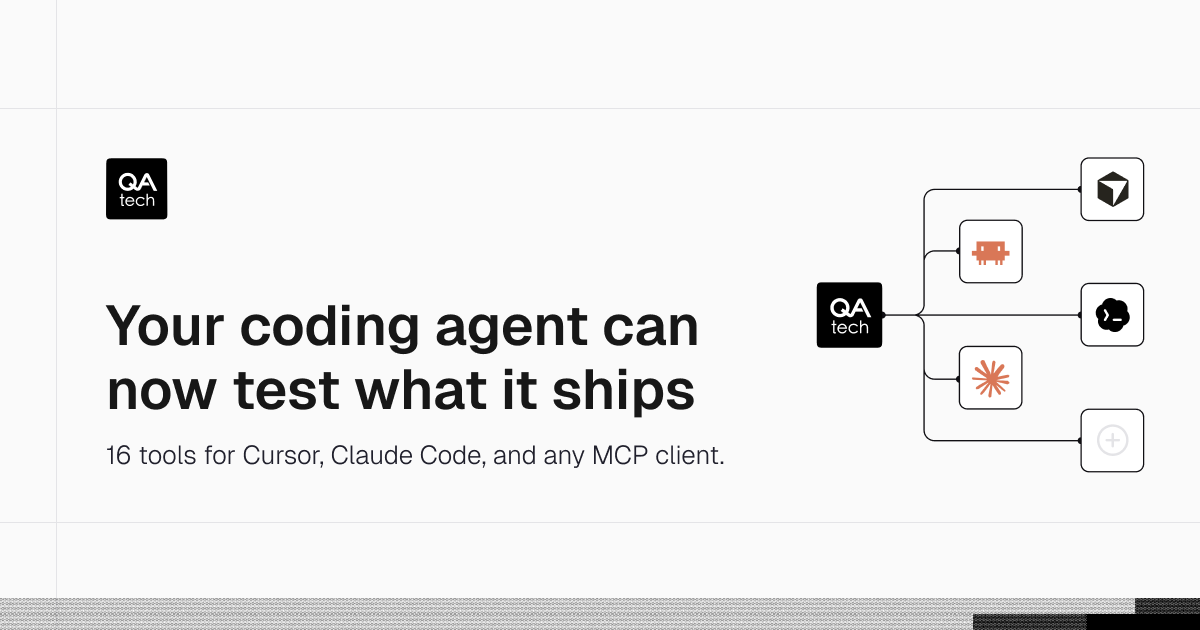
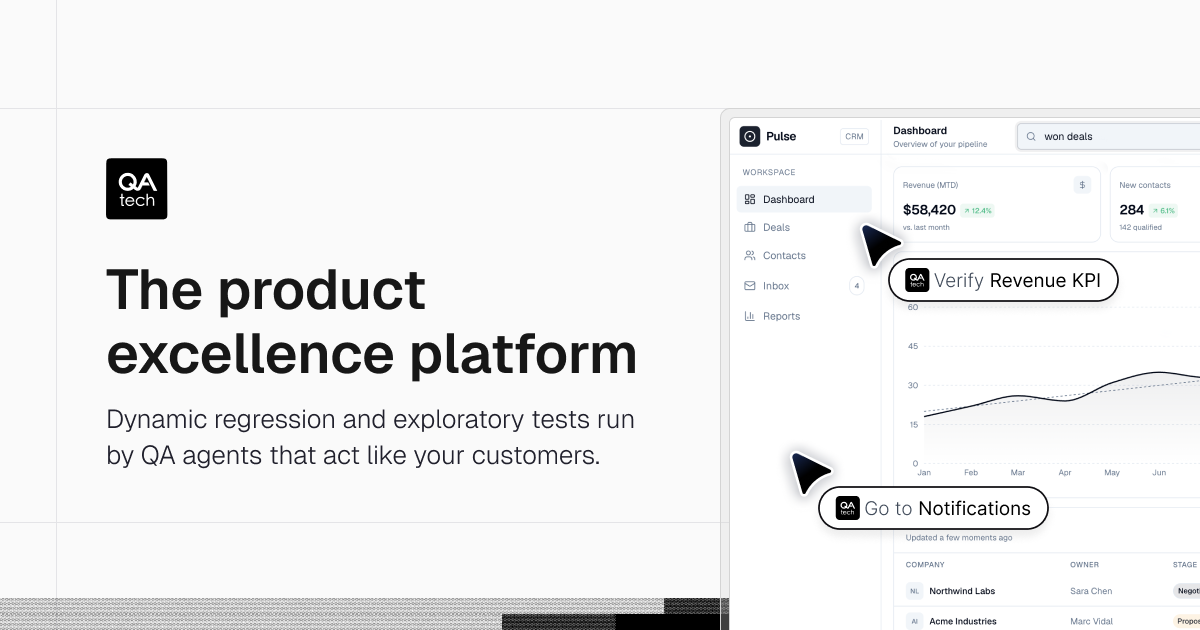
QA.tech is a Stockholm-based AI testing service: its agents open your running web or native mobile app the way a user would, work towards goals described in plain English, and report what works and what broke. The company now pitches it as "the verification layer for the AI software factory": when a pull request opens, QA.tech maps the app, works out which user journeys the change can affect, runs regression and exploratory tests against the preview environment and posts a verdict back to GitHub or GitLab before a human reviews the code. Its latest Product Hunt launch, on November 26, 2026, was the QA.tech MCP server, with the tagline "Verify every change from your IDE with QA agents": it lets coding agents such as Claude Code, Cursor and Codex start test runs, read results and create tests without leaving the editor.
The about page names Daniel Mauno Pettersson (CEO/CTO), Vilhelm von Ehrenheim (Chief AI Officer) and Patrick Lef (CPO), says the company is "backed by $5 million in funding", and the homepage says it is backed by Vercel Ventures. The team is small and works from an office in Stockholm on a hybrid model.
How it works
- Vision-based agents, no selectors. The agents look at the rendered UI rather than the DOM, so the company says tests survive refactors, redesigns and component-library upgrades without someone fixing brittle selectors. Tests are written as goals in natural language.
- No code access needed. QA.tech tests the product from the outside and says it needs no repository access, which shortens security review. It states that customer data is never used to train models and that it is SOC 2 Type 2 compliant.
- PR testing. Connect the GitHub App (or GitLab, Bitbucket, Azure DevOps) and every pull request and its preview deployment is picked up. Verdicts are anchored to the diff: pre-existing failures are reported separately, and if the run never exercised your change you get an "unverified" verdict rather than a false green. Mentioning
@qa.techin a PR comment triggers a deeper review with your own instructions. A November 17 update added four PR review verdicts with named bugs and a PR-risk GitHub label. - Surfaces. Web apps, mobile web, iOS and Android apps (uploaded builds run on emulators and simulators on AWS, with real devices through Amazon Device Farm), API testing, and on higher plans voice, email and SMS testing.
- CI and trackers. GitHub Actions, CircleCI, Jenkins, Bitrise, fastlane and a generic API for other CI; findings go to Jira, Linear or Trello; TestRail, Xray and Testmo for test management; Slack and Microsoft Teams notifications; signed webhooks for completed runs.
- Chat and knowledge. A chat agent can add test users, save key journeys and unblock tests; a knowledge base and plain-text agent rules tell the agents how your app works. You can also register your own remote MCP server so the chat agent calls your tools, with permissions per tool.
- Local development. Remote tunnels let QA.tech's cloud agents test a server running on your own machine before you commit.
The MCP server
The server lives at https://api.qa.tech/v1/mcp (streamable HTTP). Interactive clients sign in with OAuth and pick an organization and, optionally, specific projects; CI and clients without OAuth use an API key from Organization Settings, scoped to an organization or project and to read or write. The docs give one-line setup for Claude Code (claude mcp add --transport http qatech 'https://api.qa.tech/v1/mcp'), Codex, Cursor, ChatGPT, Linear Agent and Continue, and there is a CLI, npx @qadottech/cli mcp configure, that wires it into supported clients. A "set up with your agent" prompt lets Claude Code, Cursor or Codex sign you up, connect the server and run your first tests, stopping for the browser steps.
What we checked: the MCP endpoint and its tool list
On November 27, 2026 we probed the public endpoints without an account and counted the tools the documentation names.
$ curl -si -X POST https://api.qa.tech/v1/mcp -H 'Content-Type: application/json' \
    -H 'Accept: application/json, text/event-stream' \
    -d '{"jsonrpc":"2.0","id":1,"method":"initialize",...}'
HTTP/2 401
www-authenticate: Bearer realm="qatech",
  resource_metadata="https://api.qa.tech/.well-known/oauth-protected-resource/v1/mcp"

$ curl -s https://api.qa.tech/.well-known/oauth-protected-resource/v1/mcp
{"resource":"https://api.qa.tech/v1/mcp",
 "authorization_servers":["https://gkcoevrpxbysmtgfpshb.supabase.co/auth/v1"],
"scopes_supported":["openid","email","profile"],"bearer_methods_supported":["header"]}- Standard MCP auth discovery. An unauthenticated
initializegets a 401 with aresource_metadatapointer, which is what MCP clients need to start the OAuth flow on their own. The authorization server is a Supabase Auth instance, and the advertised scopes are onlyopenid,emailandprofile: the docs say project access is chosen on the consent screen, and read versus write is a property of API keys, not OAuth scopes. - Three different tool counts. The MCP product page says "Sixteen tools" and shows names such as
start_run,create_test_case,get_environmentandcreate_remote_tunnel. The machine-readable server card atqa.tech/.well-known/mcp/server-card.jsonlists 7 tools. The documentation page (last modified November 26) names 67: 20list_*, 18get_*, 17manage_*and a dozen others such asstart_run_with_test_plan,rerun_run,share_runandtrigger_automation. Four of the names on the product page (start_run,create_test_case,get_environment,create_remote_tunnel) do not appear in the docs at all. The changelog explains part of it: on November 19 QA.tech moved to "one MCP write tool per entity", which matches themanage_*pattern. The docs' own curl smoke test (tools/listwith your key) is the way to see what your account really gets; we did not sign up, so we could not run it. - Size matters in an editor. The product page notes that Cursor's tool budget is finite. If your key or OAuth grant really exposes all 67 tools, that is a lot of context next to your other MCP servers; scoping the connection to selected projects, or a read-only key, keeps it smaller.
Pricing (checked November 27, 2026)
- Free trial: $0, 10 credits, 1 application, web and PR testing.
- Starter: $89/month, 50 credits a month, up to 5 users and 2 applications; web, exploratory and dynamic PR testing; MCP, API and CLI access; 30-day test data retention; self-serve onboarding and email support. Monthly credit add-ons were added on November 19.
- Growth: custom price and credits, up to 50 users; adds mobile, API, voice and localization testing, scheduled test plans, coverage reports, SOC 2 documentation, 90-day retention and a shared Slack or Teams channel.
- Enterprise: custom; adds a fine-tuned model option, SSO with enforced MFA, private network access over SSH tunnels, a dedicated support engineer and SLAs.
Only test executions use credits; creating and maintaining tests does not. On Starter that works out to $89 / 50 = $1.78 per credit. The pricing page does not say how many credits a single run, test case or PR review costs, so you cannot turn that into a cost per PR without trying it; the 10 trial credits are the way to measure it on your own app.
How it compares
| QA.tech | TestSprite | Testifly | Currents | |
|---|---|---|---|---|
| Approach | Vision-based agents on the running app; PR verdicts; MCP | AI agent that writes, runs and maintains end-to-end tests | Autonomous AI QA that finds and tests web app flows | Dashboard and CI orchestration for your own Playwright tests |
| Entry price | Free trial (10 credits); Starter $89/month | Free (150 credits/month); Starter $19/month | Starter $29/month (30-day trial) | Scale $49/month |
| Mobile apps | iOS and Android on Growth and up | Not stated on its listing | Web apps | Whatever your Playwright suite covers |
| You write test code | No (natural language) | No | No | Yes (Playwright) |
Competitor prices are as listed on their TechLogHub pages on November 27, 2026. For a sandbox that explores your app to find bugs review misses, see also heal.dev.
Limits and trade-offs
- Mobile and API testing are not in Starter. The self-serve plan covers web only; mobile, API, voice and scheduled test plans need a custom-priced Growth contract.
- Credit cost per run is unpublished. See the arithmetic above.
- Inconsistent tool documentation. The product page, server card and docs disagree on the MCP tool list, so expect the surface to keep changing.
- Preview environments help a lot. PR testing runs against a preview deployment (Vercel, Netlify, AWS and others are named). Without one, you need a staging environment or a remote tunnel.
- SOC 2 report and SSO are on higher plans. SOC 2 is listed from Growth and SSO only on Enterprise.
- Vendor claims. Statements such as "no maintenance tax" and case-study results (Pricer, Synthesia, Lifted, Airpelago) are the company's own.
Who it is for
Teams shipping web or mobile apps quickly, especially with coding agents, who want every pull request exercised against a running preview without writing and maintaining Playwright or Cypress scripts; QA leads who want to define journeys and rules once; and developers who want their coding agent to trigger and read tests through MCP. Facts checked on November 27, 2026 against qa.tech, its pricing, about, PR testing and MCP pages, docs.qa.tech, qa.tech/llms.txt, the changelog and the live MCP endpoint.
Value & Audience
Value Proposition
Gives every pull request an end-to-end check against the running preview, written in plain English instead of test scripts, and lets coding agents trigger and read those tests through MCP.
Problem Solved
Coding agents and fast teams produce more changes than people can review or test by hand, while scripted end-to-end suites break on every UI change and need constant maintenance.
Tech Stack
Social & Links
Loading ratings...
Loading comments...
Gallery
Feedback & Roadmap
QA.tech FAQ
Common questions about QA.tech's features, pricing, and use cases
Is QA.tech free to use?
No. QA.tech is a paid product, starting at Free trial - $0 - 10 credits, 1 application, web and PR testing. Plans listed: Free trial - $0 - 10 credits, 1 application, web and PR testing; Starter - $89/month - 50 credits/month, up to 5 users, 2 applications, web/exploratory/PR testing, MCP/API/CLI, 30-day retention; Growth / Enterprise - custom - up to 50 users (Growth) or custom; mobile, API and voice testing, scheduled plans, SOC 2, SSO and private network access on Enterprise.
What are some alternatives to QA.tech?
Popular Testing & QA alternatives to QA.tech include Testifly, TheySaid and heal.dev.
QA.tech appears in
You May Also Like

Testifly
Testifly is an autonomous AI QA service for web apps: you give it a URL, and it discovers your real user flows, turns them into end-to-end tests, runs them on every deploy and on a schedule, heals them when the UI changes, and explains failures with root-cause analysis and session video.
View Product
TheySaid
TheySaid is a user-testing platform that runs usability tests with synthetic AI testers or real people and delivers findings and fix prompts inside tools like Claude Code, Cursor and Jira.
View Product
heal.dev
heal.dev is an AI agent that runs an application in a production-like sandbox to find bugs, performance regressions and runtime security issues. Each defect it files comes with a failing test that reproduces it.
View Product
BotGauge
BotGauge is an AI agent reliability platform that red-teams agents with adaptive attacks, traces every run, turns failures into evaluations and policies, and monitors agents in production; the company also runs an AI-led managed QA service.
View ProductOne email a week
TechLogHub tracks 988 tools and 629 open-source projects. Get the week's new launches, release roundups and open-source picks — nothing else.
Get the TechLogHub digest
One email a week: new and trending developer tools, fresh comparisons, and what shipped. Unsubscribe in one click.