


Prisma Postgres
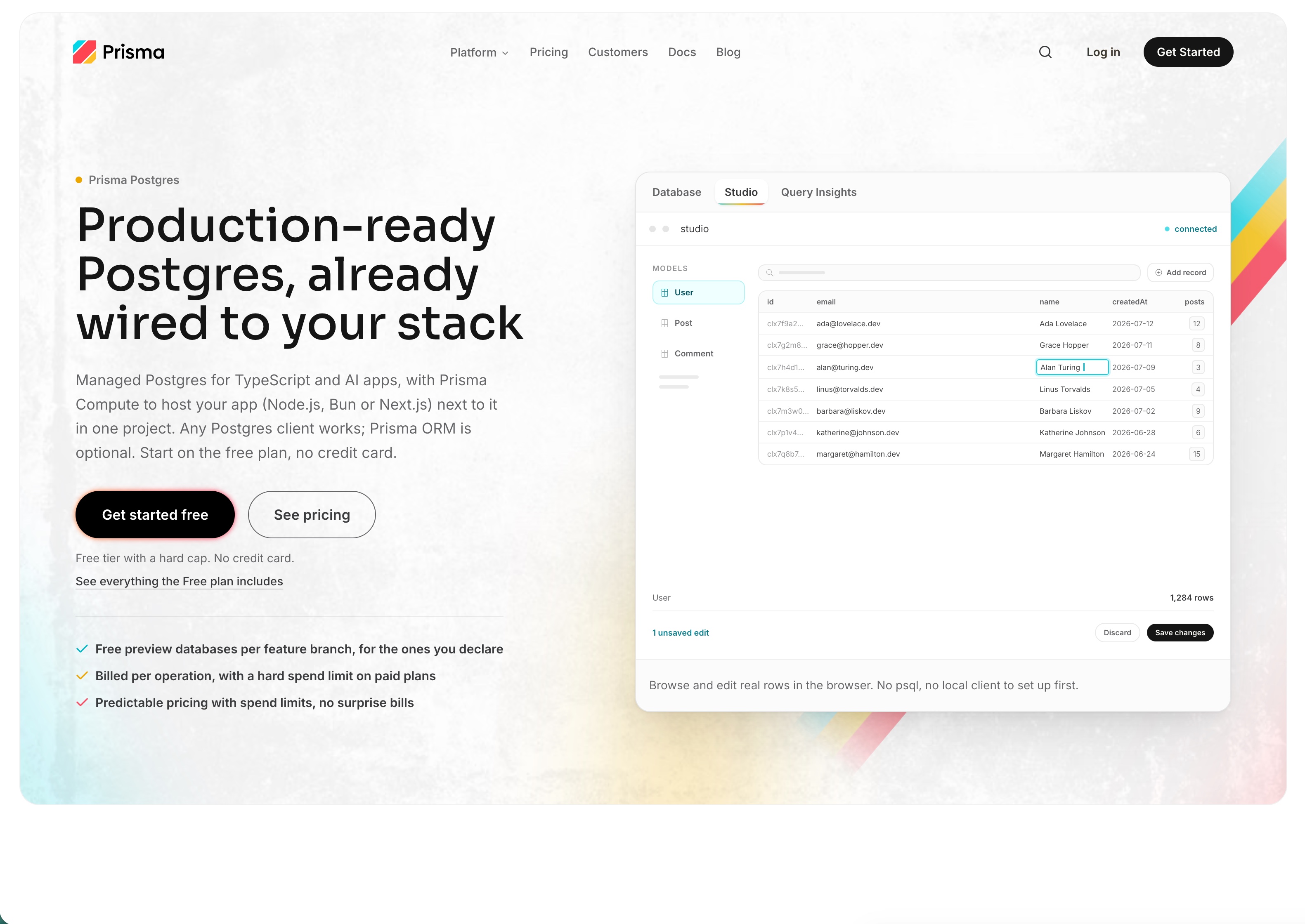
Managed Postgres for TypeScript and AI apps, with Prisma Compute to host your app (Node.js, Bun or Next.js) next to it in one project. Any Postgres client works; Prisma ORM is optional. Start on the free plan, no credit card.
About Prisma Postgres
What is your product?
Prisma Postgres is production-ready Postgres, already wired to your stack. It's managed Postgres for TypeScript and AI apps, with Prisma Compute to host your app (Node.js, Bun or Next.js) next to it in one project.
Any Postgres client works, and Prisma ORM is optional. You can create a database in seconds with npx create-db, with no account needed, or from the Prisma Console or CLI.
Key features
- Prisma Compute hosts your app next to your database in one project
- Built-in connection pooling for serverless and edge functions
- Free preview databases per feature branch
- Works with any Postgres client, with Prisma ORM optional
- pgvector on every plan, including Free
- Manage databases from Claude Code, Cursor or Codex through Prisma's MCP server
- Six regions across the US, Europe and Asia
Pricing details
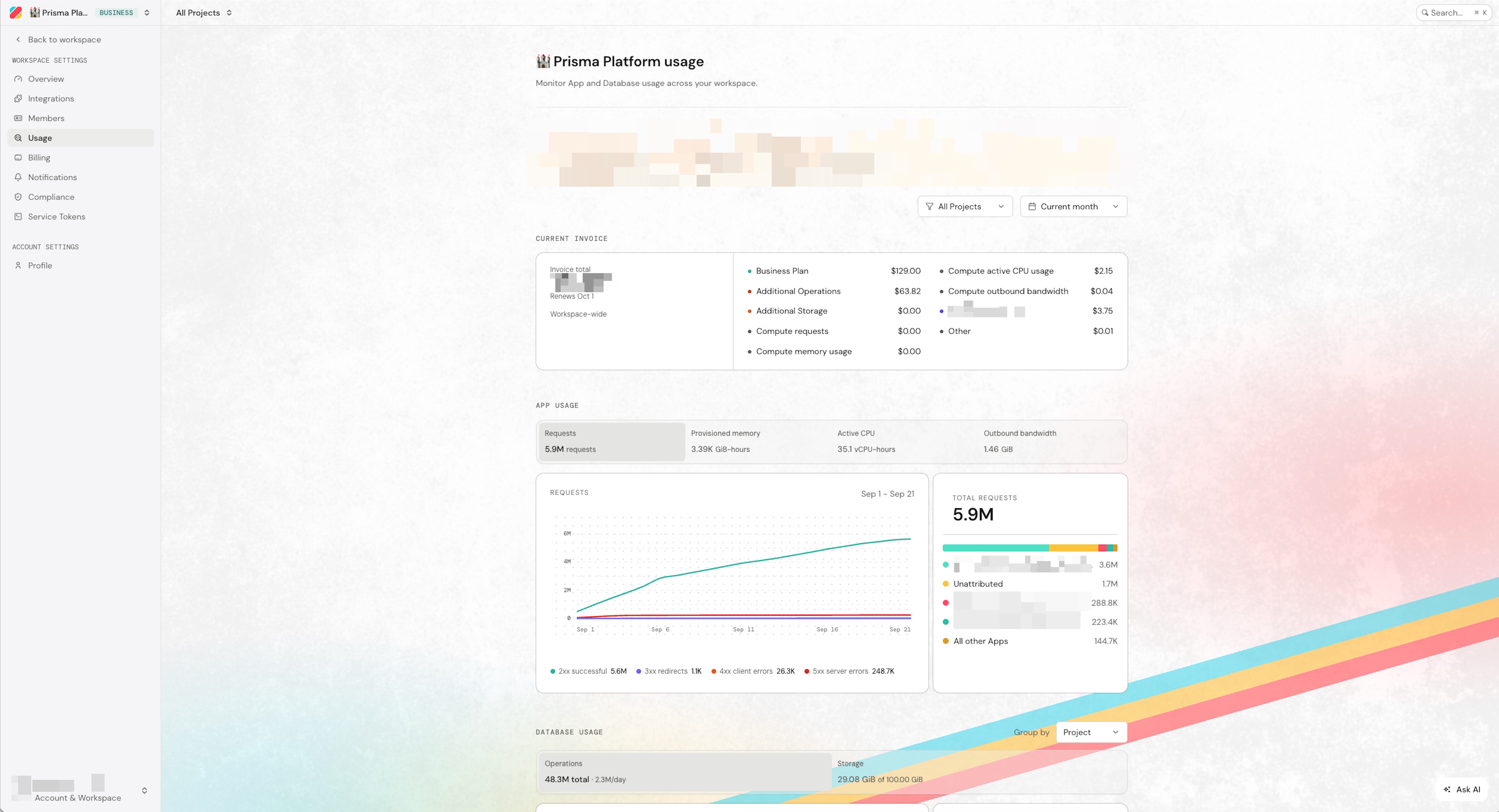
Free plan at $0 with no credit card, including 200,000 operations a month across up to 50 databases, with a hard cap. Paid plans start with Starter at $10 a month, adding daily backups and spend limits. Usage is billed per operation, with a hard spend limit on paid plans. HIPAA with a BAA is available on the Business plan at $129 a month. (See pricing)
Value & Audience
Value Proposition
Your database and your app in one project. Prisma Compute hosts your Node.js, Bun or Next.js app right next to your managed Postgres, and the free plan needs no credit card.
Problem Solved
Most apps need a database host and a separate app host, each with its own setup, account and bill. Prisma Postgres puts both in one place, so you can ship faster.
Use Cases
Tech Stack
Social & Links
Loading ratings...
Loading comments...
Gallery
Feedback & Roadmap
Prisma Postgres FAQ
Common questions about Prisma Postgres's features, pricing, and use cases
What does Prisma Postgres do?
Production-ready Postgres, already wired to your stack Your database and your app in one project. Prisma Compute hosts your Node.js, Bun or Next.js app right next to your managed Postgres, and the free plan needs no credit card.
Is Prisma Postgres free to use?
Prisma Postgres uses a freemium model — a free tier plus paid plans, starting at Free. Full pricing is listed on the Prisma Postgres product page on TechLogHub.
What problem does Prisma Postgres solve?
Most apps need a database host and a separate app host, each with its own setup, account and bill. Prisma Postgres puts both in one place, so you can ship faster.
Who is Prisma Postgres built for?
Prisma Postgres is built for Backend Developers, Agencies & Consultants, Developers, Full-Stack Developers, DevOps & SRE.
What tech stack does Prisma Postgres use?
Prisma Postgres is built with Next.js, Postgres.
What category is Prisma Postgres listed under?
Prisma Postgres is listed in the Database & Storage category on TechLogHub, alongside curated alternatives with community ratings and pricing comparisons.
Prisma Postgres appears in
You May Also Like
View all alternatives to Prisma Postgres
Sandra
Secure file transfer, secure data transfer, file requests, and encrypted Vault storage for professionals handling sensitive files.
View ProductPlanetScale
The world’s fastest and most scalable cloud hosting for Vitess and Postgres.
View Product
Truvem
The proof layer and persistent memory for AI actions, providing immutable logs and model-agnostic memory with just 2 lines of code.
View Product
Databaset
A zero-config AI memory API that provides persistent, semantic memory for LLMs without requiring vector databases or complex RAG pipelines.
View ProductOne email a week
TechLogHub tracks 674 tools and 556 open-source projects. Get the week's new launches, release roundups and open-source picks — nothing else.
Get the TechLogHub digest
One email a week: new and trending developer tools, fresh comparisons, and what shipped. Unsubscribe in one click.