
EkLine
EkLine checks what ChatGPT, Claude, Gemini and Perplexity say about a developer-tool or API company and whether coding agents can build with it, then fixes the docs, help center and marketing pages they read as pull requests your team approves. Free report; $50/month plus usage.
About EkLine
What EkLine is
EkLine is a set of AI agents for developer-tool and API companies. Its pitch starts from how developers now choose software: a buyer asks Claude or ChatGPT which product to use, then asks Cursor or Claude Code to build with it. EkLine measures what those assistants and coding agents say and do with your product, traces each answer to the pages behind it, and then fixes the pages they read (docs, help center, README files, release notes, blog and marketing pages) using your code, merged pull requests and support tickets. Every change arrives as a pull request or a draft for your team to approve; EkLine does not merge or publish on its own.
The company has been around longer than this launch suggests. Its GitHub organization dates from January 2023, and its first product was a documentation linter, the Docs Reviewer, which still runs in CI, VS Code, Google Docs and a CLI. The November 2026 launch adds AI-answer visibility ("AI SEO and GEO") on top of the Docs Agent and Marketing Agent. EkLine lists Socure, P0 Security and ContextQA as customers and says it is SOC 2 Type 2 compliant.
How it works
- Measure with Journeys. EkLine asks ChatGPT, Claude, Gemini and Perplexity the questions your buyers ask, many times each, and records whether you were recommended (not just mentioned), whether you appeared in the first answer, and whether what was said is accurate. Agent Task journeys give coding agents a build task with your product and check whether they finish it. Reports show who was recommended instead and which sites were cited, with your docs and website counted separately.
- Fix with agents. The Docs Agent reads a request (from Jira, Linear, Slack, Discord, Pylon, Zendesk, a video or a chat), gathers context from tickets, specs and merged code, flags claims it could not verify, checks screenshots, API calls and code samples, and opens a pull request across every surface the change touched. The Marketing Agent drafts posts and comparison or pricing pages. Feedback in reviews becomes shared "organization memory".
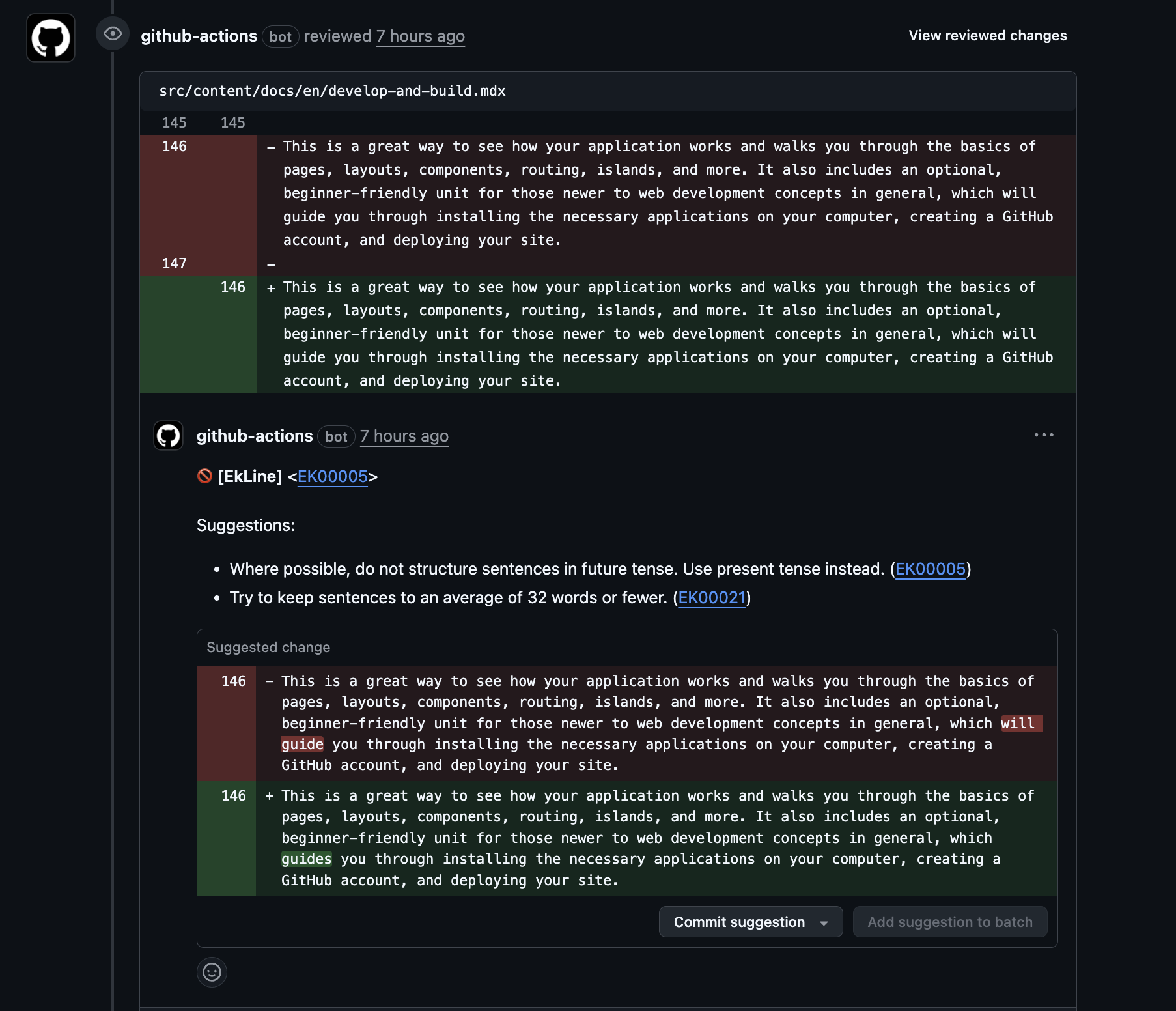
- Check with the Docs Reviewer. Style, terminology, readability and broken-link rules (EK00001 to EK20002) run on every pull request, including docs written by coding agents, through a GitHub Action, GitLab CI, Bitbucket Pipelines, the VS Code extension, a Google Docs add-on or a CLI.
- Agent readiness report. A free check of how AI agents read your website and docs, with a score, blockers (for example guides that need JavaScript to render) and the first fixes.
- No migration. It works with docs on Mintlify, ReadMe, GitBook, Docusaurus, Fern, Redocly, Astro or Markdown in a repo, plus Confluence, Notion, Zendesk and Pylon. EkLine says a Git-based docs setup takes about 15 minutes; its own docs run on Potluck Docs, its MIT-licensed Astro Starlight template.
We read the CI integration
On November 18, 2026 we checked EkLine's public GitHub repositories and the GitHub Action's action.yml. Latest releases: Action v6.57.0 and CLI 7.40.1, both published July 30, 2026, with CLI binaries for Alpine, Linux, macOS (arm64 and x64) and Windows. The Action wraps reviewdog; its required input is an organization token, and the defaults are conservative. A minimal workflow built from those inputs:
name: docs-review
on: pull_request
jobs:
  ekline:
    runs-on: ubuntu-latest
    steps:
      - uses: actions/checkout@v4
      - uses: ekline-io/ekline-github-action@v6
        with:
          ek_token: ${{ secrets.EK_TOKEN }}   # required
          content_dir: ./docs
          reporter: github-pr-review          # default
          filter_mode: added                  # default: only lines changed in the PR
          fail_on_error: false                # default: comments, never blocks the merge
          enable_ai_suggestions: true         # default is false
          # openapi_spec: ./openapi.yaml      # optional OpenAPI review
Two practical notes from that file. Out of the box the reviewer only comments on lines a pull request adds and does not fail the build, so it will not block merges until you set fail_on_error. And AI suggestions are off by default; the rule-based checks run without them. EkLine's docs also say Docs Reviewer checks do not use credits, so CI linting does not eat into the agent budget.
Pricing (checked November 18, 2026)
| Plan | Price | What you get |
|---|---|---|
| Free (Starter) | $0 | One free report and $20 of credits, once; 2 knowledge-base or docs repositories; automated improvements, style-guide rules, link checker, all integrations |
| Pay as you go | $50/month + usage at $0.01 per credit | Unlimited repositories, custom automations, scheduled agents, 1 hour a week of technical-writer support |
| Enterprise | Custom | Priority support and SLAs, zero-day AI data retention, bring your own LLM, remove EkLine branding |
Worked example: sizing a buyer-questions report
Credits are not a fixed price per task: EkLine's docs say they convert from the tokens an agent reads and writes, so a long session or a large repository costs more. What you can size in advance is how many AI answers a journey collects. EkLine's sample report used 15 questions, each asked 10 times in 4 assistants:
15 questions x 10 runs x 4 assistants   = 600 answers (each graded, then analyzed)
re-run after fixes                     = another 600 answers
free credit:  $20 / $0.01             = 2,000 credits
paid plan:    $50 base + 30,000 credits x $0.01 = $350 in a month that uses 30,000
The sample shows why the repeats matter: a single question went from 3 of 40 passing answers to 19 of 40 after the fixes, a swing you could not see from one answer per assistant. Since EkLine does not publish credits per answer, run one small journey, read its cost on the Usage page, and scale from there.
EkLine vs the alternatives
| EkLine | DocsAlot | Specsight | RankSpot | |
|---|---|---|---|---|
| Core job | Measure AI answers, then fix docs and pages via pull requests | Hosts AI-readable docs and help centers with an MCP endpoint | Keeps a product spec and changelog current from the codebase | SEO and AI-search tracking plus articles and outreach |
| Keeps your docs platform | Yes | No, it is the platform | Separate output | Publishes to your CMS |
| Tests coding agents | Yes, Agent Task journeys | No | No | No |
| Docs linting in CI | Yes, Docs Reviewer | Drift checks on Enterprise | No | No |
| Price | Free report; $50/month + usage | From $79/month | €150/month per organisation | Pay per action |
EkLine positions itself against visibility tools such as Profound and Semrush by saying those report and suggest while it makes the change; it also says to keep your SEO tool alongside it.
Who it's for
API, SDK and developer-tool companies whose docs are a sales channel; developer-relations and technical-writing teams that cannot keep up with release volume; and founders without a writer who want release notes, quickstarts and comparison pages drafted from merged code.
Limits and trade-offs
- Usage is hard to predict. Token-based credits mean two similar requests can cost different amounts; long sessions cost more because the agent rereads the conversation each turn.
- Write access to docs repos. You choose which repositories EkLine may open pull requests in and which it only reads; review the GitHub App's permissions when installing.
- Your data goes to third-party models. The trust center lists Anthropic and OpenAI among its US-based subprocessors; zero-day retention and bring-your-own-LLM are Enterprise features. EkLine says customer data is never used for training.
- Narrow audience. It is built for developer tools and APIs; a consumer brand gets less from the coding-agent checks.
- Vendor claims. "ContextQA's engineers merge 97.5% of what EkLine writes", "about 66% of documentation traffic is AI agents" and Socure's "nearly 10x more documentation PRs" are EkLine's figures.
Related on TechLogHub
- llms.txt generator and robots.txt generator, two of the AI-readiness basics EkLine checks.
- OpenAPI and OpenAPI Generator, for API reference work.
- CI/CD, GitHub Actions vs GitLab CI and the Markdown cheat sheet.
- SEO and MCP.
- DevDocs, an open-source API documentation browser.
Value & Audience
Value Proposition
Know whether AI assistants recommend your product and whether coding agents can use it, and get the fixes as reviewable pull requests in the docs stack you already have.
Problem Solved
Developer buyers now ask AI assistants what to use and coding agents how to build with it, but docs drift behind every release and teams cannot see or fix what those agents read.
Target Audience
Tech Stack
Social & Links
Loading ratings...
Loading comments...
Gallery
Feedback & Roadmap
EkLine FAQ
Common questions about EkLine's features, pricing, and use cases
Is EkLine free to use?
EkLine has a free tier plus paid plans, starting at Free (Starter) - $0 - one free report and $20 of credits once, 2 repositories, style-guide rules, link checker, all integrations. Plans listed: Free (Starter) - $0 - one free report and $20 of credits once, 2 repositories, style-guide rules, link checker, all integrations; Pay as you go - $50/month + $0.01 per credit - unlimited repositories, custom automations, scheduled agents, 1 hr/week technical-writer support; Enterprise - custom - SLAs, zero-day AI data retention, bring your own LLM, remove branding.
What are some alternatives to EkLine?
Popular Developer Tools alternatives to EkLine include CodeSpy, DevOp and Global TTFB Checker.
EkLine appears in
You May Also Like

CodeSpy
CodeSpy quietly scans your WordPress site for what's actually wrong, from messy code and plugin conflicts to broken forms and layout issues, explaining it in plain language.
View Product
DevOp
An Agentic IDE for Windows, Mac, and Linux that leverages intelligent, autonomous AI coding agents to accelerate software development.
View ProductGlobal TTFB Checker
Free global TTFB checker. Measure Time To First Byte from 114 countries with live world map, city-level results, and instant latency reports. No signup.
View Product
Next.js AI SaaS Cursor Rules Pack
15 battle-tested .mdc Cursor rules for Next.js AI SaaS, covering Supabase, Clerk, Stripe, and Verc/AI SDK.
View ProductOne email a week
TechLogHub tracks 883 tools and 608 open-source projects. Get the week's new launches, release roundups and open-source picks — nothing else.
Get the TechLogHub digest
One email a week: new and trending developer tools, fresh comparisons, and what shipped. Unsubscribe in one click.