


Scaled Content Abuse: What Google Actually Enforces
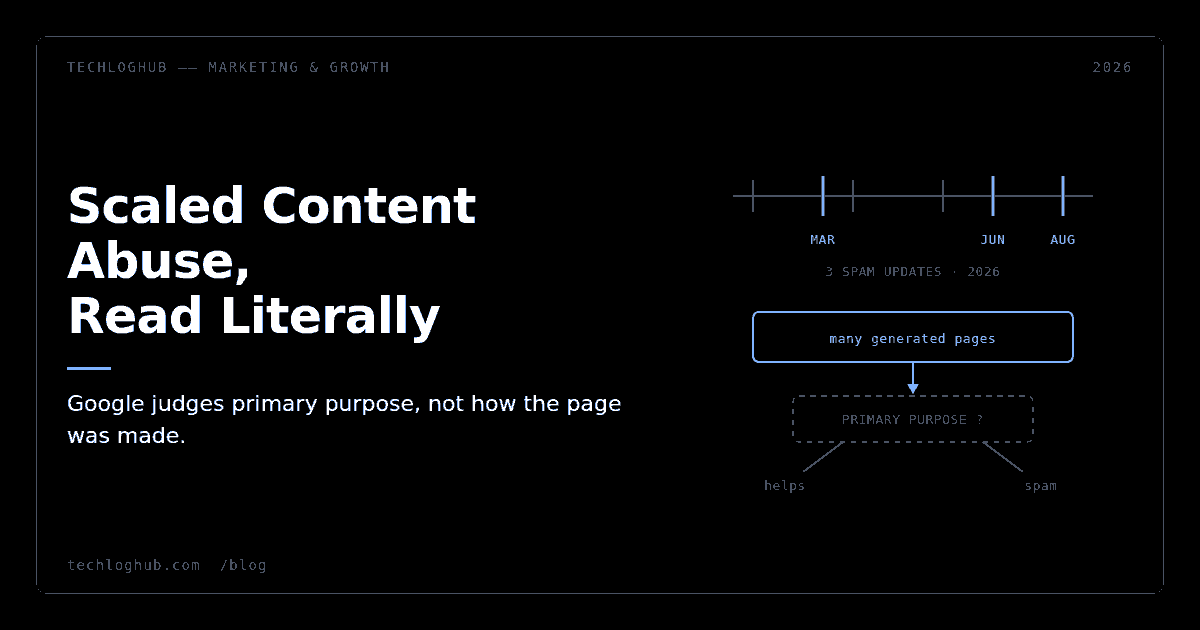
Quick answer: Google's last core update started 21 May 2026. Since then it has shipped two spam updates — 24 June and 18 August — and the August one finished in 2 days 16 hours. If you run a directory, a comparison site, or any templated page set, the spam track is the one pointed at you, and the policy text says it judges primary purpose, not whether a machine wrote the page.
Most SEO coverage treats core updates as the main event and spam updates as a footnote. For anyone publishing at scale that is backwards. Core updates reweigh quality signals across the whole index. Spam updates enforce specific named policies, and two of those policies describe what a directory does for a living.
So it is worth reading Google's own log literally rather than through commentary.
The 2026 ranking-update log
| Update | Started | Ran for |
|---|---|---|
| February 2026 Discover update | 5 Feb 2026 | 21d 17h |
| March 2026 spam update | 24 Mar 2026 | 19h 30m |
| March 2026 core update | 27 Mar 2026 | 12d 4h |
| May 2026 core update | 21 May 2026 | 11d 21h |
| June 2026 spam update | 24 Jun 2026 | 2d 1h |
| August 2026 spam update | 18 Aug 2026 | 2d 16h |
Two things jump out of that table. First, as of late September 2026 Google's status history lists no core update after May — four months, the longest gap of the year. Second, spam updates are fast. The March one ran in under twenty hours.
That speed has a practical consequence nobody talks about. A twelve-day core update is visible in your analytics as a slope. A twenty-hour spam update is a cliff that lands between two daily data points, and by the time you notice the drop the rollout has been over for a week. You will not diagnose it from a chart. You diagnose it from the policy text.
What scaled content abuse actually says
Google's spam policies page, last updated 28 August 2026, defines it in one sentence: scaled content abuse is when many pages are generated for the primary purpose of manipulating search rankings and not helping users.
Every word before "primary purpose" is a distraction. The examples confirm it: using generative AI or similar tools to produce many pages without adding value; scraping feeds, search results or other content to generate many pages where little value is provided; creating many pages whose content makes little sense to a reader but contains search keywords.
Notice what is absent. There is no page-count threshold. There is no prohibition on templates, on generated text, or on programmatic publishing as a method. The policy is about intent as evidenced by output. "We generated 4,000 pages" is not the violation. "We generated 4,000 pages and 3,700 of them have nothing a reader would want" is.
Why directories sit right on the line
A tool directory is, structurally, a generated page set. One template, a few hundred records, a URL each. From a crawler's position that is indistinguishable from the thing the policy describes — until you look at what is on the page.
The distinction Google draws elsewhere in the same document is instructive. On thin affiliate pages it says good affiliate sites add value by offering meaningful content or features: original reviews, testing, comparisons, navigation. That is a list of things a template can carry and a scraper cannot fake. Pricing you actually verified. A comparison across records that only exists because you hold all the records. Categorisation that reflects a judgement someone made.
This is the argument we made in programmatic SEO without thin pages: the safe version of programmatic publishing is not fewer pages, it is a publish gate. A page ships when it has enough verified data to be worth a reader's click, and stays unpublished when it does not. Under a policy written around primary purpose, that gate is the entire defence.
Taxonomy does more work here than people expect too. A category that exists because a real distinction exists gives every page in it a reason to be separate; a category invented to host a keyword does the opposite. We went through that design in designing a content taxonomy for a directory site, and the test has not changed: if two categories would contain the same records, you have one category and a spam signal.
The two neighbouring policies
Scaled content abuse rarely travels alone. Site reputation abuse applies where third-party content is published on a host site mainly because of that host's already-established ranking signals, so the content ranks better than it could on its own. Google's stated distinction is editorial: integrated, overseen third-party content is unlikely to trigger action; unvetted low-quality content without editorial oversight or clear authorship is the risk.
If your platform accepts submissions — product listings, guest posts, user reviews — that policy is live for you, and the mitigation is unglamorous: a human in the loop and a visible author. Expired domain abuse is the third, and it is the one that catches people buying a domain for its backlinks: repurposing an expired domain primarily to manipulate rankings by hosting content of little value to users.
What to do before the next one
Given the 2026 cadence — three spam updates in nine months, none announced in advance — the only workable posture is to be clean before the update rather than diagnostic after it. Four checks, in order of how much they tell you:
Sample your own long tail. Pull twenty of your lowest-traffic generated URLs and read them as a stranger. If you cannot say what a visitor gains from each one, Google cannot either. Word count is a weak proxy, but running a set through a content word statistics pass will at least surface the pages that are pure boilerplate.
Check for keyword-shaped padding. The policy names pages that contain search keywords but make little sense to a reader. A keyword density check across your templates finds the phrase your generator repeats in every record.
Look at internal links as evidence. Pages nothing links to are pages you did not think were worth linking to. That is a judgement your own site has already made; an internal linking audit makes it visible. Orphans are the natural first candidates to consolidate or drop.
Decide what you would delete. The most useful exercise is naming the fraction of your index you would remove if you had to. Most publishers can name it instantly, which means they already know. Removing it costs less than a spam update removing it for you, across the whole domain.
For a worked example of a page type that earns its place, our guide to comparing developer tools covers what a comparison has to contain to be worth publishing at all, and the live version of that thinking is visible across the product directory and the curated collections.
FAQ
Does Google penalise AI-generated content?
Not as a category. The policy names using generative AI tools to generate many pages without adding value. The violation is the lack of value at scale, not the tool. A generated page that is accurate, verified and useful is not what the policy describes.
How many pages counts as "scaled"?
Google publishes no threshold. The policy hinges on primary purpose, so a hundred worthless pages is a clearer violation than ten thousand useful ones.
When was the last core update?
The May 2026 core update started 21 May 2026 and ran 11 days 21 hours. As of late September 2026 Google's ranking-updates history lists no core update after it.
How do I tell a spam update hit me rather than a core update?
Shape and timing. Spam updates in 2026 completed in 19 hours to under 3 days, so the drop is abrupt and aligns to a dated entry in Google's status history. Core updates roll for one to two weeks and move traffic gradually.
Is a directory site inherently at risk?
No, but it is structurally similar to what the policy targets, so the burden of demonstrating value per page is higher. Original testing, verified data, real comparisons and navigation are the features Google names as adding value.
Does accepting user submissions put me at risk?
It engages the site reputation abuse policy, which turns on editorial oversight. Integrated, reviewed third-party content is described as unlikely to trigger action; unvetted low-quality content without clear authorship is the exposure.
The policy has said "primary purpose" for years. Everyone keeps reading it as "page count."