

Google's UGC Fresh Data Program: Who Qualifies and Who Shouldn't
Google opened a separate pipeline for fresh user-generated content. Most developer sites won't qualify, but the requirements are a solid checklist anyway.
Google's UGC Fresh Data Program: Who Qualifies and Who Shouldn't
Quick answer: The UGC Fresh Data Program, documented by Google on October 8, 2026, is an application-only pipeline that lets large forum and social platforms push fresh posts and engagement counts to Google over OAuth. It is not for blogs, vendor changelogs or small communities. If you run a smaller discussion space, its requirements still make a good checklist for regular crawling.
Google now has a side door for user-generated content, and most sites will never be allowed through it. That is fine. The list of what Google demands from the platforms it does let in is the clearest statement yet of what it wants from community content in general.
What Google launched
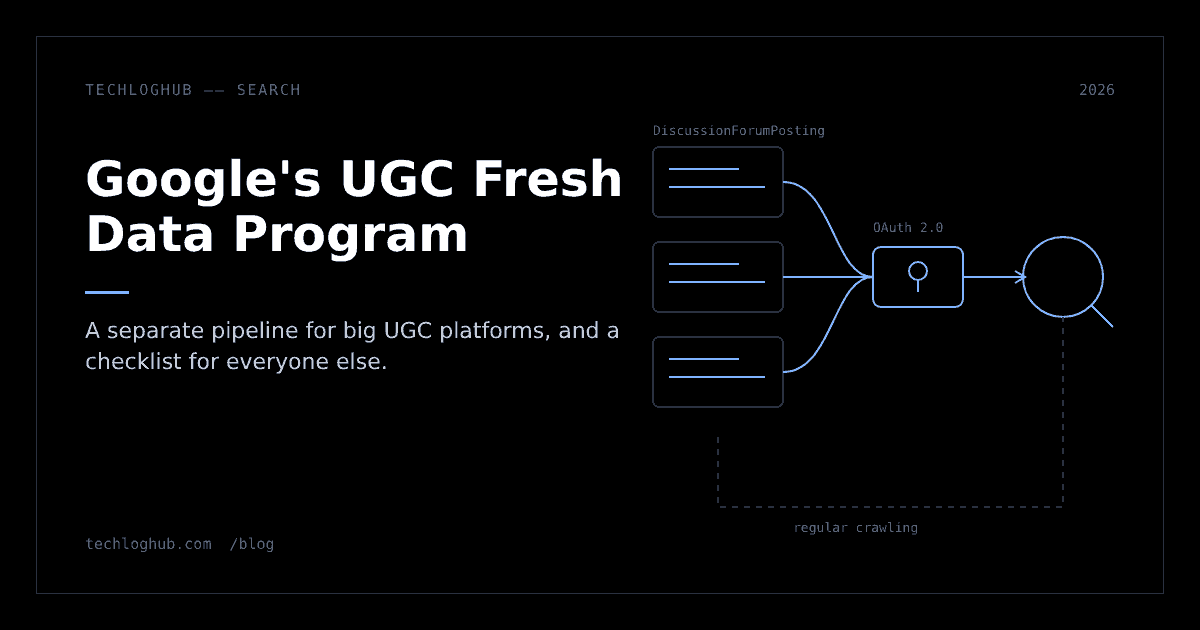
On October 8, 2026, Google's Search documentation changelog added a page for the UGC Fresh Data Program. Approved platforms send content and interaction signals to Google through a dedicated ingestion pipeline, so fresh, authentic posts can show up in Search features quickly.
Google is explicit about two things. The pipeline is designed only for trending UGC and is separate from both regular crawling and the Indexing API. And acceptance does not guarantee that any submitted content will appear in Search.
Google frames the goal as processing submitted content quickly, so it can be updated in Search and shown to people looking for first-hand perspectives. The page does not say how long submitted data is kept, whether it is used outside Search, or which countries are eligible. If those answers matter to your legal team, ask during onboarding rather than assuming.
The application is a form. Google says it will respond within six to eight weeks, and accepted platforms receive the integration documentation then. The public page does not publish the API itself.
The eligibility bar, in plain terms
The program page lists six groups of criteria. Paraphrased:
- Content focus: the platform primarily hosts user-generated content, social posts or forum discussions, each on a dedicated page with a stable URL. Profile pages and feeds do not count.
- Volume and audience: a high volume of UGC and a significant user base. Google gives no number.
- Accessibility: content is public to both Googlebot and users. Anything behind a login or paywall is ineligible, and every creator must have a public profile.
- Technical readiness: you can implement OAuth 2.0 and send strictly validated JSON-LD, with schema.org markup such as
SocialMediaPostingorDiscussionForumPostingincludinginteractionStatistic. - Moderation: no illegal content, active moderation, and a way for users to report posts.
- Freshness: content sent within minutes where possible, and engagement counters updated within 72 hours of creation.
Read the list as a filter. The volume and audience line rules out most sites before the technical items even come up.
How it differs from the Indexing API and crawling
Three routes now exist for getting content into Google, and they are not interchangeable. Regular crawling is the default for every site. The Indexing API is a separate push channel; Google updated its quota page on October 16, and the default is 200 publish requests per day per project, counting both URL_UPDATED and URL_DELETED. The UGC program is a third route, by application only, scoped to trending user content.
| Route | Who can use it | What you send |
|---|---|---|
| Regular crawling | Every site | Nothing; Googlebot fetches your pages and sitemaps |
| Indexing API | Projects with API access, 200 publish requests a day by default | URL update and delete notifications |
| UGC Fresh Data Program | Approved high-volume UGC platforms only | Content and engagement signals as validated JSON-LD over OAuth |
If you were hoping the program was a faster Indexing API for your blog, it is not. Google says general web content stays on crawling or the Indexing API.
The markup it assumes
The program leans on markup Google already documents. Its discussion forum structured data guide defines DiscussionForumPosting for forum posts, with SocialMediaPosting as the parent type for generic social platforms. Required properties are author with a name, datePublished, and one of text, image or video.
The engagement part is interactionStatistic. Google lists the interaction types it understands: LikeAction for likes or upvotes, DislikeAction, ViewAction, CommentAction or ReplyAction, and ShareAction. Those are the counters the program wants refreshed within 72 hours.
{
  "@context": "https://schema.org",
  "@type": "DiscussionForumPosting",
  "headline": "Turborepo cache misses after pnpm upgrade",
  "author": { "@type": "Person", "name": "dev_ana", "url": "https://example.com/u/dev_ana" },
  "datePublished": "2026-10-18T09:12:00+05:30",
  "text": "Since upgrading, every CI run misses the remote cache...",
  "interactionStatistic": [
    { "@type": "InteractionCounter", "interactionType": "https://schema.org/LikeAction", "userInteractionCount": 14 },
    { "@type": "InteractionCounter", "interactionType": "https://schema.org/CommentAction", "userInteractionCount": 6 }
  ]
}
Notice the gap between the two documents. In the general forum guide, interactionStatistic is a recommended property. In the program criteria it is required, and so is keeping it current. The program is stricter than the public markup rules, which shows where Google's interest lies: not just that a post exists, but whether people are engaging with it.
One rule catches developer sites out. Google says to use DiscussionForumPosting only for user-generated posts, not content authored by the site or its agents, so a company blog with comments does not qualify. We went through that boundary in forum schema is for user-generated content only. If your community is mostly questions with accepted answers, Google points you to Q&A markup instead.
Validate the JSON before you ship it; a JSON formatter catches the trailing commas and unescaped quotes that make strict validators reject a payload.
Where developer platforms actually fit
Most developer-facing sites have some user-generated content: feedback boards, feature requests, issue-style discussions, comment threads under changelogs. Very few have the volume Google is describing. A realistic sorting:
- Large developer forums and Q&A communities with public profiles and real moderation are the audience. If that is you, apply.
- Product feedback boards (feature requests, votes, replies) are user-generated, but usually too small. Treat the criteria as a quality bar and stay on crawling.
- Vendor-written content such as release notes, docs and blog posts is not UGC under Google's definition, whatever comments sit underneath.
- Gated communities on Discord, Slack or a members-only forum are ineligible by the accessibility rule, and invisible to regular crawling too.
On TechLogHub, product feedback boards sit next to editorial content. The two need different markup: forum or Q&A types for what users write, Article types for what the site writes. You can see both kinds of content from any product page.
What to do if you don't qualify
Use the program's requirements as a checklist for the route you do have. Every item helps regular crawling as well:
- Give every thread its own stable URL and a canonical tag that points to itself, not to a feed or a paginated list.
- Make creator profiles public and link them from each post, which also fills the recommended
author.urlproperty. - Mark up posts honestly with
DiscussionForumPostingor Q&A markup, including realinteractionStatisticcounts. - List thread URLs in a sitemap with accurate
lastmodvalues; a sitemap generator gets the format right. - Keep thread pages readable. One H1, clear replies; the heading structure analyzer shows when a template buries the post under navigation.
- Moderate visibly and give users a report button. It is a program requirement and a signal of quality either way.
FAQ
What is Google's UGC Fresh Data Program?
It is an application-only pipeline, documented by Google on October 8, 2026, that lets approved user-generated content platforms send fresh posts and engagement signals to Google over OAuth 2.0 for use in Search features.
Can a small forum or feedback board join?
Probably not. Google requires a high volume of user-generated content and a significant user base, along with OAuth, strictly validated JSON-LD, public creator profiles and active moderation.
Does acceptance guarantee my posts appear in Search?
No. Google states that the program does not guarantee content will appear in Search.
Is this a replacement for the Indexing API?
No. Google describes it as separate from both the Indexing API and regular crawling, and says general web content should keep using those routes.
Which structured data does the program expect?
Valid schema.org markup such as SocialMediaPosting or DiscussionForumPosting, including interactionStatistic counters like LikeAction and CommentAction.
Google built a fast lane for platforms with volume. Everyone else gets the same reward the slow way: stable URLs, honest markup, and posts worth reading.