

Google Now Wants Your AI-Written Metadata Fact-Checked Too
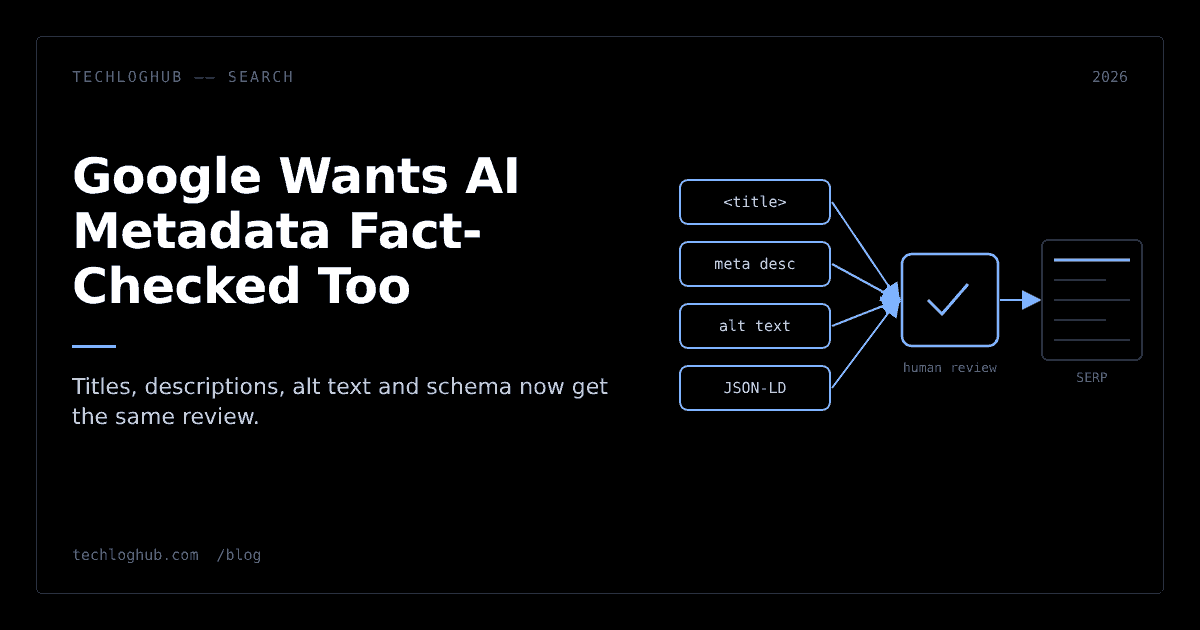
Quick answer: On 1 October 2026 Google updated its generative AI content guide to say it is "critical to manually factcheck and review all AI-generated content" before publishing, and that this review also applies to title elements, meta descriptions, structured data and image alt text. If your pipeline generates metadata with a model and ships it unread, that is now the part of your site Google's own documentation calls out.
Most teams that use AI for content already put a human between the draft and the publish button. Almost nobody does that for the metadata. Google's 1 October edit is a polite way of saying that gap is now on the record.
The change is small in word count and large in practical scope. Titles, descriptions, alt text and JSON-LD are exactly the fields that sites generate in bulk, because they feel mechanical. They are also the fields that show up in search results, often without the page around them.
What Google actually changed on 1 October
Google's documentation changelog has a single entry for 1 October 2026: the generative AI content guide was updated "with information from the Search Quality Raters guidelines," with the stated reason of keeping the docs in sync with what Google presents at developer events.
Comparing versions, Search Engine Journal and PPC Land report the same edits to the "Focus on accuracy, quality, and relevance" section:
- Three new sentences: generative models "don't retrieve facts, but predict a likely sequence of words based on their training data"; outputs may therefore contain hallucinations; and it is "critical to manually factcheck and review all AI-generated content for accuracy and trustworthiness before publishing."
- One reworded phrase: "This includes metadata" became "This review also applies to metadata," naming
<title>elements, meta descriptions, structured data and image alt text, "which can appear in Search results."
Neither publication found removed sentences. The paragraph that points to the rater guidelines' sections 4.6.5 (scaled content abuse) and 4.6.6 (low-effort main content) was already there, and the page still says rater scores "don't directly influence ranking." PPC Land notes that none of the new sentences actually quotes the rater guidelines, so the changelog's framing is broader than the edit.
Why metadata is the part that matters
Body copy gets read before it ships, at least in any team that cares. Metadata usually does not. It is generated by a template or a prompt, stored in a field nobody opens, and rendered into the <head> where no editor ever looks at it again.
That is backwards relative to exposure. A title and meta description are often the only text a searcher sees from your page. Alt text is what screen readers announce and what image search indexes. Structured data feeds rich results and, increasingly, the systems that summarise pages for AI answers. A wrong product price in JSON-LD, or a meta description that invents a feature, does more visible damage than a clumsy sentence in paragraph six.
For a directory, comparison or listings site, the ratio is even more lopsided. One generated product page can carry a title, a description, an Open Graph block, a Twitter card, three alt attributes and a SoftwareApplication schema object. Multiply that by a few thousand listings and the metadata is most of the AI-written text you publish.
What "manual review" can mean at scale
Google does not define how much review is enough, and it does not say every field needs a human reading every character. Do not invent a stricter rule than the one written. What the text does make clear is that "the model produced it" is not a review.
A workable interpretation for a site generating thousands of records is a gate with three layers.
1. Deterministic checks on every record
Machines are good at the boring half. Before anything ships, check lengths, required fields, banned phrases and parity between fields. A title over 60 characters, a description that repeats the title, alt text that says "image of" or an FAQ schema whose questions do not appear on the page should fail automatically. Our meta tag generator and OG tag generator show the shapes these fields should take, and the heading structure analyzer catches pages whose visible structure no longer matches what the metadata claims.
2. Fact checks against your own source data
The useful question for generated metadata is not "does this read well?" but "is every claim in it present in the source record?" If a listing says a tool is open source, free, or supports SSO, that claim should map to a field in your database or the vendor's docs. Anything the model added on its own, such as a pricing tier, an integration, or a superlative, gets cut. This is the same discipline as a publish gate for programmatic pages: the template can only say what the data supports.
3. Human review where it counts
Then put people on the parts automation cannot judge: a sample of every new template, every record in a new category, and every record where the model's output diverges from the source data. Log who approved what. If you ever need to explain your process, "a person reviewed a stratified sample and every flagged record" is a sentence you can defend; "we prompted carefully" is not.
Structured data deserves its own pass
The guide repeats that structured data must follow Google's general guidelines and each feature's policies, and should be validated. That matters more for AI-generated markup because models are fluent in schema.org and will happily emit properties that are valid vocabulary but unsupported or misleading for a given feature.
Two failure modes show up repeatedly. The first is markup that describes content the page does not show, such as FAQ entries that exist only in JSON-LD or review ratings with no visible reviews. The second is confident values with no source: a price, operatingSystem or aggregateRating the model filled in because the property existed. We covered the gap between what schema.org allows and what Google reads in What Schema Is For After FAQ Rich Results. If you generate FAQ markup, build it from the visible Q&A on the page, the way our FAQ schema generator does, rather than asking a model to write both separately.
Labelling: required in Merchant Center, optional elsewhere
The guide's "Give users context" section suggests explaining how automation was used and adding image metadata for automatically generated content. That is advice, not a requirement, for ordinary pages.
E-commerce is different. The guide states that Merchant Center requires AI-generated images to carry IPTC DigitalSourceType TrainedAlgorithmicMedia metadata, and that AI-generated product titles and descriptions must be specified separately and labelled as AI-generated. If you run shopping feeds, that is a policy obligation, not a best practice. PPC Land also points out that the guide does not mention the "Manage AI label" control Merchant Center added in July 2026, so check Merchant Center's own help pages rather than relying on the Search guide alone.
What this does not change
This is not an algorithm update, and Google did not say AI-generated content ranks lower. The scaled content abuse policy already existed, and the edit links to rater guideline sections that were already cited. We covered what that policy actually enforces in Scaled Content Abuse: What Google Enforces.
What changed is the documentation's tone on accuracy. "Review your metadata" moved from an aside to an explicit instruction, next to a plain explanation of why models get facts wrong. If a site gets hit by a manual action for scaled content, that sentence is what anyone reading the guide will point to.
For teams that list products, as we do across the TechLogHub directory, the practical upshot is simple. The fields you thought were too boring to review are the ones most likely to be wrong and most likely to be seen.
A checklist you can run this week
- Inventory every field your pipeline writes with a model: titles, meta descriptions, OG and Twitter text, alt text, JSON-LD, FAQ blocks.
- Add automated length, duplication and parity checks to the publish step, and fail the build rather than warn.
- Require every factual claim in generated metadata to trace back to a source field. Strip anything that does not.
- Validate structured data on a sample of each template, and keep only properties your page visibly supports.
- Human-review a sample of every new template and category, and log approvals.
- If you publish Merchant Center feeds, confirm AI-generated images and product text are labelled as Merchant Center requires.
FAQ
Did Google say AI-generated content will rank lower?
No. The 1 October 2026 edit adds accuracy guidance and extends review to metadata. The guide still warns that generating many pages without added value may violate the scaled content abuse policy, but that warning predates the edit.
Does the review requirement cover alt text and structured data?
Yes. The updated guide says the review "also applies to metadata," naming title elements, meta descriptions, structured data and image alt text, because they can appear in Search results.
Do I need to label AI-generated content on my site?
For ordinary web pages the guide suggests giving users context about how automation was used, which is advice rather than a rule. Merchant Center does require labelling: AI-generated images need IPTC DigitalSourceType TrainedAlgorithmicMedia metadata, and AI-generated product titles and descriptions must be labelled.
What do the rater guideline sections 4.6.5 and 4.6.6 cover?
Google's guide cites section 4.6.5 for scaled content abuse and section 4.6.6 for main content created with little effort, originality or added value. It also states that rater scores do not directly influence ranking.
Was anything removed from the guide?
Search Engine Journal and PPC Land both reported additions and one reworded phrase, with no removed sentences. The rater guideline references and Merchant Center section were unchanged.
If a model wrote it and a search result shows it, someone on your team should have read it first.