
Teaflask
Teaflask adds an AI agent to your product that learns it from your code repository and then completes tasks for signed-in users through your own API, with per-action Allow/Ask/Deny rules, approvals and audit. Added with a React component or script tag; the platform is free and you pay only the model, at cost.
About Teaflask
What Teaflask is
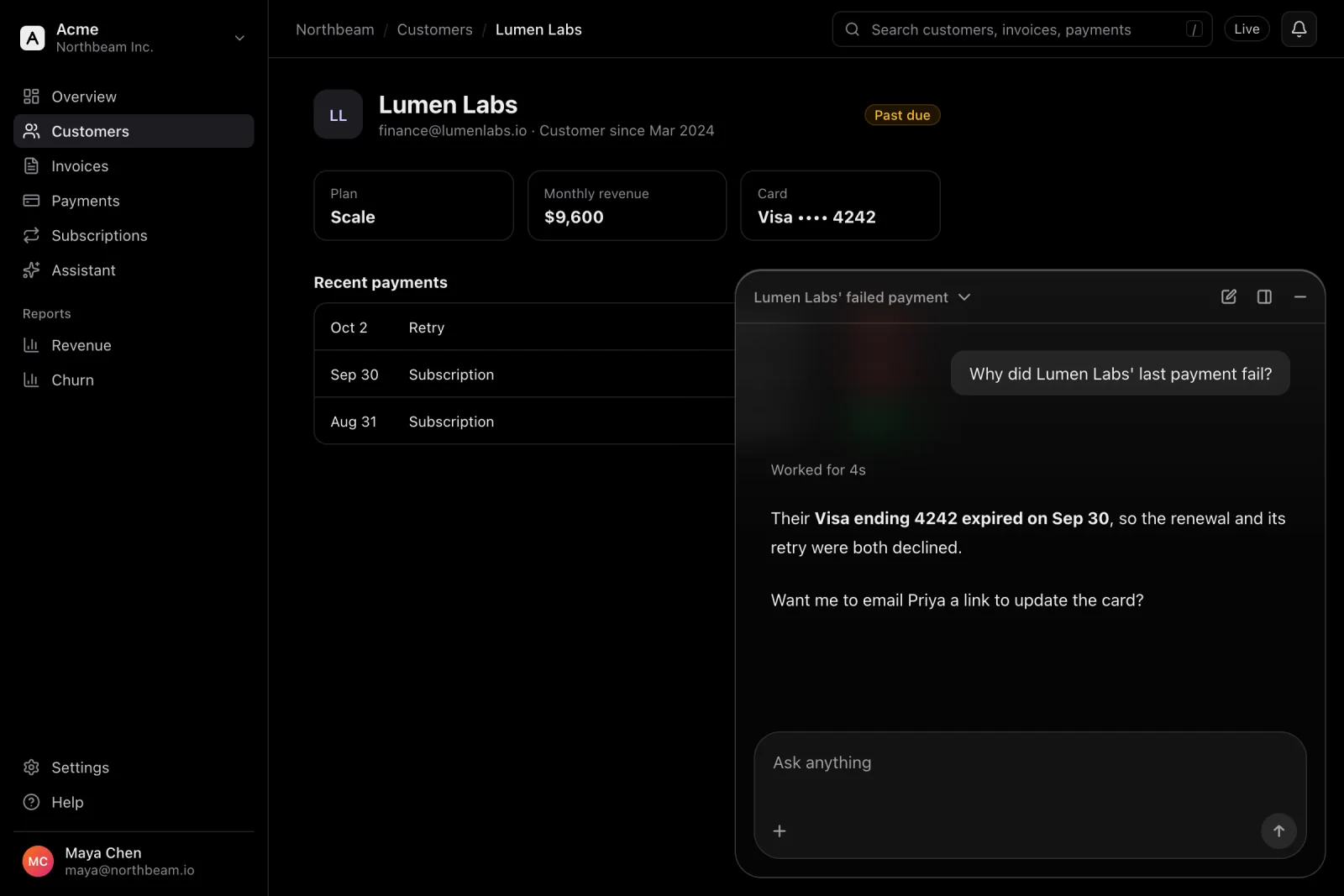
Teaflask puts an AI agent inside a software product that does work for the product's users, not just answers questions. It reads the product's code repository, writes the documentation its agent answers from, scans the API calls the agent may make, and then runs inside the product's own frontend, in the signed-in user's session, under rules the product team sets. A user types "file this hotel invoice for reimbursement"; the agent loads the right skill, opens the form, fills in the fields from the PDF and stops for a yes before anything set to require approval. The company describes it as removing the "interface tax" of menus, forms and help articles.
Teaflask is based in San Francisco and backed by Y Combinator. Its founder, Ragav Sachdeva, holds an AI PhD from the University of Oxford, according to the company's about page, which describes a small team across the USA and Australia. It launched on Product Hunt on November 19, 2026 as "Self-improving AI copilot for your app. No backend changes."
How it works
- Docs from your code. Connect a GitHub repository (or upload API files) and Teaflask drafts the docs the agent answers from. Its provenance engine ties each claim to the code behind it, such as a file and line, and re-verifies when that code changes; a push that contradicts a doc produces a proposed fix for someone to approve.
- Actions from your API. The scan lists API operations (for example
POST /v1/expenses/{id}/submit), and each one is set to Allow, Ask or Deny. New operations arrive switched off. Calls run as the signed-in user, so the product's own permissions still apply. - Agents with skills, memory and sub-agents. An agent combines a prompt, a model, knowledge, granted actions and organisation-wide skills (written playbooks that call actions by name). It can keep memory across conversations, hand long jobs to background sub-agents, use a sandboxed workspace, read and act on the current page, and, since October 30, 2026, call tools from other products' MCP servers.
- Durable runs and a governance queue. Runs survive restarts and can park for days waiting on an approval; held actions sit in a review queue. Teaflask says tenant isolation is enforced in the data layer and that provider keys are never readable.
- Four surfaces, one script tag. The assistant renders as a corner widget, a sidebar, a Cmd+K palette or a full page, through a React component, a web component for any stack, or a headless API for a custom UI.
- Steep. A separate capture package (
@teaflask/steep) records user journeys (pages, clicks, changed fields, requests) with sensitive values redacted in the browser, and a scheduled Learning job reads journeys and assistant conversations to suggest changes.
We unpacked the assistant package
The frontend piece is the npm package @teaflask/assistant, with its source on GitHub. On November 20, 2026 we downloaded the current release with npm pack and read it rather than guessing from the marketing site:
$ npm pack @teaflask/[email protected]
npm notice package size: 315.5 kB
npm notice unpacked size: 1.3 MB
npm notice total files: 739

$ node -p "require('./package/package.json').license"
FSL-1.1-ALv2
peerDependencies:  react ^18.3.0 || ^19.0.0, react-dom ^18.3.0 || ^19.0.0
dependencies:      @ag-ui/client 1.0.5, @ag-ui/core 1.0.5, shiki, react-markdown, zod, rxjs ...
exports:           ".", "./activity", "./headless", "./styles.css"
custom elements:   <teaflask-assistant>, <teaflask-assistant-page>
                   (served from https://app.teaflask.com/assistant/v1/assistant.js)
What we took from it:
- Source-available, not open source. The package uses the Functional Source License 1.1 with an Apache 2.0 future licence: you can read, run and modify it, but not offer a competing product, and each version becomes Apache 2.0 two years after release. The GitHub repository reported no recognised licence to GitHub's API for that reason.
- It speaks AG-UI. The pinned
@ag-ui/clientand@ag-ui/coredependencies mean the widget talks to the agent over the open AG-UI event protocol, the same one CopilotKit uses. - Two install paths. React apps import
TeaflaskAssistantand pass a publishable key; any other stack (Rails, Django, Laravel, WordPress, plain HTML) adds the script tag and a<teaflask-assistant publishable-key="pk_live_…">element, with React bundled inside. The script we fetched was 84 KB. - Pre-1.0 and moving fast. Version 0.11.6 shipped on November 19, 2026, four days after 0.11.5; the README says breaking changes bump the minor version.
Pricing (checked November 20, 2026)
The platform itself is free; the only bill is for the model. There are three ways to pay it, which can be combined and settle in order: a user's own connected ChatGPT subscription first, then your Anthropic or OpenAI API key, then prepaid Teaflask credits charged at list price with no markup. When credits run out, work parks and resumes when funds land.
| Plan | Price | What you get |
|---|---|---|
| Free | $0, not a trial | 1 agent, hosted docs, provenance engine, US data locality, generous global rate limits, community support |
| Enterprise | Custom, annual | Unlimited agents, docs on a custom domain, dedicated rate limits, SAML SSO, SOC 2 Type II, uptime SLA, forward-deployed engineer and deployment strategist, dedicated Slack channel |
Worked example: what a conversation costs
Teaflask's pricing page shows a per-request figure for each model at 50,000 prompt tokens, 80% read from cache and 2,000 output tokens. We recomputed three of them from the published per-million rates and they match:
                    uncached in      cache read        output           per request
Claude Haiku 5.5    10K x $0.10  +   40K x $0.01   +   2K x $0.50   =  $0.0024
Claude Sonnet 5.5   10K x $2.00  +   40K x $0.10   +   2K x $10.00  =  $0.0440
Claude Opus 5.5     10K x $4.00  +   40K x $0.20   +   2K x $20.00  =  $0.0880

Assume 2,000 conversations a month x 6 model requests each = 12,000 requests
  Haiku 5.5   12,000 x $0.0024 = $28.80/month
  Sonnet 5.5  12,000 x $0.0440 = $528/month
  Opus 5.5    12,000 x $0.0880 = $1,056/month
Two caveats. The page's example assumes a warm cache, so cache writes (priced separately) are not in the per-request figure; and the six requests per conversation is our assumption, since a multi-step task with sub-agents can make many more. The model choice moves the bill by a factor of 18, which makes a cheap default model with escalation for hard tasks the obvious pattern. Users who connect their own ChatGPT plan cost you nothing for their conversations.
Teaflask vs the alternatives
| Teaflask | Intercom (Fin) | Pendo | OpenBot | |
|---|---|---|---|---|
| What it is | In-product agent that takes actions through your API | Customer service platform with an AI support agent | Product analytics and in-app guidance | Self-hostable workspace for AI coworkers |
| Where it lives | Inside your app, in the user's session | Messenger and help desk | Inside your app | A separate workspace app |
| Learns from | Your code repository and docs | Help centre content and conversations | Usage data | Connected tools and models |
| Acts on behalf of users | Yes, per-action Allow/Ask/Deny | Through configured workflows | Guides users; does not act for them | Yes, with approvals |
| Pricing basis | Free platform, model at cost | Seats plus per-resolution AI fees | Contract | Free self-hosted, paid business plan |
Who it's for
B2B SaaS teams that want users to complete multi-step tasks (expenses, refunds, configuration, reporting) by asking, without building an agent runtime, approval flow and chat UI themselves; product and engineering teams that want docs which stay correct as the code changes; and companies that already pay for model APIs and do not want a per-seat AI add-on on top.
Limits and trade-offs
- Repository access is the price of entry. The knowledge base and action scan are built from your code, so Teaflask needs a GitHub connection or uploaded API files. Security-sensitive teams will want the trust centre and, for SOC 2 Type II and geo-specific data locality, the Enterprise plan.
- Free means one agent. Multiple agents, custom domains for docs, SSO and an SLA are Enterprise features with custom pricing that is not published.
- Model costs are yours and variable. The platform is free, but a capable model on long agentic runs can cost tens of cents per conversation; budget for the model, not the tool.
- Actions are only as safe as their settings. Teaflask's controls (Allow/Ask/Deny, new actions off by default, tools that can change data always asking on user-connected MCP servers) are good defaults, but someone has to review the action list after every scan.
- Young product. Simulation (replaying saved conversations against a changed workflow) is marked "coming soon", and the frontend package is pre-1.0.
Related on TechLogHub
Value & Audience
Value Proposition
Let users get things done in your product by asking, with an agent grounded in your own code and API that acts as them under rules you control, without building an agent runtime or paying a platform markup.
Problem Solved
Users waste time navigating menus, forms and help articles, while building a safe in-product agent with grounded docs, permissioned API actions, approvals and a chat UI is a large engineering project.
Tech Stack
Social & Links
Loading ratings...
Loading comments...
Gallery
Feedback & Roadmap
Teaflask FAQ
Common questions about Teaflask's features, pricing, and use cases
Is Teaflask free to use?
Teaflask has a free tier plus paid plans, starting at Free - $0 (not a trial) - 1 agent, hosted docs, provenance engine, US data locality; model billed at cost via your API key, credits at 0% markup or users' own ChatGPT plans. Plans listed: Free - $0 (not a trial) - 1 agent, hosted docs, provenance engine, US data locality; model billed at cost via your API key, credits at 0% markup or users' own ChatGPT plans; Enterprise - custom annual - unlimited agents, custom docs domain, dedicated rate limits, SAML SSO, SOC 2 Type II, uptime SLA, FDE, dedicated Slack.
What are some alternatives to Teaflask?
Popular AI Agents & Automation alternatives to Teaflask include NeverApply, Composio and Harness².
Teaflask appears in
You May Also Like

NeverApply
AI job-search agent that matches jobs, tailors your resume, and auto-applies.
View Product
Composio
Composio connects AI assistants and custom agents to more than 1,500 apps through managed authentication, SDKs and an MCP gateway, and its new Instant tools let agents pay per call for search, scraping, audio and data services from one balance.
View Product
Harness²
Harness² is an Apache-2.0 research framework from Google Cloud AI Research that automatically refines an LLM agent's harness (prompts, tools, memory, skills and more) for each task and carries lessons forward to future tasks, without changing model weights.
View Product
Craft Agents
Craft Agents is an open-source (Apache 2.0) desktop app from the makers of Craft Docs for working with AI agents. It connects agents to MCP servers, REST APIs, local files and a built-in browser, with multi-session workspaces, Skills, Automations and Pages.
View ProductOne email a week
TechLogHub tracks 914 tools and 611 open-source projects. Get the week's new launches, release roundups and open-source picks — nothing else.
Get the TechLogHub digest
One email a week: new and trending developer tools, fresh comparisons, and what shipped. Unsubscribe in one click.