
RelayRunner
RelayRunner is an open-source router for GitHub Actions: each job goes to the first free runner in an order you set in a dashboard, from your own Macs and Linux machines to self-hosted runners, hosted providers and GitHub-hosted, with minute caps, MCP and no workflow edits after setup. Free during early access.
About RelayRunner
What RelayRunner is
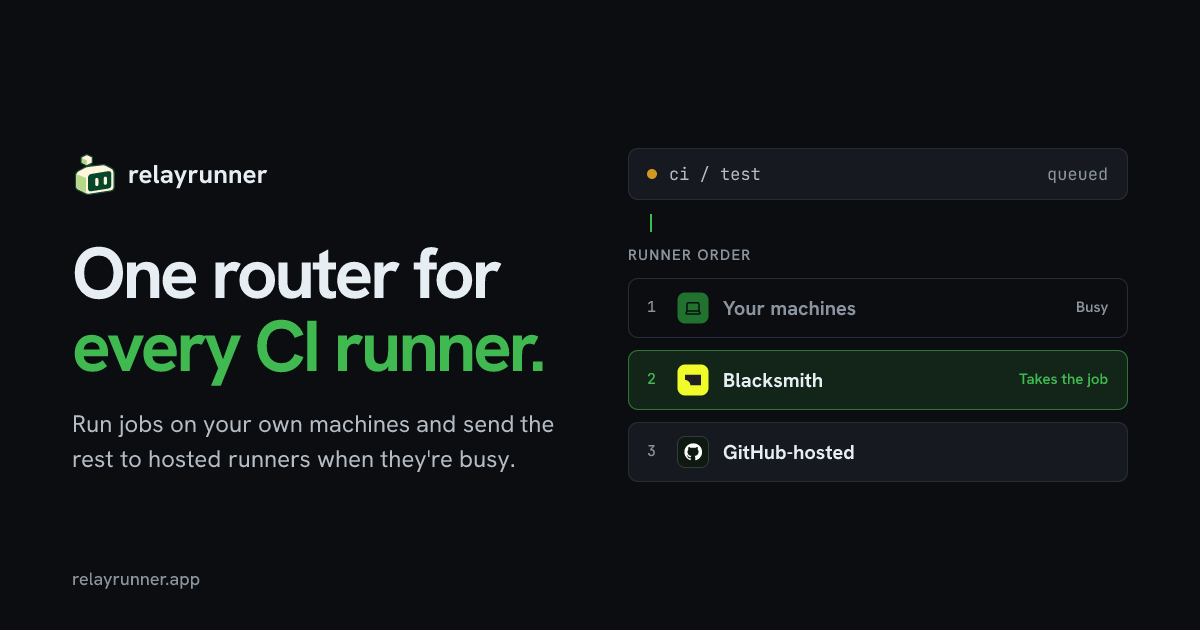
RelayRunner is an open-source router for GitHub Actions jobs. Instead of hard-coding a runner label such as ubuntu-latest in every workflow, you put your runners in an order in a dashboard, and each job goes to the first runner in that order that can take it right now: one of your own Macs or Linux machines if it is online and free, a self-hosted runner your organization already has, a hosted runner provider such as Blacksmith or Depot, or GitHub's own hosted runners. Changing the order happens in the dashboard and applies to the next job, without a commit or a pull request. The project describes its audience as small teams and individuals who do not want to pay for every push, and any team whose CI usage spikes, for example when coding agents and teammates push all day. It launched on Product Hunt on November 25, 2026 with the tagline "Swap between CI runners on-demand with zero code changes."
The code is on GitHub at relayrunner/relayrunner under the Apache License 2.0. The repository was created on November 3, 2026, so this is a very young project. Its terms of service describe it as "an open source project run by its maintainers, not a company", and say the hosted service (the dashboard at app.relayrunner.dev, its API and webhooks) is free during early access, with a promise to tell users before anything is billed if that ever changes.
How it works
- A GitHub App and a workspace. You install the RelayRunner GitHub App on an organization or a personal account. Each installation becomes a workspace, and everyone who can see the install on GitHub is a member.
- A relay job in front of each routed job. A routed job gets a small companion job that calls the reusable workflow
relayrunner/actions/.github/workflows/relay.yml@v1. The relay asks RelayRunner where the job should run and returns a runner label; the real job then setsruns-onto that answer. The project says the relay answers in about a second and bills no minutes, and that if no runner fits, the job fails at once with the reason instead of sitting in a queue. - Your own machines.
npx relayrunner connectturns a laptop, Mac mini or home server into a runner for as long as the command runs; Ctrl-C takes it offline and the next job falls through to the next runner in the order. With automatic retries on, a job cut off mid-run starts again on the next free runner. On Apple silicon Macs there is also a menu bar app (macOS 14 or newer, installable with Homebrew) that does the same thing with a switch. - Isolation on Macs. On an Apple silicon Mac with Apple's container tool, each Linux job runs in its own throwaway Linux VM that sees none of your files, starts clean and cannot reach your Mac or local network by default. On Linux and Intel Macs, or with
--no-isolatedor--macos, jobs run directly on the machine as your user, like any self-hosted runner. - Hosted providers. The site lists Blacksmith, Depot, Namespace, WarpBuild, Ubicloud, Boat, RunsOn, StarSling, Monk CI, Runloft, Latchkey, BerryBox, Celesto, InstaBox, Lizard, Groundbox, GitHub and Cloudflare as steps you can add to the order. RelayRunner does not sell compute itself; you bring your own account with each provider.
- Spend controls. A GitHub-hosted step can be capped at a share of your plan's included minutes (the docs suggest 80%) or at a monthly overage amount; past the cap, jobs go to the next step. Most hosted provider steps can also have a monthly spend cap.
- Optimized checks. Pull request title checks and lint (oxlint, ruff, actionlint and others) can run on
runs-on: relayrunnerwith no runner at all, so they bill no GitHub minutes. Lint runs in RelayRunner's own sandbox without internet access and is in limited preview. - Visibility. The dashboard has Runners, Router, History (with the failing step and whether a re-run is likely to help), Performance (job times per runner) and Signals (flaky jobs, long waits). Each workflow run can be exported as an OpenTelemetry trace to Honeycomb, Grafana, Axiom or your own collector.
- Agents. A remote MCP server at
agents.relayrunner.app/mcpexposes 14 read tools (runners, runs, failures, usage, job times, signals and more) and, once you turn on "Allow changes" per workspace, 7 tools that change the runner order, job sizes, retries, AI features and pause state. There are also installable agent skills (npx skills add relayrunner/relayrunner).
What we checked: the CLI on a sample repository
On November 26, 2026 we installed the published CLI, [email protected], in a Linux x64 sandbox and ran it against a throwaway git repository we wrote ourselves, with three CI jobs and one deploy job. We did not sign in, connect a machine or push anything; init works offline on the workflow files.
$ npm i [email protected]
# npm wrapper: 4 files, 29.8 KB; binary from @relayrunner/cli-linux-x64: static Rust ELF, 3.0 MB
$ relayrunner --version
0.21.0
$ relayrunner whoami
Not signed in. Run `relayrunner login` or `relayrunner connect` to sign in.

$ relayrunner init --plan
/tmp/claude-0/rr/sample (no GitHub remote named origin)

Ready to route
  ci.yml › test: any Router runner with Linux (was ubuntu-latest)
  ci.yml › build-mac: any Router runner with macOS (was macos-14)
  ci.yml › big: any Router runner with Linux (was ubuntu-latest-8-cores)

Skipped
  deploy.yml › deploy: looks like a deploy job (environment)

$ relayrunner init --apply test
Updated .github/workflows/ci.yml (test)
Commit and push to start routing.

$ git diff
+  relay-test:
+    uses: relayrunner/actions/.github/workflows/relay.yml@v1
+    with:
+      os: linux
+
   test:
-    runs-on: ubuntu-latest
+    needs: relay-test
+    runs-on: ${{ needs.relay-test.outputs.runner }}

$ curl -X POST https://agents.relayrunner.app/mcp   # MCP initialize, no token
HTTP/2 401  www-authenticate: Bearer resource_metadata=".../.well-known/oauth-protected-resource/mcp", scope="workspace:read"
What this shows. First, the safety default is real: init refused to route our job that used a GitHub environment and production secret, which matches the security page's advice to keep deploy jobs, which carry production secrets, off personal machines (you can override it with --allow-deploy). Second, init edits only the workflow file and does not commit, exactly as the help text says. Third, in version 0.21.0 the generated relay passes the job's shape (os: linux) rather than the old label; the README's older example shows machine: and github: inputs instead, and the CLI's --exact flag keeps a job's label under its provider. That change lines up with the November 25 changelog entry "Route jobs by os, arch and cpus". Note that our 8-core job was reported as plain "Linux", so if a job needs a bigger box you should set its size in the dashboard or use --exact. Fourth, the npm package is only a launcher: the actual CLI is a 3 MB static Rust binary pulled in as a per-platform optional dependency, published from GitHub Actions with npm provenance. Finally, the MCP server answered an unauthenticated request with a standard OAuth challenge advertising only the workspace:read scope; the docs say write tools appear only after you switch on "Allow changes" for an agent.
Pricing and project facts (checked November 26, 2026)
| Item | What we found |
|---|---|
| Hosted dashboard, API, MCP | Free during early access (terms dated November 9, 2026) |
| Code | Apache-2.0, github.com/relayrunner/relayrunner; you can run it yourself |
| CLI | npm relayrunner 0.21.0, Node.js 22+, macOS and Linux on x64 or arm64 |
| Mac app | Apple silicon, macOS 14+; Homebrew cask relayrunner/tap/relayrunner |
| Runner costs | Billed by GitHub or by each hosted provider on your own account; your own machines cost nothing extra |
| Repository | Created November 3, 2026; 11 stars and 2 forks when we checked |
A worked example of where the savings come from. GitHub bills each job rounded up to a whole minute, so a 15-second PR-title check costs a full minute. A team with 40 pull request updates a day and two such short checks per update pays for about 80 billed minutes a day, or roughly 1,760 minutes over 22 working days, for work that took a fraction of that. RelayRunner's optimized checks would bill none of those, and its docs add that macOS minutes cost about ten times Linux minutes, which is why it suggests running macOS jobs on a Mac you already own first. Your actual saving depends on your GitHub plan and how many jobs you route.
RelayRunner vs the alternatives
| RelayRunner | Codemany | Currents | Macswarm | |
|---|---|---|---|---|
| What it does | Routes each GitHub Actions job across your machines, self-hosted runners, hosted providers and GitHub-hosted | Turns your own Macs and Linux machines into single-use self-hosted runners | Records Playwright/Cypress runs in CI, detects flaky tests and orchestrates specs | Hosted Macs with Xcode for AI coding agents |
| Falls back to hosted runners | Yes, by runner order and minute/spend caps | No, jobs target your machines | Not a runner product | Not a CI router |
| Licence | Open source (Apache-2.0) | Commercial | Commercial | Commercial |
| Price | Free during early access | $20/month for 2 machines | From $49/month | Free tier; $99/month plan |
If you only want your own hardware to run CI, Codemany is the closer like-for-like product and has a paid vendor behind it. RelayRunner's difference is the ordering layer: it treats your machines as the first choice and hosted runners as the safety net, and lets you change that balance without editing workflows. If your CI pain is flaky end-to-end tests rather than runner cost, Currents solves a different problem and can sit alongside it. Teams that run many agent-driven pushes may also want to look at Talyn, which runs coding agents in cloud sandboxes and fixes failing CI.
Limits and trade-offs
- A routing service sits in your CI path. Every routed job first asks RelayRunner where to go. The terms say plainly that the service may change, go away or fail to route a job, and recommend keeping a GitHub-hosted fallback in your relay jobs. The November 25 changelog added retries through GitHub outages, which shows the team is working on this, but you are trusting a three-week-old hosted service.
- Jobs on your own machine are not sandboxed outside Apple silicon. On Linux, Intel Macs and macOS jobs, a routed job can read and write whatever your user can, including your home folder. The docs advise routing only trusted repositories, running
connectas a separate user on shared machines, and keeping deploy jobs off personal machines. - Private repositories only for your machines. Machines never take jobs from public repositories, by design, so open-source projects can only use RelayRunner to choose between hosted providers.
- No Windows. The CLI runs on macOS and Linux only.
- The GitHub App reads some logs. The App cannot read your code apart from
relayrunner.ymland never receives secrets, but it reads a failed job's log to explain the failure (and, if you enable it, to forward logs to your endpoint or bucket). The separate RelayRunner Checks App, needed for lint from repo config, can read code. - Early-access pricing. Free today, with no announced price; budget for the possibility of a paid hosted tier later, or plan to self-host the Apache-2.0 code.
- Docs still catching up. The README describes the MCP server as read-only while the MCP reference documents write tools behind "Allow changes", and the README's relay example uses older inputs than the 0.21.0 CLI writes.
Who it is for
Small teams and solo developers on private GitHub repositories who are running out of included Actions minutes or paying for macOS minutes, teams whose CI load spikes when coding agents push often, and platform engineers who want to try hosted runner providers on real workflows and compare them without rewriting runs-on lines across every repository.
Value & Audience
Value Proposition
Lets teams run CI on machines they already own first and fall back to hosted runners automatically, changing where jobs run from a dashboard instead of editing workflow files.
Problem Solved
GitHub Actions jobs are pinned to one runner label, so teams pay for hosted minutes (and macOS minutes) even when their own machines are idle, and switching providers means editing every workflow.
Use Cases
Tech Stack
Social & Links
Loading ratings...
Loading comments...
Gallery
Feedback & Roadmap
RelayRunner FAQ
Common questions about RelayRunner's features, pricing, and use cases
Is RelayRunner free to use?
Yes. RelayRunner is open source and free to use.
What are some alternatives to RelayRunner?
Popular Cloud & DevOps alternatives to RelayRunner include Deadhand, Sentry and Ohuriya AI.
RelayRunner appears in
You May Also Like

Deadhand
A unified monitoring tool for cron jobs, website uptime, and SSL/domain expiry with flat pricing.
View Product
Sentry
Application performance monitoring and error tracking for developers.
View ProductOhuriya AI
The safest way for non-DevOps founders to manage a server using plain English commands with mandatory human approval for every step.
View ProductVercel
Deploy and scale web applications instantly with AI-powered infrastructure.
View ProductOne email a week
TechLogHub tracks 966 tools and 626 open-source projects. Get the week's new launches, release roundups and open-source picks — nothing else.
Get the TechLogHub digest
One email a week: new and trending developer tools, fresh comparisons, and what shipped. Unsubscribe in one click.