
Rakazo
Rakazo is an Apache-2.0 app for persistent AI bots, each with its own chat, memory, routines, approval rules and a sandboxed browser and shell, that you self-host for free with any model or run on Rakazo Cloud from $15 a month.
About Rakazo
What Rakazo is
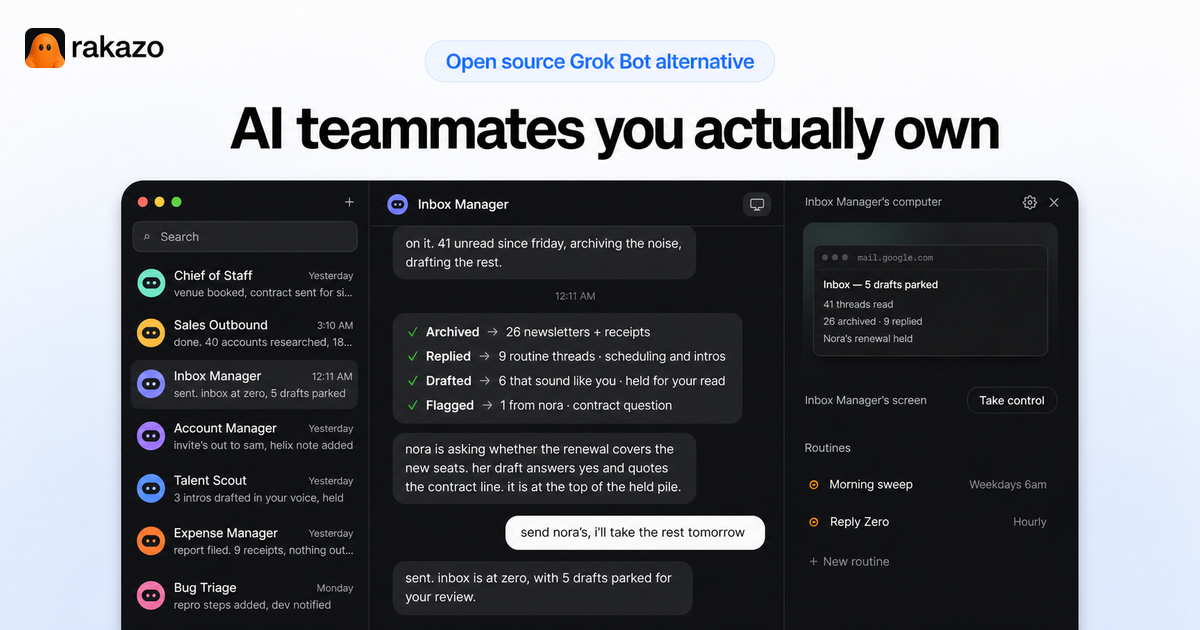
Rakazo is an open-source app for running persistent AI "bots": long-lived teammates that each have one continuous chat, their own instructions and memory, a schedule, and a computer (a sandboxed browser and shell) to work on. You give a bot a job, such as sorting your inbox, researching sales prospects, reproducing bug reports or matching receipts to payments, and check in on it from the web, desktop or mobile app, from Slack or Microsoft Teams, or by text message. Rakazo describes itself as an open-source alternative to xAI's Grok Bot. The code is Apache-2.0 licensed and lives at elie222/rakazo on GitHub; the company behind it is Inbox Zero Inc., the maker of the open-source Inbox Zero email assistant, and its founder Elie Steinbock is listed as the maker on the November 15, 2026 Product Hunt launch, where Rakazo finished first for the day.
The key design choice is ownership. Rakazo is the chat and the computer; it does not supply the model. You connect your own provider key (OpenAI, Anthropic, Google, OpenRouter, Vercel AI Gateway), sign in with an eligible ChatGPT plan, or point a bot at a local OpenAI-compatible server such as Ollama, LM Studio, llama.cpp or MLX. Each bot can use a different model. When you self-host, Postgres, bot files, browser profiles and the audit log stay on the machine you run.
How it works
A bot is a teammate with a job description. The homepage ships templates for common roles (Sales Outbound, Inbox Manager, Talent Scout, Expense Manager, Coding Agent, Account Manager, Paid Media, Chief of Staff), which you then edit. Each bot gets:
- A computer. A sandbox where it can browse, run code and edit files. Self-hosters get local Docker computers by default (capped at 2 GB of memory and 2 CPU cores per bot unless you change
RAKAZO_COMPUTER_MEMORYandRAKAZO_COMPUTER_CPUS), or can use remote sandbox providers; the pricing page lists 13 options including Kubernetes, Incus, Daytona, E2B, Railway and Apple container. Since v0.11.0 the macOS desktop app on Apple silicon (macOS 26+) can run each bot computer as its own small VM without Docker, with a firewall that blocks the Mac and the local network. - Routines. Work that wakes on a schedule, a webhook, a GitHub event, an email, or a change at a public HTTPS address it watches. Routines are stored as readable Markdown, so you can edit what a bot does without prompt archaeology.
- Memory and skills. Bots keep what they learn and can share it with other bots. You can show a bot a task once on its computer and it saves the steps as a skill.
- Integrations. Gmail, GitHub, Notion and others, plus any MCP server. Self-hosters can also enable local stdio MCP servers behind an allow-list of commands.
- Approvals. You decide which actions need your sign-off; a bot pauses and asks (in the app, in chat, or by calling you) before crossing a boundary. Enterprise deployments add allow and block rules per space and spend caps per bot.
- Delegation. Bots can hand work to each other and work in groups, and a "Chief of Staff" template coordinates the rest.
Self-hosted vs Rakazo Cloud
Self-hosting is free and has every feature. The published Docker images need Docker Engine 26 or newer with the Compose plugin, curl and OpenSSL; a source checkout needs Node.js 24.15+ (or 26+, not 25.x), pnpm 12 and Docker. The production Compose file sizes Postgres for an 8 GB host, and you need a GPU only for local models. Some features are self-host only for now: Telegram, WhatsApp, iMessage/SMS (via Sendblue) and Feishu/Lark messaging, image and video generation through fal, purchases through Stripe Link (each waiting for approval), Cursor cloud agents, and local models and local MCP servers. Using a Claude Pro or Max subscription is also a self-host path: the FAQ says to run Rakazo from a source checkout through the official Claude Code CLI signed in with your own account.
Rakazo Cloud (app.rakazo.com, in beta) hosts the app and a bot computer for you. Its computer allowance counts only while a bot is actually using its computer, which pauses when idle, and the FAQ says there are no overage charges.
Pricing (checked November 16, 2026)
| Plan | Price | Bot computer | Model |
|---|---|---|---|
| Self-hosted | Free (Apache-2.0) | Your machine, Docker, or any of 13 sandbox providers | Any model you connect |
| Standard | $15/mo ($12/mo billed yearly) | 25 hours/month, 4 vCPU, 8 GB RAM | Your Claude, ChatGPT or API key |
| Pro | $49/mo | 100 hours/month, 8 vCPU, 16 GB RAM | Your own |
| Max | $99/mo | 200 hours/month, 16 vCPU, 32 GB RAM | Your own |
| Rakazo credits | From $20/mo | From 20 hours/month ($30 includes 30) | Rakazo's catalog at provider price, no markup |
Hosted plans have a 7-day free trial that includes 10 bot-computer hours, and the site offers EU hosting. The Enterprise page adds OpenID Connect SSO (Okta, Entra ID, Google Workspace), SCIM 2.0 provisioning, an exportable audit log you can forward to a SIEM, per-space encryption at rest with a master key in AWS KMS, isolated "spaces" per team or client, and Kubernetes deployment with one pod per bot computer; it is self-hosted with no seat fee and pricing is by conversation.
We checked the project: what the repository shows
On November 16, 2026 we queried GitHub's public API for elie222/rakazo and its releases. This is what came back:
GET https://api.github.com/repos/elie222/rakazo
created_at:   2026-08-13
pushed_at:    2026-11-16T10:51Z
stars:        8,759    forks: 1,570    open issues + PRs: 226
license:      Apache-2.0
languages:    TypeScript (~41 MB), Python, JavaScript, Shell, Astro,
              CSS, Kotlin, PLpgSQL, Swift, HTML, Dockerfile, C, Ruby

GET .../releases?per_page=3
v0.11.0  2026-11-12
v0.10.0  2026-11-11
v0.9.0   2026-11-10
Three takeaways. The project is three months old but already large and busy: three minor releases in three days, and the homepage feed showed five merged pull requests dated November 16 alone. The language mix confirms the shape described on the site: a TypeScript server and web app, Postgres (PLpgSQL), and native Kotlin and Swift mobile apps. And the pre-1.0 version numbers are a fair warning: expect breaking changes and read the release notes before upgrading a self-hosted install (v0.11.0, for example, changed how webhook and email routines follow your approval mode).
Rakazo vs other self-hosted agents
| Rakazo | Nod (n8n) | goose | OpenHands Agent Canvas | |
|---|---|---|---|---|
| Shape | Persistent team of bots, each with chat, memory, routines and a computer | One personal agent with its own computer for errands | General agent on your machine: desktop app, CLI or API | Self-hosted control center for coding agents |
| Licence | Apache-2.0 | Apache-2.0 | Apache-2.0 | MIT |
| Best at | Recurring operational work across many roles, approvals, audit log | Personal errands across Gmail, Slack, Notion and the web | Hands-on tasks on your own computer | Software engineering tasks and automations |
| Mobile and chat apps | iOS, Android, Slack, Teams, SMS, WhatsApp, Telegram | Web | Desktop and terminal | Web |
If you only want one agent in the chat apps you already use, a lighter gateway such as OpenClaw (see the PaioClaw listing for a hosted setup) may be simpler. Rakazo fits when you want several named bots with schedules, shared memory and an approval trail.
Who it's for
Founders, operators and small teams who want agents doing repeated browser and shell work (inbox triage, outbound research, recruiting review, expense matching, bug reproduction) under rules they control; developers and IT teams who must keep credentials, browser sessions and model choice on their own infrastructure; and companies that need SSO, SCIM and an audit log before an agent can touch real systems.
Limits and trade-offs
- You still pay for (and trust) a model. Self-hosting the agent does not self-host the model. With a hosted provider, prompts and context go to that provider; full privacy needs a local model, a local approval model and the default local Docker computer.
- Feature split between Cloud and self-host. Messaging apps beyond Slack and Teams, media generation, Stripe Link purchases and local models are self-host only for now, and the Claude-subscription route needs a source checkout.
- Agents with a browser and a shell can do real damage. The approval system helps, but the release notes warn that text in a webhook or email can try to steer a bot, and anything on your Always allow list will run on it. Keep that list short for routines fed by outside input.
- Young, fast-moving codebase. Pre-1.0, frequent releases; plan for upgrade testing on a self-hosted install.
- Testimonials are self-reported. Usage quotes on the homepage come from the vendor's own site; we did not verify them.
Related on TechLogHub
- What is an AI agent? and Model Context Protocol (MCP), which Rakazo uses for integrations.
- What is Docker? and the Docker cheat sheet for running the self-hosted images.
- Webhooks, one of the triggers that wakes a routine, and the cron expression generator for planning schedules.
- n8n vs Zapier vs Make if your "agent" is really a workflow.
Value & Audience
Value Proposition
Long-running AI teammates for repeated browser and shell work, with your own model, keys and infrastructure, readable Markdown routines, approvals and an audit log.
Problem Solved
Hosted personal agents keep credentials, browser sessions and model choice on the vendor's side and are hard to audit; one-off chat prompts don't turn into dependable, scheduled work.
Tech Stack
Social & Links
Loading ratings...
Loading comments...
Gallery
Feedback & Roadmap
Rakazo FAQ
Common questions about Rakazo's features, pricing, and use cases
Is Rakazo free to use?
Yes. Rakazo is open source and free to use.
What are some alternatives to Rakazo?
Popular AI Agents & Automation alternatives to Rakazo include NeverApply, Composio and Harness².
Rakazo appears in
You May Also Like

NeverApply
AI job-search agent that matches jobs, tailors your resume, and auto-applies.
View Product
Composio
Composio connects AI assistants and custom agents to more than 1,500 apps through managed authentication, SDKs and an MCP gateway, and its new Instant tools let agents pay per call for search, scraping, audio and data services from one balance.
View Product
Harness²
Harness² is an Apache-2.0 research framework from Google Cloud AI Research that automatically refines an LLM agent's harness (prompts, tools, memory, skills and more) for each task and carries lessons forward to future tasks, without changing model weights.
View Product
Craft Agents
Craft Agents is an open-source (Apache 2.0) desktop app from the makers of Craft Docs for working with AI agents. It connects agents to MCP servers, REST APIs, local files and a built-in browser, with multi-session workspaces, Skills, Automations and Pages.
View ProductOne email a week
TechLogHub tracks 874 tools and 599 open-source projects. Get the week's new launches, release roundups and open-source picks — nothing else.
Get the TechLogHub digest
One email a week: new and trending developer tools, fresh comparisons, and what shipped. Unsubscribe in one click.