
Dippr
Dippr gives coding agents like Claude Code and Codex a governed data layer: it federates Snowflake, BigQuery, Postgres and other sources in place on managed Trino, adds certified metrics, row filters and column masks, exposes it all over MCP, and hosts the apps agents build. Free Community plan; Team $150/month plus credits.
About Dippr
What Dippr is
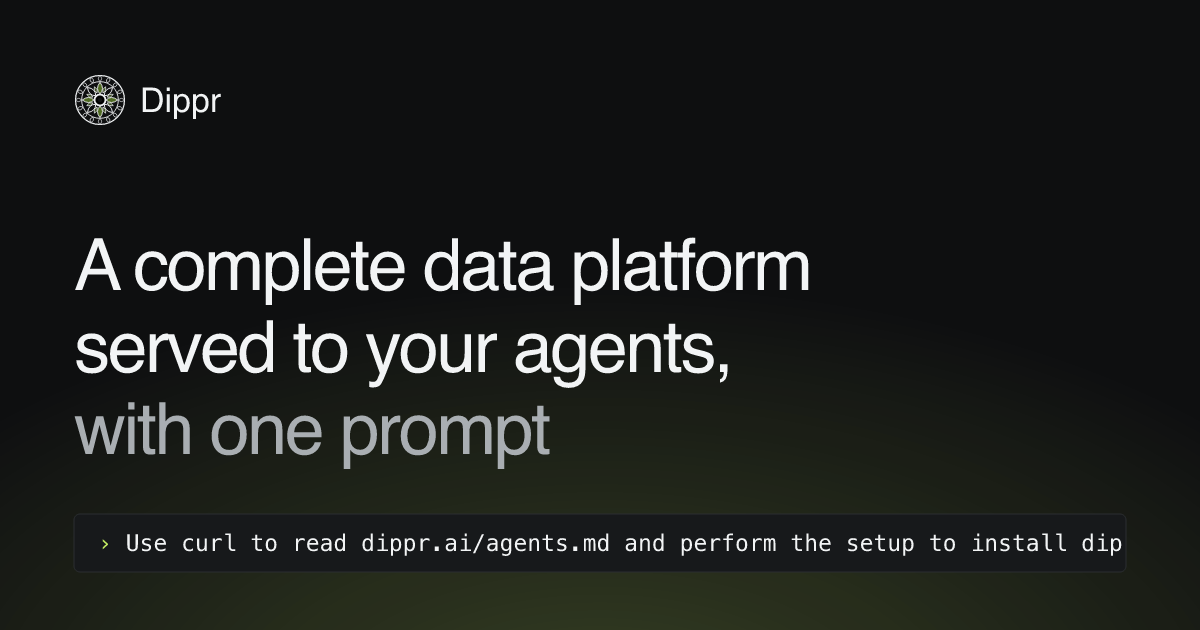
Dippr is a data platform built for AI coding agents. Claude Code, Codex or Cursor can already write a portal, an internal tool or a data app; what they lack is the company's data and the rules around it. Dippr supplies that layer. It connects to the sources a company already has, gives agents the data team's agreed definitions, enforces who may see what inside the query engine, and then hosts the app the agent builds on a shareable link, running on live data. Setup starts with one prompt pasted into a coding agent.
Dippr is provided by Altimate Inc., according to its terms of service and privacy policy, and its community runs in Altimate's agentic data engineering Slack. The company is explicit about what Dippr is not: not a BI tool, not a coding agent, not an app builder, not a warehouse, and not a replacement for the data team. It launched on Product Hunt on November 18, 2026.
How it works
- Connect. Each source is connected once and queried in place: Snowflake, BigQuery, Redshift, PostgreSQL, ClickHouse, Google Sheets, Iceberg REST catalogs, DuckDB files in your own object storage, Jira Cloud and more. Dippr says it does not keep a copy of your data. Under the hood each connected source becomes a catalog on a managed Trino cluster, so one SQL query can join across sources.
- Context. A semantic layer holds governed models and certified metrics ("active customer", "revenue"), natural-language questions paired with verified SQL, and an ontology of business concepts, so every agent means the same thing by the same word.
- Rules. Built-in roles (
viewer,analyst,data_engineer,data_admin,account_admin), custom roles, row filters, column masks and read-only access are enforced in the query engine, so a person, an agent and an app each see only what they are allowed to. Engine tokens last 15 minutes; apps and the MCP server hold no warehouse password. Every action is logged. - Agents connect over MCP. Each data plane exposes an MCP endpoint for browsing data, running SQL, searching metadata and using certified metrics, signed in with OAuth as the person, or with a scoped
alt_API key for a service user. - Build and run. The agent writes the frontend and backend with the
dipCLI; Dippr hosts the result as a data app whose link queries with each viewer's own access. Viewers and apps are free on every plan. - Control plane and data plane. Dippr runs the control plane (identity and permissions). The data plane, which holds engines, apps and query results, is operated by Dippr by default or can run in your own cloud account (see the limits below).
We read the installer before running anything
Dippr's setup is a prompt that tells your coding agent to read dippr.ai/agents.md and install the dip CLI. Piping a vendor script into a shell deserves a look first, so on November 19, 2026 we read the pieces instead of running them. The workspace config that the instructions tell agents to read names the current release:
$ curl -s https://app.us.dippr.ai/config.js
window.__APP_CONFIG__ = { appDomain: "us.dippr.ai",
  downloadsBaseUrl: "https://downloads.dippr.ai",
  dipVersion: "v0.25.2", dipPinnedVersion: "", ... };

$ curl -fsSL https://altimate-adp-downloads.s3.us-west-2.amazonaws.com/latest/install.sh | head
#!/bin/sh
# dip installer for macOS and Linux.
# WHAT IT DOES. Detects your OS/arch, downloads the matching `dip` binary plus the release's
# checksums.txt, verifies the SHA-256, installs the binary to ~/.local/bin (never with sudo) ...
What we took from it:
- No root, checksum verified. The 12 KB POSIX installer downloads the binary with its
checksums.txt, checks SHA-256, installs to~/.local/binwithout sudo, and appends that directory to your shell's rc file once. Windows gets a PowerShell equivalent. - Versions can be pinned. An empty
dipPinnedVersionmeans the workspace follows the stable channel (v0.25.2 that day); an admin can pin a release and the installer then fetchesreleases/<tag>/. - Agent guardrails are anticipated.
agents.mdtells agents not to work around a refused install (it names Claude Code's auto-mode classifier) and instead show the person one line to approve. It also tells agents never to ask for passwords, tokens or API keys in chat. - Chat-only assistants take another path. If the agent cannot run commands on your computer (claude.ai, Claude Desktop chat, a container that resets), you add the workspace's MCP address as a custom connector instead; building and publishing apps still needs
dipon a real machine.
Pricing (checked November 19, 2026)
| Plan | Platform fee | Included |
|---|---|---|
| Community | $0 | 20 credits a month, 3 builders, xs engines only |
| Team | $150/month | 250 credits a month, 5 builders, roles, row policies and column masks; engine sizes xs, s, m |
| Enterprise | From $6,000/year | Annual credit commit, SSO and SCIM, security review, SLA, all sizes up to xl and custom, private networking |
One credit is $0.40 of engine time, billed per second. An xs engine (1 worker, 1 GB query memory) costs 1.5 credits an hour. In your own cloud the rate is half, plus your AWS bill. There are no per-person charges.
Worked example: what an engine costs in a month
Only the xs rate is published, so we sized that. Engine time is what consumes credits, and an idle engine suspends to zero (the docs warn that the first query after a suspend takes tens of seconds to wake it):
xs engine          = 1.5 credits/hour x $0.40 = $0.60/hour
Community 20 cr    = 20 / 1.5   = about 13 engine-hours a month
Team 250 cr        = 250 / 1.5  = about 167 engine-hours a month

Office hours: 8 h x 22 weekdays = 176 h x 1.5 = 264 credits
  Team: $150 + (264 - 250) x $0.40 = $155.60
Never suspends: 730 h x 1.5 = 1,095 credits
  Team: $150 + (1,095 - 250) x $0.40 = $488.00
The lesson is the idle-suspend setting, not the plan: the same xs engine costs about three times as much when it is set to "Never suspends". The calculation assumes credits beyond the allowance are bought at the same $0.40; larger sizes (s has 2 workers with 8 GB heaps, m has 4) will burn credits faster, but their rates are not on the pricing page.
Dippr vs the alternatives
| Dippr | Supabase | Lovable | Trino (self-run) | |
|---|---|---|---|---|
| What it is | Governed data layer and app hosting for coding agents | Postgres backend with auth, storage and realtime | AI app builder that writes the app for you | Open-source distributed SQL engine |
| Uses your existing warehouse | Yes, federated in place | No, a new Postgres database | Through whatever backend it connects | Yes, via connectors |
| Row filters and column masks | Yes, in the engine (Team and up) | Postgres row-level security | Not its focus | Through access-control plugins you configure |
| Hosts the built app | Yes, on a link with per-viewer access | Backend only | Yes | No |
| Agent access | MCP server with OAuth or scoped keys | Client libraries and APIs | Built-in agent | JDBC and clients |
Dippr effectively packages managed Trino, a semantic layer, policy enforcement and app hosting behind an agent-first CLI. A team with platform engineers could assemble the same pieces; Dippr's pitch is that a coding agent can do it from one prompt.
Who it's for
Data teams that want agents to build on governed, certified data rather than raw table dumps; engineers and analysts who want internal tools, portals and dashboards built by Claude Code or Codex against live warehouse data; and companies whose security review needs per-person access enforced at query time. The site's starter prompts include a cash runway view for finance and an overdue invoices list with drafted reminders.
Limits and trade-offs
- Credits depend on engine discipline. Only the
xshourly rate is published; an engine left awake bills continuously, and applying catalog or size changes restarts it and fails running queries. - Cold starts. A suspended engine wakes on the first query, which the docs say takes tens of seconds.
- Governance features sit on Team. Roles, row policies and column masks are not in the free Community plan, which also caps you at 3 builders and the smallest engine.
- Own-cloud terms are inconsistent. The pricing table lists self-hosting in your own cloud account as self-serve on Community and Team, while the site FAQ calls running in your own cloud an Enterprise option; sovereign clouds and on-premises are Enterprise only. Confirm with Dippr before planning on it.
- App code is trusted. Dippr's own security notes say app code is trusted like a spreadsheet: governance limits what data an app can read, not what its code does with it.
- Young CLI.
dipwas at v0.25.2 on November 19, 2026, and scheduled routines need v0.15.0 or later plus a workspace that exposes the routines tools.
Related on TechLogHub
- Snowflake vs BigQuery vs Databricks, three of the sources Dippr federates.
- Trino, DuckDB and DuckDB vs ClickHouse.
- SQL, the SQL cheat sheet and the SQL formatter.
- MCP, RBAC and OAuth.
- PostgreSQL vs MySQL and Omnigraph, a graph database for AI agents.
Value & Audience
Value Proposition
Let coding agents build internal tools and data apps on live company data, with the data team's definitions and access rules enforced at query time, from a single setup prompt.
Problem Solved
Coding agents can write apps but cannot safely reach a company's warehouses, so teams either copy data into prompts or hand agents broad credentials with no shared definitions or per-person access control.
Tech Stack
Social & Links
Loading ratings...
Loading comments...
Gallery
Feedback & Roadmap
Dippr FAQ
Common questions about Dippr's features, pricing, and use cases
Is Dippr free to use?
Dippr has a free tier plus paid plans, starting at Community - $0 platform fee - 20 credits/month, 3 builders, xs engines; viewers and apps free. Plans listed: Community - $0 platform fee - 20 credits/month, 3 builders, xs engines; viewers and apps free; Team - $150/month - 250 credits/month, 5 builders, roles, row policies, column masks, engines up to m; 1 credit = $0.40 (xs = 1.5 credits/hour); Enterprise - from $6,000/year - annual credit commit, SSO/SCIM, security review, SLA, all engine sizes, private networking.
What are some alternatives to Dippr?
Popular Data & Analytics alternatives to Dippr include Linqry, Exeria Charts and CSV Viewer Online.
Dippr appears in
You May Also Like
Linqry
Privacy-friendly analytics that finds drop-offs in your onboarding, maps user flows, attributes revenue, tracks links and answers questions in plain English.
View ProductExeria Charts
A high-performance open source charting library for building modern financial charts in web apps, dashboards, and trading surfaces.
View Product
CSV Viewer Online
A free online tool to open, search, filter, and edit CSV files directly in your browser without installing Excel.
View Product
AdSiftly
A free Google Ads audit tool that identifies wasted ad spend and provides plain-English fixes for small businesses.
View ProductOne email a week
TechLogHub tracks 903 tools and 611 open-source projects. Get the week's new launches, release roundups and open-source picks — nothing else.
Get the TechLogHub digest
One email a week: new and trending developer tools, fresh comparisons, and what shipped. Unsubscribe in one click.