

Infinite Bookshelf: Generate Entire Books in Seconds with Groq and Llama
Infinite Bookshelf: Generate entire new books in seconds using Groq and Llama
Images speak as loudly as words in a world where ideas sprint from prompt to published content. The Infinite Bookshelf project leans into this reality, offering a streamlined path from a single idea to a full, structured book in moments. At the top of the journey is a bold visual identity: the Infinite Bookshelf logo, a symbol of the promise that knowledge can be assembled, reorganized, and expanded at the speed of your imagination. Here is the story of how this tool works, what it can do, and how you can start using it today.

The project also invites you to peek behind the curtain with a live visual demonstration. A Project Demo image gives a quick teaser of the interface and the experience you’ll encounter when you prompt Infinite Bookshelf to generate chapters, sections, and even code samples.
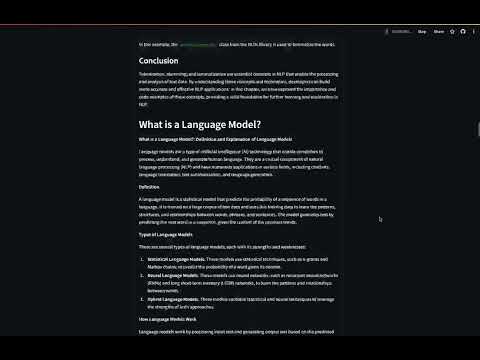
If you’re curious about the result before you dive in, you can check out the hosted demonstration and explore how a one-line prompt blossoms into a complete, navigable manuscript within seconds.
Overview
Infinite Bookshelf is a Streamlit-based application designed to scaffold the creation of books from a single-line prompt, leveraging the power of Llama on Groq Cloud. The core idea is to strike a balance between speed and depth: a larger model helps shape the overall structure of the book, while a smaller model takes the reins to generate chapter content with speed. This arrangement enables rapid iteration and experimentation, making it feasible to produce something coherent and structured in a matter of seconds.
Key points about how it works:
- The system uses a two-model strategy to optimize for both speed and quality. The larger model orchestrates the book’s structure, outlines, and chapter plan; the smaller model fills in the actual writing for each section with content that adheres to the chosen topic and chapter title.
- The generation approach currently relies on the context of section titles to craft the content of each chapter. This keeps the process efficient and controllable, while still delivering meaningful, well-formed text.
- There is an explicit intention to expand beyond the current chapter-level context in future iterations. The long-term goal is to employ fuller book-context awareness, which will enable more sophisticated fictional works, consistent character development, and intricate plot progression across chapters.
- The output you get is markdown-styled, designed to look like a polished book within the Streamlit app. This includes headings, lists, code blocks, and even tables when necessary, all rendered in an aesthetically coherent format. The content can be downloaded as a text file with the entire book’s contents.
This combination of prompt-driven scaffolding, model-aware generation, and a human-friendly formatting layer makes Infinite Bookshelf a compelling tool for learners, educators, developers, and curious thinkers who want to explore the mechanics of large language models while producing readable, usable books.
Visuals and Interface
The project places emphasis on a clean, readable output that resembles a traditional book, while delivering the convenience of a modern AI-assisted authoring workflow. The interface is designed to be approachable for non-technical users but flexible enough to support advanced writers who want to customize prompts, headings, and content pacing.
- The logo serves as a constant reminder of the mission: to empower rapid book creation with AI.
- The live demo and tutorial imagery help prospective users understand what to expect: a structured table of contents, chapter-by-chapter generation, and the ability to tweak prompts to suit different audiences, from novices to experts.
- The visual design embraces markdown rendering so that you can see headings, bolding, lists, and code snippets as they will appear in the final product. This makes the final book feel cohesive, regardless of whether the content was generated by a single prompt or a sequence of iterative refinements.
Features
Infinite Bookshelf offers a practical feature set designed to maximize productivity while preserving quality. Here are the core capabilities you’ll notice when you start using the tool:
- 📖 Scaffolded prompting that strategically balances speed and quality by switching between a smaller and a larger model. This approach accelerates generation while preserving structure and coherence.
- 🖊️ Markdown-based output that creates an aesthetically pleasing book on the Streamlit app. The content can include headings, lists, code blocks, and even tables when relevant, ensuring that the generated material is immediately usable in a clean, publishable format.
- 📂 Downloadable content: you can export the entire book as a text file, making it easy to share, edit offline, or convert into different formats (PDF, ePub, etc.) using your preferred tools.
- 📚 Structured chapters: the system assembles content into chapters with titles, subsections, and logical flow, so readers can navigate the material as they would in a conventional textbook or long-form guide.
- 🎯 Focused context: the current model leverages the section title context to generate coherent content for each chapter, with the aspiration to expand to a richer, book-wide context in the future.
Example applications might include:
- LLM Basics: A concise primer on the fundamentals of large language models, including architecture, training data considerations, and practical prompts.
- Data Structures and Algorithms: A guide or course-nursery for programming concepts with language and examples that suit a target audience, such as Java developers.
Note: the generated books are intended for entertainment and educational exploration and may include inaccuracies or placeholder content. It’s wise to review and refine output for factual accuracy and alignment with your goals.
Quickstart
Getting started with Infinite Bookshelf is designed to be frictionless. You can either use the hosted version or run the app locally with Streamlit. The hosted option offers instant access, while local setup provides a controllable environment for those who want to customize or experiment with different prompts and configurations.
- Hosted on Streamlit: You can try Infinite Bookshelf at the hosted URL infinite.benjamin.sh. This option is ideal for quickly testing prompts and experiencing the generation process without any local installation.
- Run locally: A typical local setup mirrors the hosted experience but gives you full control over dependencies, environment variables, and runtime behavior.
Step-by-step guidance for a local setup (summary):
- Step 1: Set your Groq API key in the environment variables. This step can be skipped if you prefer to provide the key within the app, but setting it early makes for a smoother run:
- export GROQAPIKEY="gsk_yA…"
- Step 2: Create a virtual environment and install the required dependencies:
- python3 -m venv venv
- source venv/bin/activate (for Bash)
- venv\Scripts\activate.bat (for Windows)
- pip3 install -r requirements.txt
- Step 3 (Windows-specific): Some Windows setups may require GTK3 support. If you encounter display issues, you may need the GTK for Windows Runtime Environment:
- https://github.com/tschoonj/GTK-for-Windows-Runtime-Environment-Installer?tab=readme-ov-file
- Step 4: Run the Streamlit app:
- python3 -m streamlit run main.py
Hosted and local options give you flexibility to experiment with different prompts, languages, and audience levels. The Quickstart emphasizes accessibility while preserving the core engineering decisions that enable rapid book generation.
Technologies at the heart of Infinite Bookshelf include:
- Streamlit: A lightweight, interactive front end for rapidly deploying machine learning demos and tools.
- Llama models on Groq Cloud: A split-model approach that optimizes for both speed and quality in generating structured, readable content.
Limitations to keep in mind:
- The system may produce content that is inaccurate or placeholder-like. It is intended for entertainment and exploratory use, and users should review and curate output before publication or distribution.
Details and Design Philosophy
The design philosophy behind Infinite Bookshelf centers on empowering users to transform a single seed prompt into a full, publishable manuscript blueprint. The app’s architecture and workflow are crafted to encourage experimentation with prompts, to observe how small changes in a chapter title or section heading can influence the tone, depth, and structure of the generated material.
Key elements include:
- A pragmatic approach to context: by focusing on section titles, the system can rapidly produce coherent chapters while maintaining a clear mapping from title to content. This makes it straightforward to adjust the book’s outline without reworking the entire draft.
- A two-model collaboration: the larger model provides the scaffolding—outlines, the book’s arc, and chapter structure—while the smaller model fills in the content with detailed writing, examples, or code snippets, depending on the prompt’s intent.
- Lightweight, flexible formatting: the markdown rendering in the Streamlit app makes the output immediately legible and publishable. Writers can export the result as a plain text file and then refine it with other tools as needed.
- Future-proofing through modularity: the plan is to extend the system’s capacity to consider the entire book context rather than individual chapters, enabling more consistent voice, deeper character development (for fiction), and more sophisticated plot progression across chapters.
These design choices position Infinite Bookshelf as a practical playground for exploring how AI-assisted writing can accelerate learning, coding instruction, and creative publishing workflows.
Use Cases and Thought Starters
- Educational learners: Create structured, topic-focused books that break down dense subjects like natural language processing, data structures, or algorithms into digestible chapters with practical code examples and explanations.
- Developers and researchers: Generate technical writing with clear outlines, then iterate on content to align with research findings, experiments, and real-world applications.
- Educators and trainers: Build customizable teaching materials, lab guides, and course notes that can be updated quickly as new concepts emerge.
- Fiction and world-building: As the tool evolves to incorporate fuller book context, it will be capable of producing narrative arcs, character-driven chapters, and consistent world-building across a complete manuscript.
In all these cases, the ability to tailor prompts, adjust the level of detail, and control the pacing of ideas helps users produce material that feels coherent and purposeful, rather than disjointed or randomly assembled.
Contributing and Community
The project encourages improvements through pull requests and community contribution. If you have ideas for enhancing the model orchestration, adding new formatting features, or integrating additional export formats (PDF, ePub, etc.), your input is welcome. Collaborative development can help broaden the tool’s capabilities and ensure it remains useful to a broader audience.
Changelog
Keeping track of updates helps users understand how Infinite Bookshelf evolves and what new capabilities or improvements to expect. Here are two recent entries that illustrate the trajectory of the project:
- v0.2.0 (May 29, 2024): Added new inference statistics to provide visibility into how generation is performing. A demo image reflects the enhanced statistics and performance dashboards.
- Image reference: Demo of New Statistics
- v0.3.0 (June 8, 2024): Introduced the ability to download books as styled PDFs, a step toward publishing-ready formats and distribution-friendly outputs.
- Image reference: Image of New PDF Download Option

Future directions highlighted in the project notes include:
- The ability to title books so the title appears on downloads, making organization and sharing simpler.
- Save-books-to-Google-Drive functionality for streamlined cloud-based storage and collaboration.
- An optional seed content field to input existing notes, enabling users to bootstrap new books from their own knowledge base.
These planned features reflect the project’s emphasis on practicality and seamless integration into everyday workflows for educators, students, researchers, and hobbyists alike.
Why Infinite Bookshelf Matters
In a world where information is abundant but time is scarce, the capacity to assemble structured, coherent text from a single prompt is transformative. Infinite Bookshelf does not pretend to replace human authorship; rather, it accelerates the ideation-to-draft process, enabling writers to explore more prompts, test more ideas, and iterate rapidly. The collaborative potential is clear: you provide the prompt, the outline, and the boundary conditions; the AI provides the first pass of content, structure, and substance. You then refine, curate, and publish—often in less time than it takes to outline a traditional chapter.
The project also demonstrates practical advances in the deployment of AI writing tools at scale. By using a dual-model strategy and a streamlined Streamlit interface, it shows how sophisticated AI capabilities can be packaged into accessible tools that non-experts can use meaningfully. The inclusion of Markdown rendering and export options means the tool’s outputs are immediately usable in educational settings, developer tutorials, and creative projects.
Practical Tips for Getting Excellent Results
- Start with a strong title and a precise, descriptive chapter heading. The more clearly you define the section’s purpose, the better the generated content will align with your expectations.
- Use short prompt prefixes that set the tone, audience level, and disciplinary context. For example, a prompt like “Explain concept X to a beginner with practical Python examples” helps the model generate approachable content.
- Iterate: generate a draft, skim for coherence, adjust titles or prompts, and regenerate. The scaffolded approach intentionally supports quick iteration cycles.
- Don’t rely on AI for final accuracy in technical subjects. Treat the output as a draft that you review, fact-check, and refine as needed.
- Consider exporting and formatting in a word processor or typesetting tool if you plan to publish, to further polish typography, citations, and layout.
Final Thoughts
Infinite Bookshelf embodies a practical synthesis of cutting-edge language modeling with thoughtful UX design. It leverages Groq and Llama to deliver fast, structured content, turning a single-line prompt into a complete, navigable book in seconds. The approach—split responsibilities between larger and smaller models, yield content that is human-readable and ready for editing—has the potential to reshape how people learn, teach, and create.
Whether you are a student seeking a clear text that you can study offline, a developer looking for a rapid way to generate technical tutorials complete with code, or a writer exploring ideas for fiction with a consistent narrative style, Infinite Bookshelf offers a scalable, user-friendly pathway from concept to content.
For ongoing updates, demonstrations, and community involvement, you can explore the hosted experience, contribute via the project’s channels, and watch as the platform continues to evolve toward even richer capabilities—such as full-book context awareness, better control over tone and voice, and expanded export formats.
And as you embark on your own book-building journey, remember that the visuals you see here—from the logo to the demo imagery—are more than decoration. They symbolize a modular, adaptable toolset designed to empower you to transform ideas into readable, compelling books in a fraction of the time. The Infinite Bookshelf is not just a technology demonstration; it’s an invitation to reimagine how knowledge can be authored, organized, and shared in a digital age.
Enjoying this project?
Discover more amazing open-source projects on TechLogHub. We curate the best developer tools and projects.
Repository:https://github.com/Bklieger/infinite-bookshelf
GitHub - Bklieger/infinite-bookshelf: Infinite Bookshelf: Generate Entire Books in Seconds with Groq and Llama
A Streamlit-based application designed to scaffold the creation of books from a single-line prompt, leveraging the power of Llama on Groq Cloud using a two-mode...
github - bklieger/infinite-bookshelf
Maintain Infinite Bookshelf: Generate Entire Books in Seconds with Groq and Llama? Add the badge to your README
Show that the project is featured on TechLogHub and send readers to this write-up.

[](https://techloghub.com/open-source/infinite-bookshelf?utm_source=techloghub_badge&utm_medium=referral&utm_campaign=readme)