

Zod's z.compile(): Where the Speedup Shows Up in Production
Quick answer: Zod 4.5's z.compile() turns a schema into a precompiled validator that benchmarks 3x to 9x faster on objects, arrays and unions. In production, most of the win comes from upgrading Zod 3 to Zod 4 itself: Trigger.dev cut one service's CPU by 31% with the upgrade, then measured only about 5% more from compilation. Turn it on for hot-path schemas on Node or Bun, and skip it where a Content Security Policy blocks new Function.
Zod got fast enough this year that "validation is our bottleneck" stopped being a good excuse for skipping it. That is the real story behind z.compile(). The headline numbers are true, but they are microbenchmarks. Here is what they mean once real traffic arrives, and the upgrade traps worth checking before you chase them.
What z.compile() does
The Zod 4.5 release post (28 August 2026) introduces z.compile(schema), which returns a precompiled version of any schema. The post is explicit that there are no special rules: compiled schemas behave like the originals, "They're just faster."
You can opt in two ways:
- Per schema: wrap the schemas on your hot path with
z.compile(). - Globally: import
zod/compilebefore any module that defines schemas, or runnode --import zod/compile app.js. Bun users can add it as apreloadinbunfig.toml. Schemas defined after that import compile lazily on their first parse.
As InfoQ's coverage (16 October 2026) points out, compilation happens in-process at runtime, not at build time. There is no bundler plugin or codegen step to maintain.
The benchmark numbers, read carefully
Zod's own table compares time per parse for standard and compiled schemas:
| Schema | Standard | Compiled | Speedup |
|---|---|---|---|
| --- | --- | --- | --- |
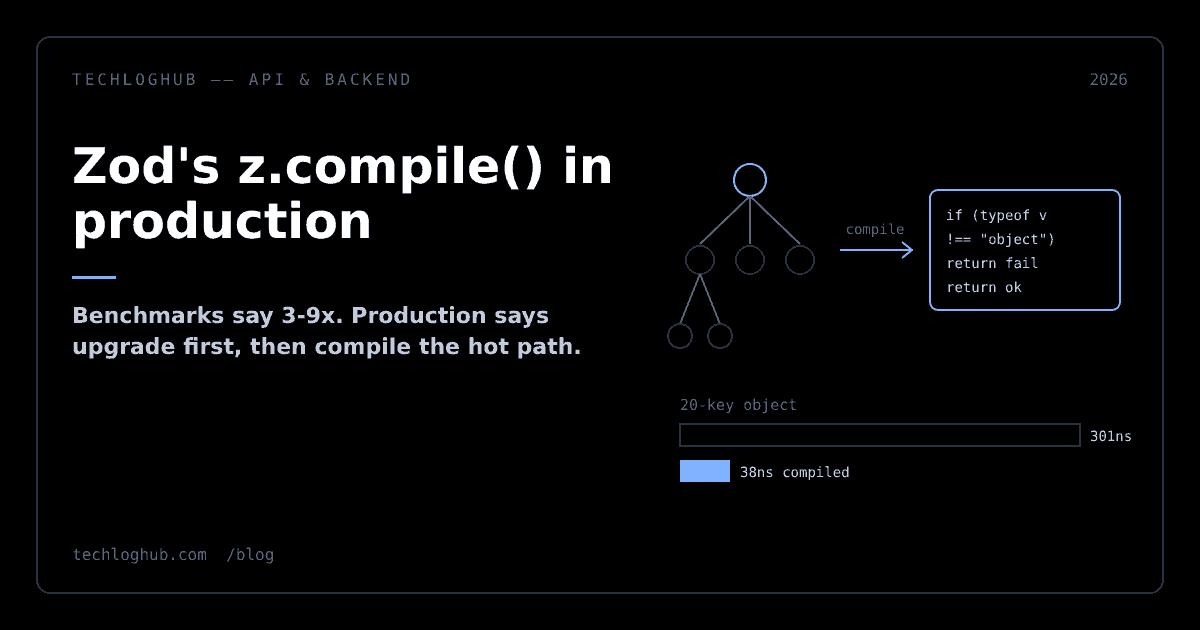
| 20-key object | 301 ns | 38 ns | 7.8x |
| Array of 10 strings | 241 ns | 33 ns | 7.3x |
| Array of 10 objects | 377 ns | 68 ns | 5.5x |
| Union of 3 objects | 190 ns | 36 ns | 5.3x |
| Discriminated union | 92 ns | 27 ns | 3.4x |
| 5-key object | 76 ns | 28 ns | 2.8x |
The pattern is the useful part. The post says objects, arrays, tuples and unions gain the most, while simple scalar validators gain less. On the third-party Moltar benchmark, compiled Zod reached 47.5M safe-parse operations per second against 45.3M for typia, per the release post.
Now notice the units. A 5-key object goes from 76 to 28 nanoseconds. That saves 48 ns per call. At 1,000 parses per second, that is about 48 microseconds of CPU every second. It only matters at very high volume, with very large schemas, or on CPU-billed serverless functions where every millisecond is money.
What production data actually showed
The best public evidence is Trigger.dev's write-up, Zod 4 got rid of a bunch of CPUs for us, by Chris Arderne (2 October 2026). Trigger.dev parses JSON constantly: task payloads, batch items, queue messages and retry wrappers.
Their upgrade from Zod 3.x to Zod 4.5 produced, on 24-hour means indexed to Zod 3:
- Engine worker CPU down 31%, batch worker CPU down 15% and API CPU down 10%.
- Batch throughput up 14% and task-trigger p99 latency down 18%.
Then they tried schema compilation on simple internal schemas such as queue messages and trigger bodies. On a like-for-like day of production telemetry, worker CPU was about 5% lower. The author calls it "nothing huge" and notes that user-defined schemas were not part of the test.
That ordering is the takeaway. If you are still on Zod 3, the upgrade is the big lever and compilation is the topping. Zod 3 is end of life per the library author guide, receiving only security and clear bug fixes, so the upgrade is overdue anyway.
The traps before you flip the switch
Content Security Policy
InfoQ reports that compilation uses new Function, which a strict Content Security Policy can block. That rules out the global import for many browser bundles. Zod's z.withParser() accepts an externally generated parser, but per InfoQ it does not create one for you. Keep compilation on the server unless your CSP allows it.
The 4.5 memory regression
InfoQ also reports a 4.5 regression in which recursive schemas retained parsed data and could cause out-of-memory failures, fixed in Zod 4.6 (9 September 2026). If you adopt compilation, adopt it on 4.6 or later.
Behavior changes hiding in a minor release
The 4.5 post lists changes that can turn passing input into failures:
z.iso.datetime()now requires seconds, so2020-01-01T06:15Zis rejected.- String length counts Unicode code points instead of UTF-16 units, so
.min()and.length()can reject some emoji input that used to pass. - Unrecognized keys no longer abort the rest of a strict object, so you may see more issues per failure.
__proto__is always stripped from parsed objects and records.
Run your fixtures through the new version before deploying. Generating schemas from real payloads with our JSON to Zod converter and diffing them against your hand-written ones is a quick way to find fields your fixtures never exercised. Pretty-print a few production payloads with the JSON formatter first so the diff is readable.
Library authors: get the import path right
Trigger.dev's addendum is the most useful paragraph in their post. After the upgrade, a colleague added a module with a bare zod import to their core package. Users who were still on Zod 3 and installed with npm rather than pnpm hit delayed warm starts, and the team added an oxlint rule to stop it happening again.
The Zod library author guide explains why. A bare "zod" import resolves to Zod 3 under 3.x and Zod 4 under 4.x, so your code changes meaning with your users' installs. The guide recommends "zod/v4/core", described as a permalink that stays available across future majors, and calls depending on "zod/v4" or "zod/v4/mini" in library code "extremely discouraged" because it ties you to Classic or Mini. For supporting both majors it suggests a "^3.25.0 || ^4.0.0" peer range and detecting Zod 4 schemas by their _zod property.
Application code can keep importing from "zod". Libraries should lint for it. If your SDK also ships generated types, our JSON to TypeScript tool helps you check that the inferred types still match after the move.
A practical rollout
1. Upgrade to Zod 4.6 or later and run your test suite. Fix the 4.5 behavior changes first. 2. Measure CPU and p99 latency for a week on the upgrade alone. That is your real baseline. 3. Wrap the three or four hottest schemas with z.compile(), usually request bodies, queue messages and webhook payloads. 4. Compare against the baseline. Expect single-digit percentages unless validation is a large share of your CPU. 5. Only then consider the global zod/compile import, and never in a browser bundle under a strict CSP.
Weighing Zod against other validators? Start with our Zod vs Yup comparison and the API and backend category. If you are also upgrading the compiler underneath, see what TypeScript 7.1 beta changes.
FAQ
What does z.compile() do in Zod?
Added in Zod 4.5, z.compile(schema) returns a precompiled version of a schema that behaves the same but parses faster. Zod's benchmarks show 2.8x to 7.8x speedups, with the biggest gains on objects, arrays and unions.
How do I enable Zod schema compilation globally?
Import zod/compile before any module that defines schemas, or run node --import zod/compile app.js. Bun can load it with a preload entry in bunfig.toml. Schemas then compile on their first parse.
Does z.compile() work in the browser?
It depends on your Content Security Policy. Compilation uses new Function, which a strict CSP can block. In that case keep compilation on the server, or supply an externally generated parser through z.withParser().
How much faster is Zod 4 than Zod 3 in production?
Trigger.dev reported 31% lower CPU on its engine workers, 14% higher batch throughput and 18% lower p99 trigger latency after upgrading from Zod 3 to Zod 4.5. Schema compilation added about 5% lower worker CPU on top.
Which import path should a library use for Zod 4?
Zod's library author guide recommends zod/v4/core, a permalink that stays available across future majors. A bare zod import changes meaning between Zod 3 and Zod 4 installs.
Upgrade first, measure second, compile third. The order is where the savings are.