

Rust Stops Shipping a 32-bit Windows Toolchain in 1.100
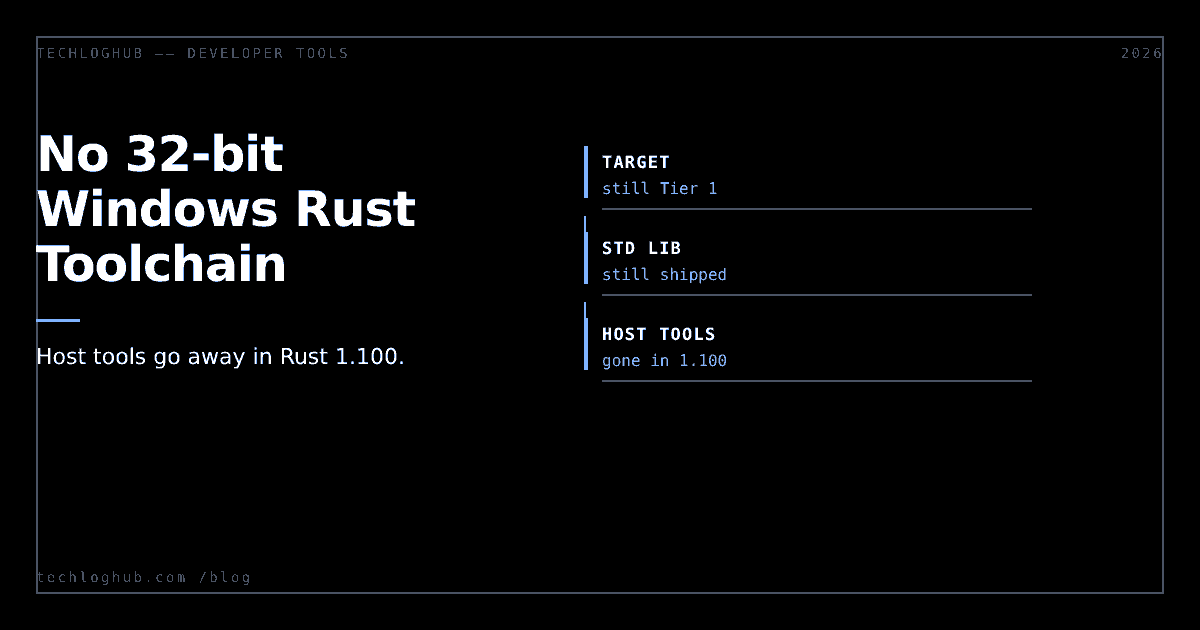
Quick answer: From Rust 1.100.0, due 12 November 2026, you will not be able to install a Rust toolchain on a 32-bit Windows host. You can still build for 32-bit Windows — i686-pc-windows-msvc stays Tier 1 and keeps shipping a standard library. What goes away is running rustc and cargo on that platform.
The easy misreading of this change is "Rust is dropping 32-bit Windows". It is not, and the distinction is the entire story: Rust is dropping 32-bit Windows as a place you run the compiler, not as a thing you compile for.
The Rust project announced it on 2 October 2026, one day after Rust 1.99.0 shipped. If you ship a Windows binary, this probably costs you nothing. If you have a 32-bit Windows machine in a CI fleet or on a factory floor, it is a hard deadline.
What changed, precisely
Two target triples move, and neither moves tier. They lose host tools.
| Target | Before | From 1.100.0 |
|---|---|---|
i686-pc-windows-msvc | Tier 1 with host tools | Tier 1, no host tools |
i686-pc-windows-gnu | Tier 2 with host tools | Tier 2, no host tools |
The announcement defines the consequence in one sentence: "Builds of the standard library will continue to be distributed, but host tools such as the compiler will be no longer available." And the operational version, which is what you should put in a ticket: "After Rust 1.100, it will no longer be possible to install toolchains on 32-bit Windows hosts."
Rust 1.100.0 is scheduled for 12 November 2026, on the project's standard six-week cadence. Rust 1.99.0 landed 1 October 2026 with extern "C" variadics, Vec::into_parts, std::fs::set_times and a handful of other stabilisations — and no mention of the platform change. The two announcements are separate posts on the same blog, one day apart. If you track Rust by reading release notes, you missed this.
What a tier without host tools actually guarantees
Rust's tier system is often read as a single ranking. It is two axes: how strong the guarantee is, and whether the platform can host the toolchain. The platform support page is explicit about both.
Tier 1 targets "can be thought of as 'guaranteed to work'", with official binary releases and automated testing confirming each one builds and passes tests after every change. Adding host tools means the target "additionally support[s] running tools like rustc and cargo natively on the target", with automated testing of the host tools too — which "allows the target to be used as a development platform, not just a compilation target."
Tier 2 is the weaker guarantee — "guaranteed to build" — where official standard library (or sometimes only core) releases are built and automated builds confirm the target can still be used as a build target.
Read against those definitions, the demotion is narrower than it sounds. i686-pc-windows-msvc keeps the strongest guarantee Rust offers. It is still Tier 1, still CI-tested, still gets a prebuilt standard library. Nothing about the quality of the code you produce for 32-bit Windows changes on 12 November. Only the ability to sit at a 32-bit Windows box and run cargo build does.
Why: one reason is about hardware, two are about pain
The announcement gives three justifications, and they are not equally weighted.
First, the demand argument: the post notes that 32-bit x86 CPUs have not been sold for more than fifteen years, and that Windows 32-bit support ended in October 2025. Fair enough — a host platform with no new hardware and no vendor support is not a development platform anyone should be choosing in 2026.
The other two are maintenance pain, and they are the honest reason. Building i686 toolchains produced compiler binaries that crash, and the GNU C++ toolchain failed with out-of-memory errors during the LLVM build. That is the real cost: a 32-bit address space is a bad place to link a modern LLVM, and no amount of community interest makes 4GB of addressable memory sufficient for the job.
This matters because it tells you the decision is irreversible in the way that matters. A demotion caused by low interest can be reversed by interest. A demotion caused by a fundamental resource ceiling cannot. Nobody is bringing 32-bit host tools back by filing an issue.
Who actually breaks, and what you do about it
The exposed population is small and specific: machines running 32-bit Windows that compile Rust. In practice that means legacy industrial controllers, kiosk and POS images frozen years ago, and the occasional ancient CI worker nobody has looked at since it stopped failing.
For all of them the answer is the same, and the announcement says it: cross-compile from a supported platform. Cross-compilation from 64-bit Windows hosts remains possible, so a 64-bit host with the 32-bit target installed replaces the 32-bit host entirely:
rustup target add i686-pc-windows-msvc then cargo build --target i686-pc-windows-msvc --release
Three practical notes. One: do the migration before 12 November, not after, because once a 32-bit host cannot install a toolchain you also cannot easily reproduce an old build on it. Two: pin your current toolchain in rust-toolchain.toml if you genuinely need a working 32-bit host for a while — the last release with host tools keeps working, it just stops receiving updates. Three: if you are on the gnu variant, you were already on the weaker Tier 2 guarantee, and the out-of-memory failures the announcement names are the GNU C++ toolchain's. Moving to msvc as a target is worth considering at the same time. If your CI is the thing that needs rethinking, the cloud and DevOps directory is a reasonable place to start on hosted runners that are not twelve years old.
The docs are already ahead of the release
This is the detail that will confuse people, and it is worth knowing before you go checking. The nightly platform support page already lists i686-pc-windows-msvc under "Tier 1 without Host Tools" and i686-pc-windows-gnu under "Tier 2 without Host Tools". Nightly documents nightly, and the change has landed there.
So for the next five weeks the documentation and the stable release disagree: stable still ships host tools, nightly docs say there are none. That page also says nothing about 1.100 or about an upcoming transition — it simply reflects the new state. The dated announcement on the blog is the only place the timing exists.
That is a recurring shape across ecosystems. Reference pages describe a state, changelogs and release posts describe a transition, and only one of them tells you when. It is the same reason support-window changes need reading twice — the Next.js 15 maintenance window caught people out for exactly this kind of reason, and Node's move to an annual release cadence is readable only from the announcement, not the download page. If you are diffing a platform table between versions, a text diff checker makes the movement obvious in seconds.
Read the tier policy, not the headline
Separate from the news itself, Rust has a written, public policy for exactly this situation, and it is short enough to read in one sitting. The target tier policy states that "any proposal for demotion of a tier 1 target requires a full RFC process, with approval by the compiler and infra teams", and that any such proposal "will be communicated widely to the Rust community, both when initially proposed and before being dropped from a stable release". The 2 October post is that wide communication.
More useful than the process, though, is the list of things host tools must keep satisfying. They need "substantial, widespread interest" and must serve "ongoing needs of multiple production users". They must build, run and pass tests reliably in CI. Building them must not take substantially longer than for other targets. And they must offer a substantively similar experience to other targets.
Written down like that, the i686 Windows demotion stops looking like a judgement call and starts looking like an audit result. Crashing binaries fail the reliability clause. LLVM OOMs fail the build-time clause. The policy did not need a new argument; it needed someone to check. That is a genuinely good governance model, and worth stealing — if you maintain anything with a platform matrix, having the demotion criteria written before you need them is what stops every deprecation becoming a fight. There is no shortage of open-source projects that could use one.
FAQ
Can I still build 32-bit Windows binaries with Rust after 1.100?
Yes. i686-pc-windows-msvc remains a Tier 1 target with a distributed standard library, and cross-compilation from 64-bit Windows hosts remains possible. Add the target with rustup target add and build with --target.
What exactly stops working, and when?
Installing a Rust toolchain on a 32-bit Windows host, from Rust 1.100.0 onward. 1.100.0 is scheduled for 12 November 2026. Nothing uninstalls a toolchain already on the machine; it simply stops receiving new releases.
Is i686-pc-windows-msvc being demoted out of Tier 1?
No. It moves from Tier 1 with host tools to Tier 1 without host tools, and continues to undergo CI testing. The tier guarantee for the target itself is unchanged.
Does this affect i686 Linux or other 32-bit targets?
The announcement covers only i686-pc-windows-msvc and i686-pc-windows-gnu. Check the platform support page for the current status of any other triple rather than assuming the reasoning transfers.
Why not just keep building the 32-bit toolchain?
Because it did not reliably build. The announcement cites compiler binaries crashing and the GNU C++ toolchain failing with out-of-memory errors during the LLVM build — failures that come from the 32-bit address space, not from lack of effort.
Where do I check a target's current tier?
The rustc platform support page, which lists every target under its tier and host-tools status. Be aware the nightly version of that page reflects nightly, so it can describe a state the stable release has not reached yet — as it does right now for these two targets.
Find build tooling, cross-compilation helpers and CI platforms in the TechLogHub developer tools directory, or read how to compare developer tools before you swap a toolchain.