


Review Stars on Software Listings: Upvotes Aren't Ratings
Quick answer: Google's review snippet guidelines now explicitly ban fake reviews and undisclosed incentivised reviews, in the page and in the structured data. For software listings the rest of the rules haven't changed: SoftwareApplication markup needs a price plus a rating or review, ratings have to come directly from users on that page, and list pages and ratings pulled from other sites don't qualify. An upvote count isn't a rating. Don't mark it up as one.
Star ratings are the most tempting structured data a software site can add and the easiest to get wrong. In July Google added a guideline banning fake and undisclosed incentivised reviews. Read alongside the existing software app rules, it draws a clear line, and a lot of launch-platform habits cross it.
If you run a directory, list a product on one, or put stars on your own pricing page, here's where the line is.
What Google added in July
On 24 July, Google's Search documentation changelog recorded "a new guideline to the review snippet documentation about fake and undisclosed incentivized reviews." The review snippet guidelines now say not to include them "on your page or in your structured data markup," and give two examples: reviews that aren't based on a genuine experience of the product, and reviews written in exchange for a benefit, "such as money, discounts, vouchers, or free products," that don't clearly and prominently disclose it.
Look at the wording. It isn't limited to the markup. If the page shows incentivised reviews without disclosure, the page is the problem, whatever the JSON-LD says. Hiding the incentive from the markup but not the page, or the other way round, doesn't work.
What software markup actually needs
Google's software app structured data docs require three things:
| Property | Rule |
|---|---|
name | Required. The app's name. |
offers.price | Required. Set to 0 if the app is free. |
aggregateRating or review | Required. One of the two must be present. |
applicationCategory | Recommended. DeveloperApplication is a listed value. |
operatingSystem | Recommended. |
On aggregateRating, the review snippet docs say you must give the average rating, and at least one of ratingCount or reviewCount. So a software listing without real ratings has no route to the rich result. That's intended. It's also why people are tempted to invent one.
The five rules that matter for software listings
1. Ratings must come directly from users
The guideline says it outright. An editor's score, a house rating worked out by staff, or a weighted mix of signals isn't user ratings. Show it on the page by all means. Just don't mark it up as aggregateRating.
2. Don't aggregate ratings from other websites
Copying your G2 or App Store average into your own SoftwareApplication block breaks the rule against aggregating "reviews or ratings from other websites." The same applies to a directory showing a vendor's self-reported score. The reviews have to be collected on the site that marks them up.
3. The reviews must be on the page
The review content you mark up has to be "readily available to users from the marked-up page." A rating in JSON-LD that has no visible reviews behind it, or whose reviews sit behind a login, doesn't meet that.
4. One item, never a list
Google says to give review information "about a specific item, not about a category or a list of items." Category pages, "best tools for X" roundups and leaderboards aren't eligible, however many rated products they show. Put the markup on each product's own page and nowhere else.
5. Self-serving rules are type-specific
The self-serving rule says pages with LocalBusiness or any Organization markup are ineligible for stars if the entity being reviewed controls the reviews about itself. It doesn't name SoftwareApplication. That isn't a loophole for vendors, though. Hand-picked testimonials on your own homepage still fail the "sourced directly from users" and the new fake/incentivised tests. The safe reading is simple: if you choose which reviews appear, don't mark them up.
Upvotes aren't ratings
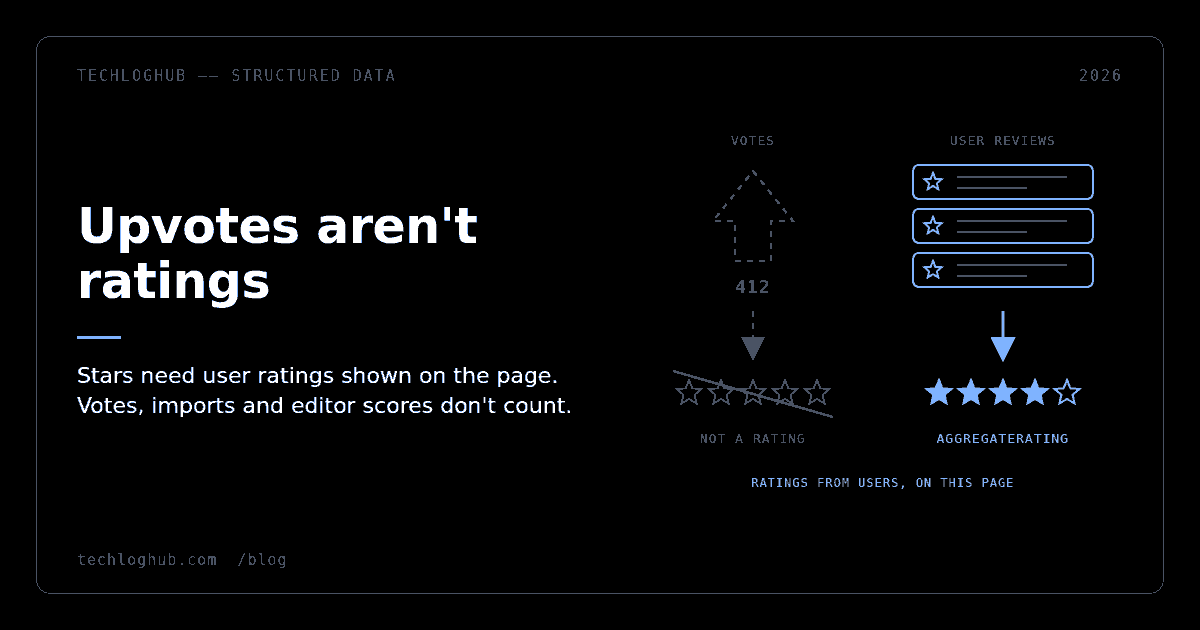
This is the mistake launch platforms and directories are most prone to, so it deserves its own section. An upvote is a single bit: someone liked it, or they did nothing. A rating is a value on a scale that someone gave after judging the product. Google asks for the second: an "aggregate evaluation of an item by many people," with an average value.
Turning 412 upvotes into "ratingValue": 5, "ratingCount": 412 tells Google that 412 people each gave the product five stars. None of them did. You can argue about whether that counts as "not based on a genuine experience," but it's clearly a misrepresentation of what the page shows, and it's exactly the sort of markup the structured data guidelines exist to rule out.
If your platform has both, keep them separate. Votes drive ranking on your product listings and stay out of structured data. Written reviews with a star value, an author name and a comment, which is what Google recommends collecting, can go into review and aggregateRating on that product's page.
Launch-day review drives, after July
"Leave a review and get a month free" is a common launch tactic. Most guides on where to launch assume you'll push your community for reviews on day one. There are now two rules to satisfy, and they're different.
Google's rule is about disclosure. An incentivised review has to disclose the benefit clearly and prominently. A small-print footnote on a different page won't do.
The FTC's rule is about conditions. The US Consumer Reviews and Testimonials Rule, in force since 21 October 2024, bans making an incentive conditional on a review expressing a particular sentiment. Courts can impose civil penalties for knowing violations. Incentives with no sentiment condition are allowed, but the FTC notes that disclosure duties under the FTC Act still apply. The rule also exempts businesses that do nothing more than host consumer reviews, which is the part that applies to a directory simply hosting reviews. It isn't the part that applies to the vendor running the incentive.
| Practice | Google review snippet | FTC rule (US) |
|---|---|---|
| Free month for any honest review, disclosed on each review | OK | OK |
| Free month for a review, not disclosed | Violates the July guideline | Disclosure duty under FTC Act |
| Free month for a 5-star review | Violates | Prohibited |
| Upvotes marked up as ratings | Misrepresents the page | — |
This isn't legal advice. If you're running a paid review campaign in the US, have a lawyer read the rule.
A checklist for directory and product pages
Before you ship stars, validate the JSON-LD block with a JSON formatter so you're checking valid syntax, not a trailing comma, then go through the list:
- Markup only on single-product pages, with
SoftwareApplicationandapplicationCategoryset. offers.pricepresent,0for free tiers.- Every rating counted in
aggregateRatingwas left on this site, by a user, and is visible on this page. - Incentivised reviews are labelled on the review itself.
- No upvotes, editor scores or imported averages in rating properties.
When you're evaluating tools for your own stack, the same scepticism is worth applying as a reader. Our guide on how to compare developer tools tells you to weigh release activity and the most-commented GitHub issues over popularity signals, for the same reason. And if you're listing a product, submit it with a real description and let the reviews build up on their own.
FAQ
Can I add review stars to my SaaS product page?
Only if the ratings were left by users on your site and are visible on that page. SoftwareApplication markup needs name, offers.price and either aggregateRating or review. Ratings copied from G2, app stores or other sites don't qualify.
Are incentivised reviews allowed in Google review snippets?
Only when the incentive is clearly and prominently disclosed. Google's July 2026 guideline bans undisclosed incentivised reviews, meaning reviews given for money, discounts, vouchers or free products, both on the page and in the structured data.
Can upvotes be used as aggregateRating?
No. An upvote isn't a rating on a scale, and marking upvote counts up as ratingValue and ratingCount claims that users gave star ratings they never gave. Keep votes out of structured data and mark up only real user ratings.
Can a category page or leaderboard show review stars in Google?
No. Google's guidelines say review information must be about a specific item, not about a category or a list of items. Put the markup on each product's own page.
Does the self-serving review rule apply to software?
The rule names LocalBusiness and Organization markup, not SoftwareApplication. Vendor-curated testimonials still fail the requirement that ratings come directly from users, so they shouldn't be marked up either way.
Stars are an assertion about what users said. If users didn't say it on this page, leave the markup out.