

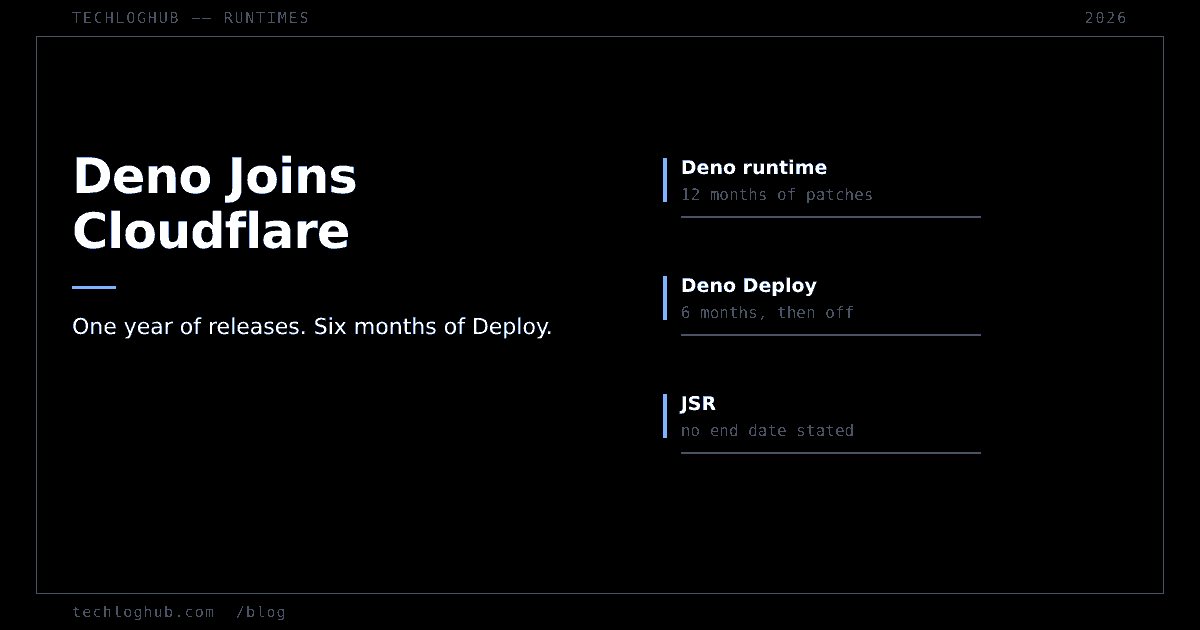
Deno Joins Cloudflare: One Year of Releases
Quick answer: Cloudflare has hired the Deno team. The Deno runtime gets monthly bug-fix and security releases for one more year, and then, in Deno’s own words, development ends. Deno Deploy runs for six months and shuts down. JSR keeps operating with its infrastructure moving to Cloudflare. If you host on Deploy you have a migration deadline; if you only use the CLI you have a support horizon, not an outage.
On 9 October 2026 Deno published a post announcing that the entire Deno team is joining Cloudflare. The headline reads like a win. The body contains three dates that change how you should plan the next twelve months, and only one of them is good news.
Here is the sentence that matters, from the Deno post: Cloudflare will support the runtime “for another year with monthly releases of bug fixes and security updates,” and after that development ends. Deno “will remain open source, and we welcome others who want to continue its development.” That is not a roadmap. That is a handover notice with a date on it.
The three clocks
Strip the announcement down to commitments with expiry dates and you get this:
| Thing | What was committed | When it ends |
|---|---|---|
| Deno runtime (the CLI) | Monthly bug-fix and security releases | One year from 9 Oct 2026, then development ends |
| Deno Deploy | Keeps running; paying customers get migration support to Cloudflare Workers | Six months from 9 Oct 2026 |
| JSR | Keeps operating, infrastructure moves to Cloudflare | No end date stated |
| rusty_v8 | Support continues, with work toward integrating it into workerd | No end date stated |
Two of those four rows are shutdowns with clocks. One is a continuation. One is a migration into somebody else’s codebase. Notice which row is shortest: the hosted product, not the runtime.
Deno Deploy went generally available in February
This is the part worth sitting with. Deno’s own blog index shows “Deno Deploy is Generally Available” dated 3 February 2026. The shutdown was announced on 9 October 2026. That is roughly eight months from GA to wind-down notice, on a platform whose whole pitch was that you could stop thinking about infrastructure.
The lesson is not “Deno lied.” Nobody at Deno knew in February what would be true in October. The lesson is that GA is a statement about software maturity, not about corporate runway, and a lot of teams read it as both. If your deployment target is a hosted service from a venture-funded runtime company, the maturity label tells you the product works. It tells you nothing about how long the company will keep running it. Price that in when you compare cloud and DevOps platforms and give weight to the ones you can run yourself.
What Cloudflare actually bought
The Cloudflare side of the announcement is noticeably not about Deno the runtime. Kenton Varda writes about workerd, Cloudflare’s open-source Workers runtime, and its one real limitation for self-hosters: workerd’s Durable Objects support runs as a single instance, which Cloudflare describes as fine for local testing but not for scaling, because the routing behind production Durable Objects was built for Cloudflare’s own scale.
Ryan Dahl’s answer to that is celld, which he describes as “one binary, written in Rust, with object storage as its only external service dependency.” Cloudflare says celld and workerd are being merged, with celld’s code and ideas flowing back into workerd. So the stated plan is: one runtime, self-hostable, Durable Objects as the primary abstraction — a distributed singleton with its own SQLite database, single-threaded execution and WebSocket handling.
Read that as a product direction and it is coherent. Read it as a message to Deno users and it is blunt: the engineering effort goes into the Workers model, not into the Deno runtime you have been writing TypeScript against.
Nothing shipped since June
One underreported detail: Deno’s blog lists Deno 2.9 on 25 June 2026 as the most recent release. There has been no minor release announced in the three and a half months since. So the “monthly bug fixes and security updates” promise is not a slowdown from a fast cadence — it is roughly a formalisation of where the project already was. If you were waiting on a feature in a 2.10, stop waiting.
The practical read for the next year: treat the Deno CLI the way you would treat any runtime in maintenance. Pin the version in CI, keep an eye on the security releases, and stop adding Deno-specific APIs to code you expect to run in 2028. We made the same argument about reading a runtime’s own support calendar rather than its marketing when Node moved to an annual release schedule.
What to do, by how you actually use Deno
You deploy to Deno Deploy
You have the hardest deadline: six months. Deno says paying customers get migration support to Cloudflare Workers. Start the port now rather than at month five, because the gap between Deno’s APIs and the Workers runtime is where the work is — filesystem access, long-running processes and Node compatibility shims are the usual casualties. If Workers is not where you want to land, this is also the moment to evaluate a container platform instead, which is a bigger port but ends the dependency.
You use the Deno CLI for scripts and tooling
Lowest risk. A maintained-for-a-year runtime is fine for lint scripts, build steps and one-file utilities. The failure mode is not the runtime disappearing, it is your dependency on Deno. APIs growing until a future port is expensive. Prefer standard Web APIs and Node-compatible imports where both work.
You publish to JSR
JSR is the one thing explicitly continuing, and its infrastructure is moving to Cloudflare. Keep publishing. The registry is also consumable from npm-based tooling, so JSR packages are not Deno-only, which is exactly why it is the piece worth keeping alive. If you are auditing which registries your build depends on, our open-source listings are a reasonable starting point for finding maintained alternatives to anything you decide to drop.
You run Deno in production as your application runtime
You have twelve months of security patches and then an open-source project that needs new maintainers. Either budget for that maintenance yourself, or start the migration. The honest options are Node, Bun, or workerd/celld if the Durable Objects model fits your architecture. We covered what is and is not safe to rely on in the alternative runtime when Bun 1.4 shipped its built-in APIs.
The part that should change your defaults
Runtime consolidation is the trend here, not a one-off. The JavaScript server-side runtime market produced three serious implementations in a decade and is now visibly converging — Deno’s team into Cloudflare’s runtime, and Cloudflare’s runtime toward something self-hostable. Betting a product on a runtime’s unique APIs was always a bet on that runtime’s company. That bet just resolved once, publicly, with dates.
The defensive posture is boring and it works: keep application code on APIs that exist in more than one runtime, keep deployment behind a thin layer you can repoint, and prefer self-hostable targets when the cost difference is small. Cloudflare and Deno both say more announcements are coming in the next months. Plan on the dates you have, not the ones you hope for. If you are reassessing your stack, our product directory and curated collections are built for exactly that kind of side-by-side comparison.
FAQ
Is Deno dead?
No, but it is in maintenance with a stated end to development. Deno says Cloudflare will ship monthly bug-fix and security releases for one more year, after which development ends and the project stays open source for others to continue. Treat it as a maintained runtime for a year and an unmaintained one after that unless new maintainers appear.
When exactly does Deno Deploy shut down?
Deno’s post says Deploy “will run for six months” from the 9 October 2026 announcement before shutting down, and that paying customers get migration support to Cloudflare Workers. No calendar date was published, so work from the six-month figure and confirm with Deno if your renewal falls near it.
Does this affect JSR packages I already publish?
Not on the stated plan. JSR keeps operating and its infrastructure moves to Cloudflare. JSR and rusty_v8 are the two items in the announcement with no end date attached — everything else came with a clock.
What are celld and workerd, and do I need them?
workerd is Cloudflare’s open-source Workers runtime, the same code Cloudflare runs in production. celld is Ryan Dahl’s single-binary Rust system for running distributed apps on your own infrastructure with object storage as its only external dependency. Cloudflare says the two are being merged. You need them only if you want to self-host the Workers programming model.
Should I migrate off Deno right now?
If you are on Deno Deploy, yes, start now — six months is not long for a platform port. If you use the CLI for tooling, no, there is no urgency. If Deno is your production application runtime, decide within this year whether you will maintain it yourself or move, because deciding in month eleven removes your options.
Did Cloudflare say anything about Deno KV, Queues or Sandbox?
Neither post addressed Deno KV, Queues, Subhosting or Deno Sandbox. If you depend on one of those, treat its status as unannounced rather than safe, and ask Deno directly.
Both announcements are dated 9 October 2026 and both promise more detail “in the coming months.” Until that detail arrives, the six-month and twelve-month clocks are the only firm numbers anyone has published.