

SaaS Ideas: 25 Micro SaaS Ideas With Real Demand, and How to Test Them
25 micro SaaS ideas tied to demand you can check: new rules, deadlines, platform shifts and developer pain. Plus how to find, validate and price your own.
SaaS Ideas: 25 Micro SaaS Ideas With Real Demand, and How to Test Them
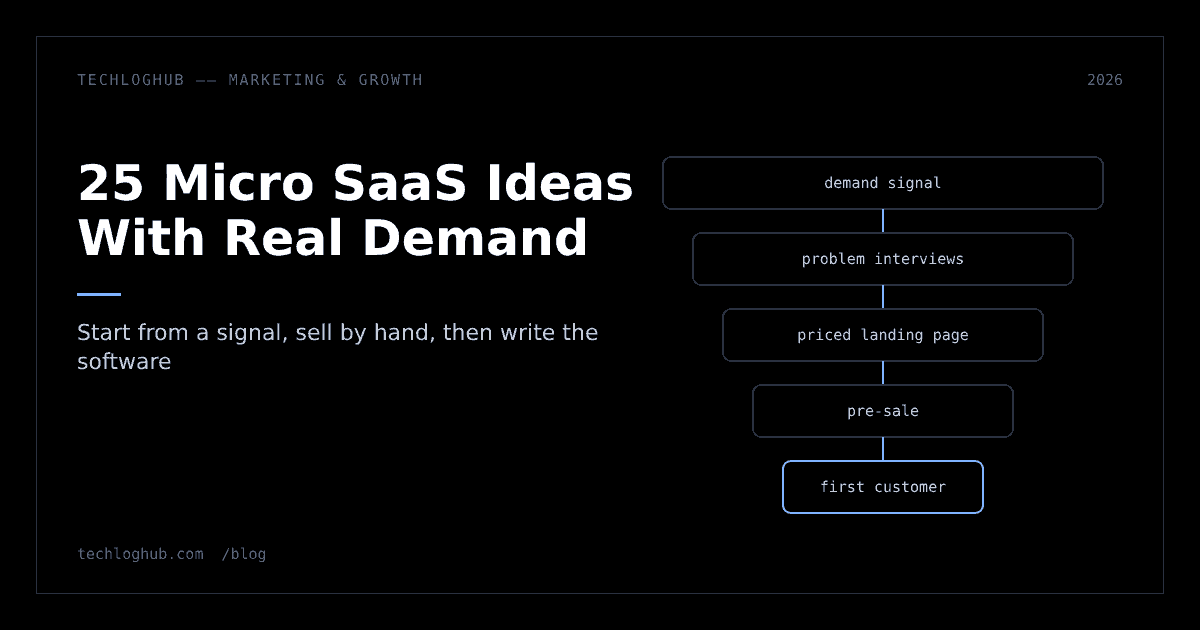
Quick answer: The best SaaS ideas come from a change that forces someone to act: a new rule, a deadline, a platform shift or a workflow that just got more expensive. Pick a narrow group who already pay for software, confirm the pain in their own words, sell before you build, and charge on a value metric they understand. Below are 25 micro SaaS ideas, each tied to a demand signal you can check yourself, plus the validation steps and pricing basics to test them.
Most lists of SaaS ideas are lists of products that already exist with "AI" added. That's backwards. A micro SaaS works when a small, specific group has a problem they must solve, can name it, and already spends money near it.
So every idea below starts from a signal you can verify: a published rule, a dated deadline, a platform change, or a measurable shift in how developers work. We haven't invented revenue numbers for any of them, because nobody can honestly promise those. What we can show is where demand comes from and how to test it in weeks rather than months.
Where good SaaS ideas come from
Paul Graham's essay How to Get Startup Ideas still has the best one-line advice: "look for problems, preferably problems you have yourself." YC calls ideas that grow out of founders' own experience "organic." His other line is the one that fits micro SaaS: you can dig a hole "that's broad but shallow, or one that's narrow and deep, like a well." A micro SaaS is a well. A few hundred customers who need you badly beat ten thousand who find you mildly interesting.
In practice, demand for small software products clusters around five kinds of change:
| Signal | Why it creates demand | Where to watch |
|---|---|---|
| New rules and enforcement | Companies must comply by a date, and small ones lack staff to do it | Regulator pages, platform policy pages, Google and Apple developer updates |
| Deadlines and end-of-life dates | Upgrades get forced on teams that would rather not | Release schedules, endoflife.date (it tracks 489 products and offers an API) |
| Platform shifts | New workflows create new chores and new gaps | Changelogs, developer surveys, GitHub's Octoverse |
| Rising costs | Teams look for ways to measure and cut a new expense | Pricing changes, billing complaints in public forums |
| Repeated manual work | Someone keeps doing a boring task in a spreadsheet | Your own job, job postings, forum threads asking "is there a tool for…" |
Graham's advice to "live in the future, then build what's missing" maps neatly onto the third row. Developers living with AI coding agents today are hitting problems most companies will hit next year.
How to find your own idea in a week
You don't need a brainstorm. You need a routine that turns signals into specific problems:
- Pick a group you can reach. Developers, Shopify merchants, accountants, clinic managers, agencies. If you can't name three places they talk online, pick another group.
- Collect complaints for five days. Read forum threads, GitHub issues, app marketplace reviews and support communities. Copy exact sentences into a document. Phrases like "I spend every Friday…" or "is there a tool that…" are gold.
- Tag each complaint by signal. Rule, deadline, platform shift, cost or manual work. Complaints with a deadline attached are worth more, because the buyer has to act.
- Check who already sells a fix. Search the category on marketplaces and directories. Competition is good news if reviews complain about price, complexity or a missing segment. It's bad news if the incumbent is cheap, loved and focused on exactly your group.
- Write the one-sentence pitch. "[Product] helps [specific group] [do job] without [current pain]." If you can't fill every bracket, keep collecting.
Browsing what other makers have shipped helps with step four. Scan the SaaS and web apps category, the trending leaderboard and recent comparisons to see which niches are crowded and which have one tired incumbent.
25 micro SaaS ideas grounded in observable demand
Each idea names its signal. Treat them as starting points to validate, not guarantees. Some are crowded already; your angle has to be a narrower group or a sharper job.
Email and compliance
1. Gmail bulk-sender compliance monitor. Google's email sender guidelines require senders of more than 5,000 messages a day to Gmail to set up SPF, DKIM and DMARC, support one-click unsubscribe for marketing mail, and keep spam rates in Postmaster Tools below 0.30%. A small tool that checks all of that weekly for agencies managing many client domains is a narrow, recurring job.
2. One-click unsubscribe tester. Same signal, smaller product: send a test message, confirm the unsubscribe headers and link work, and alert when a template change breaks them. Good fit for teams running several email providers.
3. Accessibility monitoring for small online shops. The European Accessibility Act has applied since 28 June 2025 and covers e-commerce services, banking, e-books and more. Large retailers have consultants; small shops selling into the EU have a plugin and a worry. A monitor that scans key pages, flags regressions and explains fixes in plain language serves them. Be careful not to promise legal compliance; sell monitoring and evidence.
4. Accessibility statement and issue log. Many shops need a maintained record of known issues and fixes, not just a scan. A simple app that tracks issues, owners and dates and publishes a public statement page is boring and useful.
5. EU CRA reporting workflow for small software vendors. The Cyber Resilience Act's reporting duties put a clock on vulnerability reporting, as we covered in CRA reporting: the 24-hour clock is live. A small product that keeps a component inventory, a contact list and pre-filled report templates fits teams with no compliance staff.
Developer workflow and AI agents
6. Agent instruction sync. The AGENTS.md format is used by more than 60,000 open-source projects and read by Codex, Copilot's coding agent, Gemini CLI, Cursor, Zed and others, while Cursor also has its own .mdc rules and calls .cursorrules legacy in its help docs. Teams end up with AGENTS.md, CLAUDE.md and Cursor rules that drift apart. A linter and sync tool that keeps them consistent is a clean developer niche.
7. Agent pull request triage. GitHub's Octoverse 2026 reports more than 40% of pull requests started with an agent as of September 2026, and agents started 110 million pull requests that month. Small teams drown in agent PRs. A dashboard that groups them by risk, size and files touched, and routes them to the right reviewer, solves a new chore.
8. AI coding usage reports for team leads. The 2026 Stack Overflow Developer Survey found 73% of respondents who use AI coding tools use them daily, and 31% of daily users spend four or more hours a day with them. Managers want to know what that time produces. A report that joins tool usage with merged PRs and incidents, without surveillance features, has a clear buyer.
9. Runtime end-of-life tracker for agencies. Python 3.10 reached end of life in October 2026, according to python.org. Agencies maintain dozens of client apps on different versions. A dashboard that reads each repo's runtime and framework versions, checks them against endoflife.date's API and emails a quarterly upgrade plan saves real hours.
10. Changelog from merged PRs. Turning PR titles into a readable customer changelog is a weekly chore for every SaaS team. Products exist; the opening is a specific stack or audience, such as mobile apps or API products with versioned docs.
11. Webhook inspector with replay for one platform. Generic webhook tools exist. A version built for one platform's events (a payments provider, a commerce platform) with sample payloads, signature checks and replay is narrower and easier to sell.
12. Typed client generator from sample payloads. Developers paste JSON and want types and validators. Free tools such as our JSON to Zod cover one-offs; a paid version that watches an API and opens a PR when the response shape changes is a product.
AI for specific jobs
These follow Y Combinator's Requests for Startups for Winter 2027, shrunk to micro SaaS size. YC's versions are venture-scale; a solo maker can serve one narrow slice.
13. Brand-voice checker for documentation. YC asks for "LLMs that write well," noting that coding-focused training flattens style. A tool that checks docs and release notes against a company's own style examples is a small, sellable slice.
14. Private AI gateway for small regulated offices. YC's "AI for the air-gapped economy" targets banks, hospitals and defense contractors that can't use cloud APIs. The micro version: a self-hosted gateway with audit logs and redaction for a law or accounting office.
15. Permit status tracker for contractors. YC's "AI for City Hall" is about cities. The flip side is contractors waiting on permits across several cities. A tracker that watches public permit portals and alerts on status changes serves them.
16. Specialist form copilot. YC's "$15-an-hour expert" describes AI helping people do specialist work in taxes, insurance and medical billing. Pick one form or workflow, such as insurance claim appeals for small clinics, and build a guided assistant. Regulated work needs expert review; don't skip it.
Small business and marketplaces
17. Review reply assistant for one marketplace. App and product marketplaces show public reviews that sellers must answer. A tool that drafts replies in the seller's voice and flags reviews that report bugs is a narrow job. Check demand by reading what sellers say in the marketplace's own community forum.
18. Price-change monitor for SaaS buyers. Teams get surprised by vendor price changes at renewal. A tool that tracks the pricing pages of the 20 tools a company uses and alerts on changes is simple to build and easy to explain.
19. Renewal calendar for software subscriptions. Same buyer, different job: import card statements, detect subscriptions, and remind the owner 30 days before each renewal.
20. Client reporting for freelancers in one niche. Freelance developers and SEO consultants rebuild the same monthly report by hand. Pick one niche, pull data from the two or three tools they use, and send a branded PDF.
21. Booking and intake for one profession. Generic schedulers are crowded. A version with the intake questions, reminders and document checklists for one profession, such as tax preparers or tutors, can win on fit.
Content and SEO operations
22. Structured data monitor. Sites add schema markup and then templates break it. A crawler that alerts when required properties disappear after a deploy is a small, technical product. Pair it with free generators, like we do with our meta tag generator, as a top-of-funnel.
23. Broken outbound link watcher for docs sites. Documentation links rot as vendors move pages. A weekly check of outbound links with suggested replacements is a chore every docs team has.
24. Social preview QA. Shared links with missing or broken preview images look careless. A tool that checks every new page's Open Graph tags and image on deploy is narrow and easy to demo.
25. Directory listing manager. Founders submit to many directories, then forget to update them. A tool that stores one product profile, tracks where it's listed and flags stale listings solves the problem in our guide to where to launch your startup.
Ideas we'd skip
Some SaaS ideas show up on every list and rarely work for a solo maker:
- Another general to-do or note app. Huge demand, but users already have free options they like, and switching costs are low in both directions.
- "ChatGPT for X" with no data or workflow. If the product is a prompt over a public model, the model vendor or a free template will replace it.
- Tools for other indie makers only. Makers are a loud audience online but a small, price-sensitive market. Sell to their customers instead.
- Social media schedulers. Crowded, with platform API rules that can change under you.
None of these are impossible. They just need an angle so narrow that it becomes a different idea, which brings you back to the list above.
How to validate a SaaS idea before you build
Validation answers one question: will a specific person pay to fix this soon? Run these steps in order, and stop when the answer is no:
- Ten problem interviews. Talk to people in the group, not friends. Ask about the last time the problem happened, what they did, and what it cost. Don't pitch. If fewer than half describe the pain without prompting, move on.
- Search for spending. Are they paying for a workaround: a consultant, a spreadsheet template, an expensive suite they use 5% of? Existing spend is the strongest signal you'll get.
- A one-page site with a clear price. Describe the outcome, show the price, and add a "start trial" or "reserve" button. A waitlist with no price tells you about curiosity, not demand. Our guide to pre-launch marketing covers the page itself.
- Ask for money early. Offer a discounted annual pre-sale or a paid pilot to the people you interviewed. A handful of pre-payments beats hundreds of sign-ups.
- Deliver by hand first. Run the service manually for the first customers: run the scan yourself, write the report, send the alert. You'll learn what to automate and what nobody needs.
Worked example: the bulk-sender monitor (idea 1)
Interviews with agency owners would test whether domain compliance is a recurring headache or a one-time setup. If they say "we fixed it once when Gmail started enforcing," the pain may have faded; pivot to monitoring for regressions after DNS or provider changes. Search for spending: are agencies paying deliverability consultants or using several free checkers by hand? Then put up a page priced per monitored domain and offer the first ten agencies a manual weekly report. If nobody pays for the manual version, software won't change that.
Worked example: agent instruction sync (idea 6)
Start with your own repos: do you actually have drifting AGENTS.md and Cursor rules files? Then search public GitHub repositories for projects containing several agent instruction files and read their issues for complaints about inconsistent agent behaviour. Interview team leads at small companies using two or more AI coding tools. If the pain is real, the first version can be a free command-line linter, with a paid tier that syncs rules across an organisation's repos and reports drift. Free tools build trust with developers; organisation-wide sync is what a team lead pays for.
Pricing basics for micro SaaS
Pricing is part of validation, not a step after launch. Stripe's guide to SaaS pricing and packaging calls the value metric "the foundation" of pricing and describes the main models:
| Model | How it charges | Fits ideas like |
|---|---|---|
| Per seat | Number of users | Team dashboards (idea 8), PR triage (idea 7) |
| Tiered flat rate | Fixed plans for different segments | Freelancer reporting (20), booking tools (21) |
| Usage-based | Consumption, such as checks or API calls | Monitors (1, 22, 23), typed client generation (12) |
| Hybrid | Base fee plus usage | Accessibility monitoring (3) with a page allowance |
| Per outcome | Measurable results | Rare for micro SaaS; hard to measure fairly |
Stripe's tests for a good value metric are worth applying to every idea: it should grow with customer success, be easy to understand, be hard to game, and match the customer's budget. "Per monitored domain" passes all four for an agency tool. "Per project" fails the gaming test, because customers can merge projects.
Three practical rules from watching small SaaS products price themselves:
- Charge from day one. A free beta attracts people who like free things. Offer a discount, not free access.
- Offer annual billing early. It funds development and filters for customers who are serious.
- Price for the buyer's budget, not your costs. An agency bills clients for compliance work, so a tool that saves an hour a month has a clear value to them, whatever it costs you to run.
Launching and getting first users
Once a few customers have paid, launch where your users already are. For developer-facing products that means Show HN, developer launch platforms and comparison directories; for small-business tools it means the marketplaces and communities you found during research. You can list a product on TechLogHub for free if it has a technical angle, and browse our free developer tools to see the kind of utilities that pull in a developer audience. Our SaaS product launch guide covers the MVP, soft launch and GA stages.
Keep the scope small after launch, too. The fastest way to kill a micro SaaS is to chase every feature request from customers who aren't your core group.
FAQ
What is a micro SaaS?
A micro SaaS is a small software-as-a-service business that serves a narrow group of customers with a focused product, usually run by one person or a very small team. It aims for a sustainable, profitable niche rather than venture-scale growth.
How do I find SaaS ideas that people will pay for?
Look for problems a specific group must solve soon, such as a new rule, a deadline or a rising cost, and check whether they already spend money on workarounds. Collect complaints in their own words, then confirm with interviews and an early pre-sale.
How do I validate a SaaS idea quickly?
Run about ten problem interviews, check for existing spending, publish a one-page site with a real price, and ask interested people to pre-pay or start a paid pilot. Deliver the first version by hand before you automate it.
Are micro SaaS ideas with competitors worth pursuing?
Often yes. Competitors prove that people pay. Look for reviews complaining about price, complexity or a neglected segment, and serve that segment better. Avoid niches where a cheap, loved product already serves exactly your group.
How should I price a micro SaaS?
Choose a value metric that grows with customer success, is easy to understand, is hard to game and matches the buyer's budget, such as per monitored domain or per seat. Charge from day one and offer annual billing early.
Can a side project become a SaaS business?
Yes, if it solves a recurring problem for a group that will pay. Start by charging a few users for the side project, keep the scope narrow, and only expand once you have steady paying customers.
Start from a change someone has to respond to, sell the fix by hand, and only then write the software.