

Best Programming Language to Learn in 2026: A Decision Guide by Goal
Which language to learn first in 2026, by goal: web, data and AI, mobile, systems, games or jobs, checked against Stack Overflow, GitHub and TIOBE data.
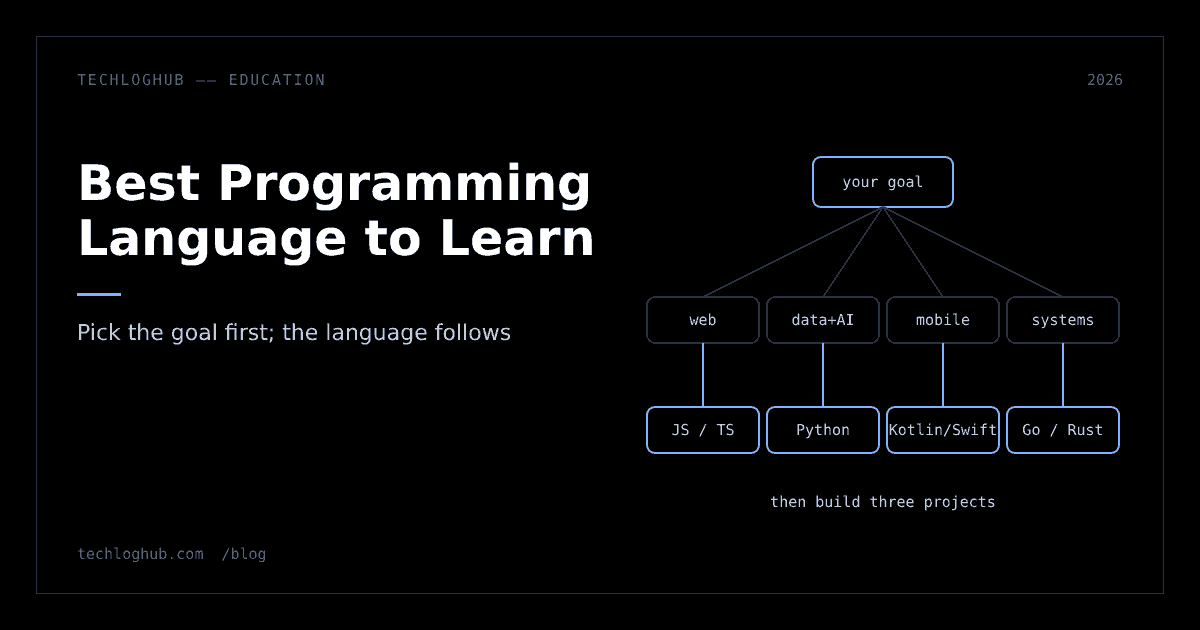
Best Programming Language to Learn in 2026: A Decision Guide by Goal
Quick answer: For most people the best programming language to learn first is Python or JavaScript. Choose Python if you're drawn to data, AI, automation or backend work; choose JavaScript, then TypeScript, if you want to build websites and web apps. Pick Kotlin or Swift for mobile, C# for Unity games, and Go or Rust only once you know one language and want systems or infrastructure work. The goal decides the language; the first one matters less than finishing projects in it.
There is no single best programming language to learn, but there is a best one for what you want to build. Pick the goal first, and the choice narrows to one or two languages in a minute.
This guide gives a decision framework by goal, then checks it against the newest data we could verify in November 2026: the 2026 Stack Overflow Developer Survey, GitHub's Octoverse 2026, and the November 2026 TIOBE Index. They measure different things, and the differences are useful.
The short answer: pick by goal
| Your goal | Learn first | Then add | Why |
|---|---|---|---|
| Websites and web apps | JavaScript | TypeScript, then a backend language | It runs in every browser; TypeScript is the most-used language on GitHub |
| Data, AI and machine learning | Python | SQL | Python leads TIOBE and is the top language among survey respondents using AI |
| Automation and scripting | Python | Bash | Readable syntax and a huge standard library |
| Android apps | Kotlin | Java basics | Google says over 60% of professional Android developers use Kotlin |
| iOS and Apple apps | Swift | SwiftUI | Apple's language, now with tools for Linux and Windows too |
| Games | C# (Unity) or GDScript (Godot) | C++ later | Engines decide the language |
| Systems, infrastructure, performance | Go or Rust (after a first language) | C | Rust is the fastest-growing top language on GitHub; Go just entered TIOBE's top 10 |
| "I just want a developer job" | JavaScript/TypeScript or Python | SQL | Highest usage in surveys and job-heavy ecosystems |
| Not sure yet | Python | Whatever your first project needs | Gentlest syntax, widest range of uses |
If two rows fit you, choose the one with a project you'd build this month. Motivation finishes courses; optimal choices don't.
What the 2026 data actually says
Three popular sources measure three different things. Read them together.
Stack Overflow Developer Survey 2026: what developers use. More than 30,000 people took the survey. JavaScript leads at 62%, with SQL, HTML/CSS and Python each at 58%; SQL moved into second place, and Rust rose to 12th. The full language results put TypeScript at 43.8%, Java at 27.6%, C# at 27.1%, C++ at 24.3% and Rust at 18.0%. Among respondents using languages for AI work, the survey's overview puts Python first at 39.0%, just ahead of JavaScript at 38.4%.
GitHub Octoverse 2026: what gets written in the open. TypeScript ranks first by contributors, Python second and JavaScript third, the same order as last year. From September 2025 to September 2026, TypeScript added 3.62 million monthly contributors, Python 3.23 million and JavaScript 1.82 million. Rust grew fastest by percentage among the top languages, roughly doubling. GitHub links part of this to AI: more than 40% of pull requests now start with an AI agent.
TIOBE Index, November 2026: what people search for. TIOBE ranks languages by search-engine signals, not usage. Python leads with 20.86%, followed by C (11.48%), Java (8.89%), C++ (8.35%), C# (3.39%) and JavaScript (2.42%). Go is 10th at 1.69%, having pushed Rust out of the top 10, and Dart entered the top 20 for the first time, which TIOBE credits to Flutter.
| Language | Stack Overflow 2026 (used) | Octoverse 2026 | TIOBE Nov 2026 |
|---|---|---|---|
| JavaScript | 1st, 62% | 3rd by contributors | 6th |
| Python | 4th, 58% | 2nd | 1st |
| TypeScript | 6th, 43.8% | 1st | Outside the top 10 |
| Java | 7th, 27.6% | Lowest growth of the languages GitHub highlighted | 3rd |
| C# | 8th, 27.1% | n/a | 5th |
| Rust | 12th, 18.0% | Fastest-growing top language | Outside the top 10 |
| Go | n/a | n/a | 10th |
How to read these rankings: a survey reflects the people who answered it, mostly professional developers who visit Stack Overflow. Octoverse reflects code on GitHub, which favours open source and web projects. TIOBE reflects search activity, which rewards languages people look up often, including those taught in universities. None of them measure how easy a language is to learn or how many entry-level jobs it has where you live.
The takeaway: Python and the JavaScript/TypeScript family are at or near the top of every list. Java, C# and C++ remain big in established companies and in search interest. Rust and Go are growing but are rarely the right first language. Our comparisons of Python vs JavaScript, Python vs Go and Go vs Rust go deeper on each pairing.
The easiest programming language to learn
"Easiest" means three different things, and languages win on different ones:
- Easiest to read: Python. Indentation instead of braces, few symbols, and code that reads close to English. Beginners spend less time fighting syntax.
- Easiest to see results: JavaScript. Open a browser, press F12, type code, and change a web page in front of you. No installation at all.
- Easiest to get right: languages with strong types, such as TypeScript, Kotlin, C# and Go, catch mistakes before the program runs. That feels harder in week one and easier in month three.
For a complete beginner, Python is the easiest coding language to start with in the reading sense, and JavaScript in the instant-results sense. Both are fine. The common mistake is spending weeks deciding.
What makes a language hard for beginners is usually not its syntax but its setup and its ecosystem. JavaScript's web tooling (bundlers, frameworks, package managers) changes fast and can overwhelm a newcomer; stay with plain JavaScript in the browser for the first month. Python's environment management can confuse people; use one virtual environment per project and don't install packages globally. Rust is genuinely hard for beginners because its ownership rules ask you to understand memory before you've written much code.
Here's how common first languages compare for a beginner, in our assessment:
| Language | Syntax for beginners | Setup | Instant feedback | Typing | Main early hurdle |
|---|---|---|---|---|---|
| Python | Very readable | Install one program | Interactive shell | Dynamic, optional hints | Managing packages and environments |
| JavaScript | Moderate | None (browser) | Browser console | Dynamic | Tooling and framework churn |
| TypeScript | Moderate | Needs a compiler or runtime support | Editor errors as you type | Static | Learning JavaScript and types together |
| Java / C# | Verbose | IDE and SDK | Slower compile-run loop | Static | Boilerplate before your first program |
| Go | Small and consistent | Install one toolchain | Fast compiles | Static | Explicit error handling everywhere |
| Rust | Dense | Install one toolchain | Strict compiler messages | Static | Ownership and borrowing rules |
Keep a reference open while you learn. Our Python cheat sheet covers syntax, data structures and idioms on one page.
The best language for each goal, explained
Web development: JavaScript, then TypeScript
Every web page runs JavaScript, so it's unavoidable for front-end work. Learn HTML, CSS and plain JavaScript first, build three small sites without a framework, then move to TypeScript and a framework such as React. TypeScript leading Octoverse by contributors tells you where professional web code is heading: typed JavaScript. When you start working with APIs, generating types from real responses with a JSON to TypeScript converter is a quick way to see how types describe data.
Three first projects that teach the right things in order:
- A personal page with HTML and CSS only, published for free. It teaches structure, layout and deployment.
- An interactive tool in plain JavaScript, such as a tip calculator or a quiz. It teaches events, the DOM and state.
- An app that fetches data from a public API and shows it, with loading and error states. It teaches asynchronous code, which is where most beginners get stuck.
Only after these should you pick up a framework. You'll understand what it's doing for you, and you'll debug it far faster.
You can stay in one language for back-end work with Node.js, or add Python, Go, Java or C# later. Many web developers learn a second language within two years.
Data, AI and machine learning: Python plus SQL
Python is the default for data analysis, machine learning and AI tooling, and the data agrees: first on TIOBE, first among survey respondents using languages for AI. Learn Python basics, then SQL, which 58% of Stack Overflow respondents use and which almost every data job asks for. After that, learn the libraries your field uses for data frames, plotting and machine learning.
The Stack Overflow survey also found 79% of respondents want to build AI skills. Python is the most direct route to that work.
Mobile apps: Kotlin or Swift, or a cross-platform option
For Android, Google's Kotlin page says Kotlin is used by over 60% of professional Android developers and that Android's modern UI toolkit is built on it. For iPhone and Mac apps, learn Swift; swift.org describes it as a multiplatform language with tools for Linux, macOS and Windows.
If you want both platforms from one codebase, cross-platform frameworks exist in several languages. Dart with Flutter is one; TIOBE's November commentary credits Flutter for Dart entering its top 20. React Native lets JavaScript developers build mobile apps. Native languages give you the most control; cross-platform gets you to both stores faster.
Systems, infrastructure and performance: Go or Rust, second
Go has a small, simple language core, compiles to a single binary, and is widely used for cloud services and command-line tools. Rust gives memory safety without a garbage collector and is the fastest-growing top language on GitHub, but it has a steep learning curve. Learn either as your second language once you understand variables, functions, data structures and debugging in your first. Our Go vs Rust comparison breaks down which suits which work.
C and C++ still sit at second and fourth on TIOBE and run operating systems, embedded devices, browsers and game engines. They're worth learning for those fields, but they are hard first languages because you manage memory yourself.
Games: the engine picks the language
Unity uses C#; its scripting docs are built around C# types. Godot offers GDScript, C# and C++ through GDExtension, according to its documentation. For a first game, pick an engine whose tutorials you like and learn its main language. Large studios lean heavily on C++, so learn it later if you want engine or performance work.
Career switchers and non-developers
If you work in finance, marketing, operations or research and want to automate parts of your job, learn Python and SQL. You'll use them on spreadsheets, reports and databases you already deal with, which gives you real projects from day one. Analysts who can write a query and a script tend to become the person everyone asks for data, and that's often the bridge into a technical role.
Students and younger learners
For school students, the best first language is the one their course or club uses. Visual block-based tools are fine for very young learners; by the early teens, Python is a common next step because its syntax is readable and its uses are broad. JavaScript works well for students who want to show friends a website or a browser game.
Getting a job: follow the ecosystem, then go local
The US Bureau of Labor Statistics projects 10% growth in software developer jobs from 2025 to 2035, with a 2025 median pay of $135,980; that's US data, and pay and demand vary widely by country. Language matters less than people think: employers hire for problem-solving, projects and fundamentals. Still, a larger ecosystem means more openings.
The practical method: search job listings in your city or for remote roles you'd want, count which languages appear in entry-level postings, and learn the top one. JavaScript/TypeScript, Python, Java and C# usually dominate, but local markets differ. India alone has 32.0 million developers on GitHub, according to Octoverse, so global rankings blur very different local markets. Check your own market rather than trusting them.
Three worked examples
Here's the framework applied to three common situations.
Priya, a commerce graduate who wants a tech job within a year. Her local job listings show many entry-level roles asking for JavaScript and React, and some for Python and SQL in analytics. She likes visual work, so she picks JavaScript: HTML, CSS and plain JavaScript for two months, then TypeScript and React, then a small Node.js API. SQL comes in month six. Her portfolio is three web apps people can open in a browser, which is easy for recruiters to look at.
Marco, a lab researcher drowning in spreadsheets. His goal isn't a developer job; it's getting his evenings back. He learns Python, then the data libraries his field uses, and writes scripts that clean instrument output and draw the charts he used to make by hand. Six months later he adds SQL to query the lab's database directly. He never needed JavaScript, and that's fine.
Aisha, a backend developer with three years of Python. She wants infrastructure work and better performance. Rust tempts her, but her team runs Go services. She learns Go first because she can use it at work next week, and puts Rust on the list for next year. The second language came from her job, not from a ranking.
In all three cases, the decision took minutes once the goal was clear. The hard part was the months of building that followed.
Honest trade-offs nobody puts in the ranking
Popular means crowded. Python and JavaScript have the most learners, so entry-level competition is high. The upside is more tutorials, answers and libraries. A niche language can mean fewer jobs and fewer applicants per job.
Dynamic typing is easy now and costly later. Python and JavaScript let you skip types, which speeds up learning but lets bugs reach run time. Both have optional typing (type hints in Python, TypeScript for JavaScript). Learn to use them by your second month.
Ecosystem churn is real. JavaScript frameworks rise and fall quickly. Learn the language deeply and treat frameworks as tools you'll swap. Python changes more slowly but still ships yearly releases; its downloads page shows 3.15 as the newest branch, with 3.10 already end of life.
AI assistants change what "learning" means. The 2026 Stack Overflow survey found 73% of AI coding tool users use them daily. Assistants are strongest in the most common languages because there's more training data, which is another quiet advantage for Python and JavaScript. The risk is skipping understanding. Use AI to explain errors and code, not to write your projects for you.
Learning two languages at once slows you down. Beginners who split time between Python and JavaScript in the same month confuse syntax and finish nothing. Stick with one until you've built three projects.
Your second language teaches more than your first. Moving from Python to Go, or JavaScript to Rust, shows you which ideas belong to programming and which belong to one language. Plan on learning a second within a year.
A 90-day plan for your first language
Here's a plan that works for Python or JavaScript. Adjust the projects to your goal.
| Weeks | Focus | Build |
|---|---|---|
| 1 to 2 | Variables, types, conditionals, loops, functions | A guessing game, a calculator, a unit converter |
| 3 to 4 | Lists, dictionaries or objects, strings, files | A to-do app that saves to a file, a word counter |
| 5 to 6 | Modules, packages, error handling, JSON | A quiz from a JSON file, a tool that calls a public API |
| 7 to 8 | Git, debugging, reading docs, basic testing | Put every project on GitHub with a README |
| 9 to 10 | Your goal's first tool: a web framework, data library or game engine | One small app in that area |
| 11 to 12 | One portfolio project you'd show an employer | Something you or a friend will actually use |
Ten focused hours a week is enough to finish this plan. If you fall behind, cut the scope of a project rather than skipping weeks; consistency matters more than pace, and a smaller finished project still counts. Learning regex along the way pays off in every language; a regex tester makes patterns visible while you learn them. For structured courses, browse our tutorials and the education and learning category, and use comparisons when you're deciding between tools later.
FAQ
What is the best programming language to learn first?
Python or JavaScript for most people. Choose Python for data, AI, automation or backend work, and JavaScript for websites and web apps. If you already know you want Android, iOS or Unity games, start with Kotlin, Swift or C# instead.
What is the easiest programming language to learn?
Python is usually the easiest to read and write because it uses indentation instead of braces and has few symbols. JavaScript is the easiest to try, since it runs in any browser without installing anything.
Is Python or JavaScript better for beginners?
Both are good. Python has cleaner syntax and is the default for data and AI. JavaScript is required for web front ends and gives instant visual results. Pick the one that matches the first project you want to build.
Which programming language has the most jobs?
Job demand depends on your location, but JavaScript and TypeScript, Python, Java and C# appear most often in developer job listings across large markets. Check entry-level postings in your own city or target remote roles before you decide.
Should I learn Rust or Go as my first language?
Usually not. Both are excellent second languages for systems, cloud and infrastructure work, but Rust's ownership model is hard without prior experience, and Go is easier to appreciate once you know another language. Learn one of them after Python or JavaScript.
How long does it take to learn a programming language?
Around three months of about ten hours a week is enough to learn the basics of one language and build a few small projects. Becoming job-ready usually takes longer and depends on building a portfolio of real projects.
Pick the goal, pick the language that serves it, and finish three projects before you second-guess either.