

Best Open Source Projects on GitHub in 2026: The Ones Worth Watching
GitHub now hosts over 4.3 million AI-related repositories. We cut through the noise to highlight the open source projects actually worth your attention in 2026 — from local AI assistants and LLM frameworks to runtime contenders and monitoring stacks.
Best Open Source Projects on GitHub in 2026: The Ones Worth Watching
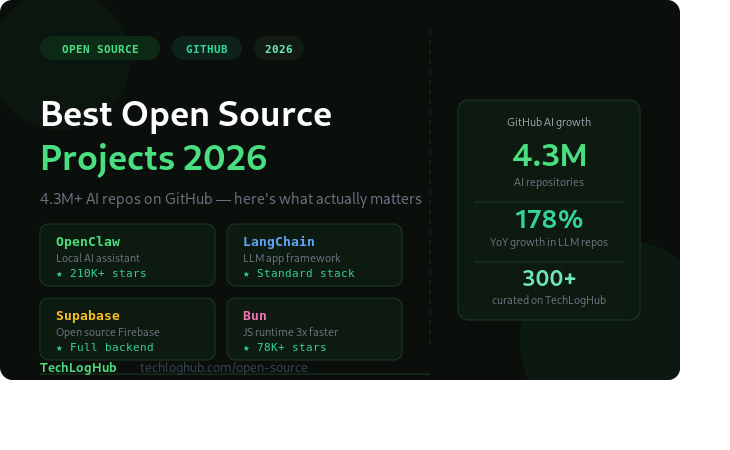
GitHub's Octoverse 2025 report revealed that over 4.3 million AI-related repositories now exist on the platform — a 178% year-over-year jump in LLM-focused projects alone. That's a lot of noise to cut through.
This list focuses on the open source projects that are genuinely worth your attention — whether you're building AI applications, choosing a JavaScript runtime, or looking for a self-hosted alternative to an expensive SaaS.
The Breakout Star: OpenClaw
No open source story from 2026 is more dramatic than OpenClaw.
Created by PSPDFKit founder Peter Steinberger, it surged from 9,000 to over 60,000 stars in just a few days after going viral in late January 2026 — and has since blown past 210,000 stars, making it arguably the fastest-growing open source project in GitHub history.
What it does: OpenClaw is a personal AI assistant that runs entirely on your own devices. It acts as a local gateway connecting AI models to over 50 integrations — WhatsApp, Telegram, Slack, Discord, Signal, iMessage, and more. Your data never leaves your machine. It can browse the web, fill out forms, run shell commands, write and execute code, and even write its own new skills to extend its own capabilities.
In a world of cloud-dependent AI tools, OpenClaw's privacy-first, local-first approach hit a nerve.
LLM Infrastructure: The Foundational Layer
Ollama — Run Large Language Models Locally
The simplest way to run open source LLMs (Llama 3.2, Mistral, and others) entirely on your own hardware. No API keys, no data sent to the cloud. For developers who want to experiment with local AI, Ollama is the default starting point.
LangChain — The Standard LLM Application Framework
LangChain remains the go-to framework for building LLM-powered applications — chatbots, question-answering systems, summarization tools, and content generation pipelines. If you're connecting an LLM to data, tools, or workflows, LangChain likely belongs in your stack.
Hugging Face Transformers
State-of-the-art machine learning for PyTorch, TensorFlow, and JAX. The library that powers deep learning research worldwide, used by 70%+ of researchers in the field. An essential open source building block for anyone working in applied AI.
Backend & Database
Supabase — The Open Source Firebase Alternative
Supabase ships with a Postgres database, authentication, real-time subscriptions, edge functions, file storage, and — as of 2026 — vector buckets for AI applications. It's genuinely full-stack out of the box.
Developer experience is consistently rated the best in its category. For anyone building a product that needs a backend and isn't running a large enterprise, Supabase is typically where you start.
JavaScript Runtimes: The New Competition
Node.js remains dominant by install base, but 2026 has real contenders:
Bun — 3x Faster Cold Starts
78K+ GitHub stars and growing fast. Bun ships with a built-in bundler, package manager, and SQLite driver. Three times faster cold starts than Node.js make it ideal for serverless, edge functions, and CLI tools.
When to use it: New projects where startup speed and bundle size matter.
Deno 2.0 — TypeScript-First, Security-First
106K GitHub stars. Full npm compatibility, built-in TypeScript without a build step, and deno audit for dependency security scanning. Deno 2.0 removed the friction that held earlier versions back.
When to use it: Teams who want TypeScript-first development and don't want to configure a build pipeline.
Monitoring & Observability
Prometheus + Grafana — Still the Standard
Prometheus remains the leading open source monitoring and alerting toolkit for cloud-native environments — widely described as the unbeatable standard for scraping application-level metrics in 2026. It's almost always paired with Grafana, the premier visualization platform for metrics, logs, and traces.
If you're running anything in production, this combination is the baseline.
Machine Learning Frameworks
TensorFlow — Production Scale
Google's end-to-end open source machine learning platform. 194K GitHub stars, constant updates, massive ecosystem. The standard choice for production-scale AI where stability and deployment tooling (TensorFlow Serving) are priorities.
PyTorch — Research & Prototyping
The dominant framework in deep learning research, used by 70%+ of researchers. Dynamic, Pythonic, and GPU-accelerated. Where TensorFlow dominates production, PyTorch dominates research and rapid prototyping.
Self-Hosted Alternatives Worth Knowing
Gitea / Gogs — Lightweight, self-hosted Git services. For teams that want full control over their repositories without GitHub or GitLab.
NocoDB — An open source no-code platform turning databases into smart spreadsheets. Popular with teams building internal tools without dedicated developers.
Supabase (again) — Worth repeating as a genuine Firebase alternative, not just a database. Auth, storage, edge functions — it's a full platform.
How TechLogHub Curates Open Source
TechLogHub tracks and curates 300+ open source projects for developers — organized by category, reviewed by our team, and updated daily. Whether you're looking for AI tools, DevOps projects, or developer utilities, you'll find them organized and searchable.
→ Browse Open Source on TechLogHub → Submit your open source project → Promote your project to 10K+ monthly builders
Updated: June 2026 | Category: Open Source | Published by TechLogHub