

Vibe Coding in 2026: How Indie Founders Are Shipping SaaS Without Writing Code
Vibe coding has gone from a Twitter meme to a mainstream movement. In 2026, non-technical founders are shipping real, revenue-generating SaaS products in days. Here's what's real, what tools to use, and what to watch out for.
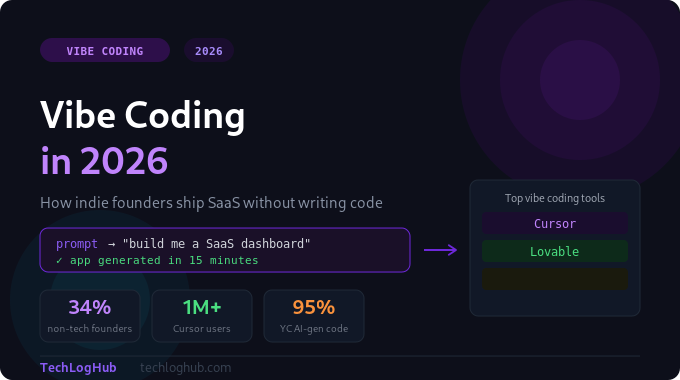
Vibe Coding in 2026: How Indie Founders Are Shipping SaaS Without Writing Code
In January 2025, Andrej Karpathy tweeted about "vibe coding" — describing what you want in plain English and letting AI write the software. Most people laughed it off as a meme. Eighteen months later, it's a movement generating millions in revenue for non-technical founders.
Here's what's actually happening, what tools are leading the wave, and what you need to know before jumping in.
The Numbers That Changed Everything
The vibe coding shift isn't hype. The data is real:
- Cursor, the AI-native code editor, crossed 1 million monthly active users in early 2026
- 34% of new micro-SaaS products launched in Q1 2026 were built by founders with no prior programming experience (Indie Hackers)
- Some of those products are generating $5K–$50K in monthly recurring revenue
- YC's latest batch shipped approximately 95% AI-generated code
- 92% of US developers now use AI coding tools daily
This isn't about building toy projects. Non-technical founders are shipping real businesses faster than traditional dev teams.
What Vibe Coding Actually Looks Like
The workflow is simpler than most developers expect:
- Describe your product in plain English to a tool like Cursor, Lovable, or Bolt
- The AI generates the code, UI, database schema, and sometimes deployment config
- You review, iterate with more prompts, and refine
- Deploy — often in one click to Vercel or a similar platform
One non-technical founder reportedly hit $456K ARR in 45 days using Lovable. That's an extreme case, but it illustrates what's now possible.
The Best Vibe Coding Tools in 2026
Cursor — The Command Center
The most popular vibe coding tool among indie hackers and dev teams. Cursor handles repo-wide edits, backend refactoring, and multi-file tasks. If you're building anything beyond a landing page, Cursor is likely in the stack.
Best for: SaaS founders who need backend logic, API endpoints, and multi-file editing.
Lovable — Non-Coders Ship Fastest Here
Non-coders are building and deploying with Lovable faster than some developer teams. Strong for full-stack apps with databases and authentication built in.
Best for: Founders with zero coding experience who want a complete app fast.
Bolt.new — Full Apps in 15 Minutes
Bolt is shipping full applications in 15 minutes — not landing pages, full apps. Strong community of indie hackers sharing what they've built.
Best for: Rapid prototyping and validating ideas before committing to a full build.
v0 by Vercel — UI Generation at Speed
v0 generates production-ready React + Tailwind components from prompts or design imports. Then deploy straight to Vercel. Freelancers and indie founders building landing pages or client portals get the most from v0's streamlined workflow.
Best for: Frontend-heavy products, landing pages, and SaaS dashboards.
Claude Code — For Long-Horizon Work
Anthropic's terminal-based agent that understands your entire codebase. Where other tools struggle with multi-file complexity, Claude Code handles long-horizon tasks — debugging across files, refactoring systems, explaining what went wrong.
Best for: Developers who want a terminal-first experience and deep reasoning across a codebase.
Replit — From Idea to Live in One Place
Replit's integrated environment combines editor, database, hosting, and deployment in one place. No config. No Vercel setup. Just build and hit deploy.
Best for: Founders who want the fastest path from concept to a live URL, without touching infrastructure.
What to Watch Out For
Vibe coding is powerful, but it comes with real risks:
⚠️ Security is the Achilles Heel
Studies show 45% of AI-generated code contains security vulnerabilities. One well-known case — the Moltbook breach — exposed 1.5M API keys from a fully vibe-coded platform. The lesson: prototype with AI, but get a human to review before handling real user data.
⚠️ The 70% Wall
Most vibe coders hit a wall around 70% completion — where the AI starts breaking existing features when adding new ones. The fix: smaller prompts, more frequent deploys, and keeping the AI's context focused.
⚠️ Prototype ≠ Production
Vibe coding gets you fast to a working prototype. Production-readiness — performance, error handling, auth edge cases, scalability — still requires engineering discipline. Use it to validate, then engineer to ship.
The Smart Approach in 2026
The winners in 2026 aren't the ones generating the most AI code. They're the founders who direct AI agents with clear intent — prototyping fast, validating early, then layering in engineering discipline for production.
Karpathy himself has moved from "vibe coding" to calling it "agentic engineering" — the idea that you're orchestrating AI agents with precise goals, not just describing vibes and hoping for the best.
The formula:
- Prototype with Bolt or Lovable → validate the idea
- Build the real version with Cursor or Claude Code → ship with confidence
- Deploy with Vercel + Supabase → keep infra costs near zero early
Find the Best Vibe Coding Tools on TechLogHub
TechLogHub curates the best AI tools, SaaS products, and open-source projects — including the top vibe coding platforms used by indie founders right now.
→ Browse AI & Machine Learning Tools → Explore Open Source Projects → Submit your vibe-coded product — free
Updated: June 2026 | Category: AI & Machine Learning | Published by TechLogHub