

Best Developer Tools in 2026: The Complete Guide for Builders
A curated breakdown of the best developer tools in 2026 — from AI coding assistants and deployment platforms to open-source picks — chosen for builders, indie founders, and dev teams who want to ship faster.
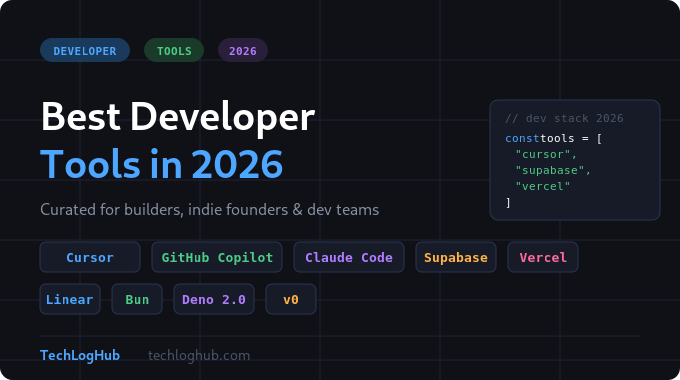
Best Developer Tools in 2026: The Complete Guide for Builders
The developer toolchain in 2026 looks nothing like it did two years ago. AI assistants now write code, review pull requests, and handle multi-file tasks that used to take half a day. Deployment platforms ship with auth, vector search, and inference hooks built in. Testing frameworks automate what used to be manual grunt work.
This guide covers the tools that actually matter — chosen for builders, indie founders, and small teams who want to move fast without breaking things.
Why Developer Tools Changed So Fast
The shift started with AI coding assistants going mainstream. According to Stack Overflow's developer survey, 76% of developers are now using or planning to use AI tools in their workflow — up from 70% the prior year. That number is likely higher today.
The result: categories that barely existed in 2023 are now table stakes. AI-native editors, agentic coding tools, and intelligent code review platforms have reshaped every layer of the stack.
The Best Developer Tools in 2026 (by Category)
🤖 AI Coding Assistants
GitHub Copilot The most widely adopted AI coding tool by market share, crossing 20 million users with 1.3M paid subscribers. Copilot's agent mode — shipped in late 2025 — turns it from an autocomplete tool into a full-blown coding agent inside your IDE. Available for VS Code, JetBrains, and Neovim.
Best for: Teams already on GitHub who want AI built into the PR workflow.
Cursor The AI-native code editor that crossed $1 billion ARR with fewer than 50 employees — a product velocity story in itself. Cursor handles repo-wide edits, multi-file refactors, and context-aware suggestions that go well beyond line-level autocomplete.
Best for: Indie founders and small teams who want an AI-first editor experience.
Claude Code Anthropic's terminal-based agentic coding tool that understands your entire codebase. Widely cited in developer communities as the best option for debugging, explaining errors, and long-horizon multi-file tasks. Runs in your terminal and integrates with existing workflows.
Best for: Developers who prefer the terminal and need deep codebase reasoning.
🚀 Deployment & Backend
Vercel The standard deployment platform for modern web apps. Zero-config deploys, edge network, serverless functions, and their AI UI generator v0 — which produces React + Tailwind components from prompts. If you're building with Next.js, Vercel is the natural home.
Best for: Frontend teams and founders who want to ship without thinking about infrastructure.
Supabase The open-source Firebase alternative that now ships with Postgres, authentication, real-time subscriptions, edge functions, file storage, and vector buckets for AI apps. Developer experience is widely regarded as the best in its category. If you're building anything that needs a backend in 2026 and aren't running a large enterprise, Supabase is usually where you start.
Best for: Full-stack founders who need a production-ready backend fast.
⚡ Runtime & Tooling
Bun A JavaScript runtime built from scratch for speed — with 3x faster cold starts than Node.js and a built-in bundler, package manager, and SQLite driver. Now at 78K+ GitHub stars and growing fast. Worth evaluating for any new project where startup speed matters (serverless, edge functions, CLI tools).
Best for: New projects where performance and bundle size are priorities.
Deno 2.0
Now at 106K GitHub stars, Deno 2.0 brings full npm compatibility, a built-in TypeScript runtime, and deno audit for dependency security scanning. No build step required.
Best for: Teams who want TypeScript-first development and built-in security tooling.
📋 Project Management
Linear The issue tracker built by developers, for developers. Keyboard shortcuts for everything. Clean, fast UI that makes Jira feel like it was designed in a different era. In 2026 comparisons, Linear consistently wins for speed and modern UX for teams under 500 people.
Best for: Dev teams who want fast, keyboard-driven project management without enterprise overhead.
How to Choose
The key question isn't "which tool is best" — it's which tools fit your specific stage:
| Stage | Priority Tools |
|---|---|
| Solo founder / MVP | Cursor or Bolt, Supabase, Vercel, Linear |
| Small team (2–10) | GitHub Copilot, Supabase, Vercel, Bun |
| Growing startup | Claude Code, Deno, full CI/CD stack |
Time-to-productive and free tier viability matter more than feature lists when you're early. Build with what lets you ship fastest.
Discover More Tools on TechLogHub
TechLogHub tracks and curates developer tools, SaaS products, and open-source projects daily — all submitted by builders, reviewed by our team, and organized by category.
→ Browse Developer Tools on TechLogHub → Explore Open Source Projects → Submit your product — free
Updated: June 2026 | Category: Developer Tools | Published by TechLogHub